Confederate E.R. and R.I.P. at Mount Jackson

Sandy Pendleton recorded that the combat at First Kernstown “was a harder fight than Manassas.” In two hours of fighting a quarter of Stonewall Jackson’s army became casualties in one form of another. In addition to the two hundred and sixty-three that were captured, and the eighty were killed, three hundred and seventy-five were wounded. Many of the injured would have been left behind as the Confederates were forced to relinquish the field. It would have been the walking wounded, and those receiving assistance from comrades, that would have been able to escape the battlefield.

In his book, Stonewall in the Valley, Robert Tanner wrote that “by dawn on March 24, after all Confederate wounded were on their way to the rear” the Valley Army started their retrograde movement. The wounded were, quite naturally, given priority and were already proceeding in the direction of the nearest aid station. This was as it should be.

Fortunately for Stonewall Jackson, the wounded had the advantage of walking, or being transported along the best road in the Shenandoah Valley. Further, the Valley Pike passed right by the front doorstep of the only Confederate military hospital in the lower Shenandoah Valley. In addition to the best road, Mount Jackson also served as the western terminus of the Manassas Gap Railroad. As long as the rail line or the Valley Pike were free from Union occupation, it was a logical place to build a hospital. Sick and wounded soldiers could easily be directed toward the facility by foot, by ambulance, or by rail.
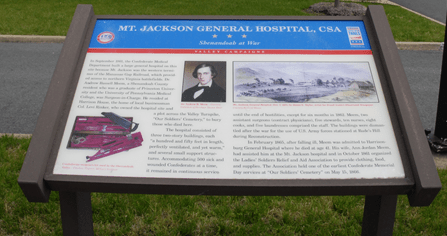
Hospital plaque

Sign Marking the Location of the Confederate Hospital at Mount Jackson

In September 1861, shortly after the First Battle of Manassas, the Confederate Medical Department had ordered a hospital be built in the town of Mount Jackson. That same month, Doctor Andrew Russell Meem, a resident of the town, was contracted to design and construct an infirmary there. The facility would consist of “three, two story buildings which were one hundred and fifty feet in length.”

The hospital was designed to accommodate some five hundred patients. The staff would include “Dr. Meem, two assistant surgeons, five stewards, ten nurses, eight cooks, and five laundry workers.” Dr. Meem, himself, was a well-respected area resident who was a graduate of both Princeton University and the University of Pennsylvania Medical College. The doctor had been the head surgeon for the town of Mount Jackson before the war.
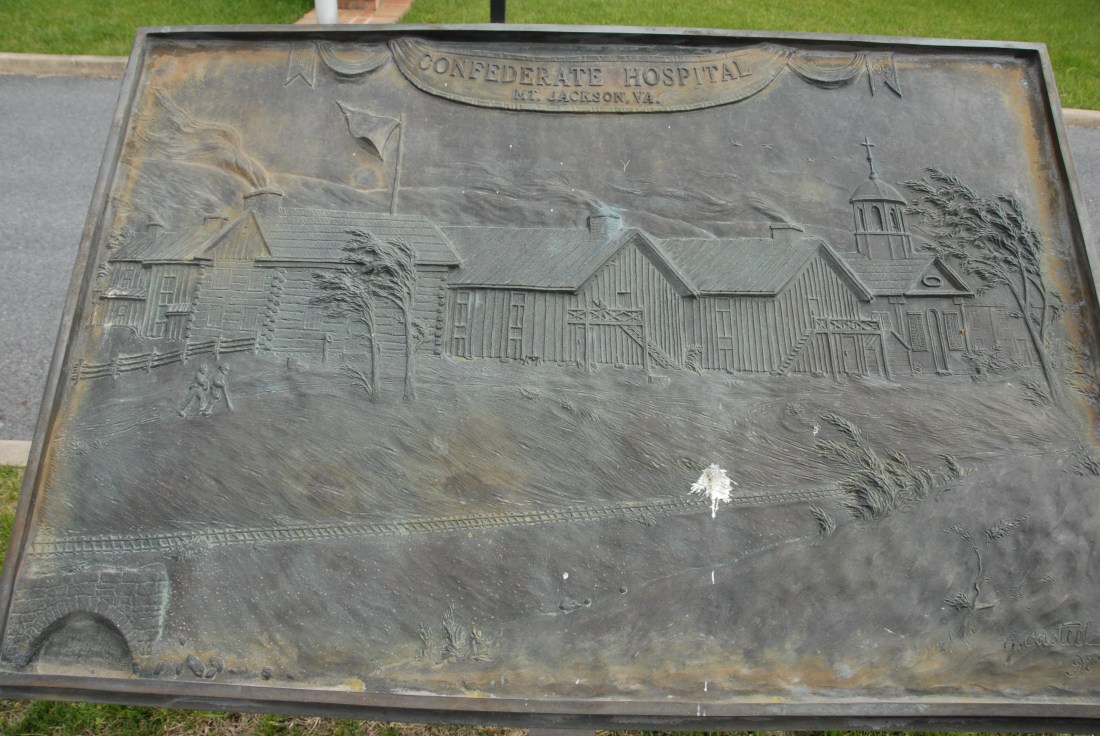
DSC_0089.JPG

Plaque Showing the Design of the Mount Jackson Hospital

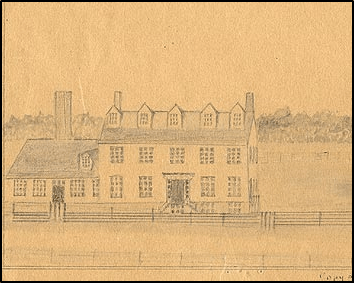
The parcel the hospital was built upon was donated by another Mount Jackson native, Colonel Levi Rinker. The building materials, though, were contributed by the Meem’s family. The Meem’s resided on a twenty-five-hundred-acre plantation they called Mt Airy. The residence survives today and is located just south of the North Branch of the Shenandoah River. The Meem’s had traditionally farmed their acreage with the aid of more than a hundred slaves and were among the wealthiest families in the valley.

Mt Airy

Photo of Mt. Airy Plantation in Mount Jackson

The Meem’s household was renowned for their hospitality and on many occasions hosted Civil War Generals and other wartime celebrities. Jedediah Hotchkiss, Stonewall Jackson’s mapmaker, spent some time there waiting with other recruits while Jackson attacked Nathaniel Bank’s troops at the First Battle of Kernstown in March 1862. On March 20th he noted they had “marched to ‘Mount Airy’ the celebrated Meem estate.” “Our men found quarters in the large barns and the officers in the house of Gen. Gilbert C. Meem.”

It was noted that the infirmary “was in continual use throughout the war, aside from six months in 1862 when the hospital was not in active use.” There are several interesting considerations regarding why the building was not in continual use. For example, on April 17, 1862, General Nathaniel Banks’ troops drove Jackson’s forces out of Mount Jackson. At the same time, a Massachusetts soldier noted in April of 1862 that the hospital “buildings were admirably contrived and constructed. He stated they were “perfected ventilated, and yet warm.” He also noted the “hospital flags were still flying, but the 500 sick Rebels convalescing there had been removed ten days previous.” Having done so this would have isolated the now empty hospital behind Union lines.

Additionally, in early June of the same year, Stonewall’s Army was driven back up the valley and through Mount Jackson by General John Fremont’s Army. Once again, the town of Mount Jackson would fall to a Union legion. Following Jackson’s victories at Cross Keys and Port Republic, Stonewall abandoned the valley completely, crossing over the Blue Ridge at Brown’s Gap, on his way to reinforce Robert E. Lee’s army during the Seven Days Campaign.
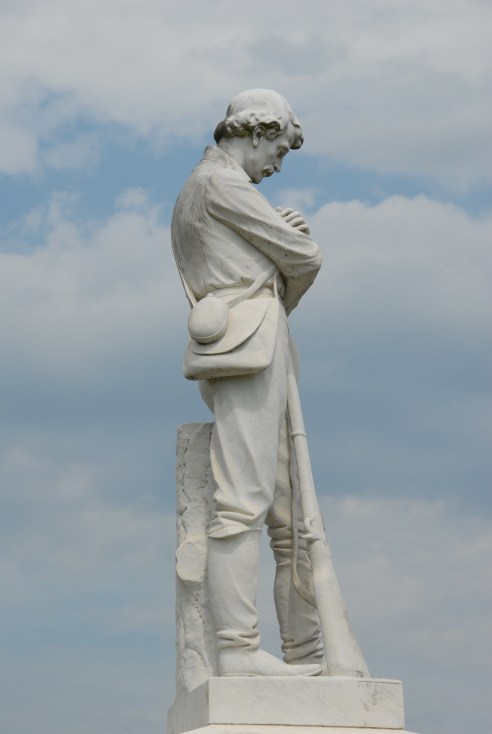
DSC_0105.JPG

Soldier’s Statue at Our Soldiers Cemetery in Mount Jackson

The Mount Jackson facility had always been intended as a “wayside hospital.” Is was not designed to be a “permanent treatment facility for the badly wounded.” As a result, early in the war the hospital was mainly used to treat diseases. The hospital would tend to the sick and wounded from Jackson’s Valley Campaign of 1862. as well as casualties from the Battle of Antietam later that same year. It is reported that the “hospital treated at least one hundred patients almost every month for the first two years of the war.”

Following the Battle of Gettysburg some “8500 wounded Confederate soldiers, plus 4000 Union prisoners” passed by the doors of the Mount Jackson Hospital. In July the five hundred bed facility had collected some 667 patients. More that two hundred of these were there for gunshot wounds. Without adequate medical supplies, though, the hospital was operating far beyond it limitations. Still. in the month of July, 1863, just thirteen patients perished at the facility.

In the wake of his defeat at the Battle of Third Winchester, in late September 1864, Jubal Early withdrew his army back through the town of Mount Jackson as well. When General Phil Sheridan’s Army appeared in the town it was noted that the hospital was “filled with Confederate wounded.” Sheridan ordered that the third building, which was vacant at the time, be burned. Following the war, the two remaining buildings would be disassembled by members of the 192nd Ohio Infantry Regiment. They would use these building materials to construct a barracks for occupation forces at Rude’s Hill, just south of the town.


DSC_0096.JPG

Entrance to the Our Soldiers Cemetery

Mortality rates were always high at the facility mostly due to the lack of medical supplies. Recognizing that not all patients could be saved from their illnesses or their wounds, Colonel Rinker had also donated land on the opposite side of the Valley Pike for two cemeteries. In the first, which was placed adjacent to the Valley Pike, some four hundred war dead, from eleven southern states, would find their final resting place.

Mount Jackson casualties

Plaque Memorializing Confederate Soldiers Who Died at Mount Jackson Hospital

Dr. Andrew Meem, himself, would become ill in February 1865. Andrew was taken south to the Harrisonburg General Hospital where medical supplies were more readily available. Treatment failed, though, and the doctor soon expired at age forty-one. The doctor’s wife, Ann, who had served as his assistant at the hospital, would return to Mount Jackson. Here she helped to organize the Ladies’ Soldiers and Aid Organization which provided food, clothing, and supplies to Confederate soldiers.

On May 10, 1866, the third anniversary of Stonewall Jackson’s death, a “Memorial and Decoration Day” celebration was organized by that same Soldiers and Aid Organization of Mount Jackson. As part of the ceremony a service was conducted in a local church. Here Henry Kyd Douglas, a surviving member of Jackson’s staff, made an address to commemorate the occasion. Following the church observance “ladies, gentlemen, and children as well as many ex-Confederates, all marched to the cemetery ¾ of a mile north of town to place those wreathes on each of the 400 graves.” Today a ceremony takes place with the placement of Confederate Battle flags on each of the graves on Veteran’s Day each year.

Initially the Confederate dead had had their final resting place denoted in various ways, including boards stuck in the ground with the soldiers’ names, units, and death dates scratched upon them. By the time the United Daughters of the Confederacy were able to construct a monument at Our Soldiers Cemetery in 1908 only three of the original markers still stood, all of whom were undoubtedly Gettysburg related casualties. A list of the majority of the casualties was generated and commemorated. Some one hundred and more are still unknown.
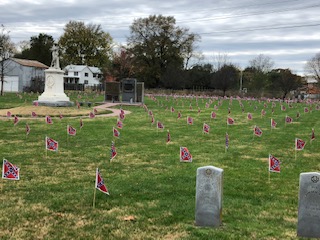
Mt Jackson Cemetery2

Confederate Veteran’s Day 2018 at Our Soldiers Cemetery in Mount Jackson

Mr. Rinker was also responsible for the creation of a second cemetery located across the railroad tracks and adjacent to Our Soldiers Cemetery. This site would provide a final resting spot for African Americans and ex-slaves. Over the years many of the markers were lost and the identity of many of the occupants vanished. In 2004 a new memorial marker was placed denoting the names of all of the individuals that could be recovered. Here they dedicated a new memorial, retaining the cemetery’s traditional name, “The Mount Jackson Colored Cemetery”.
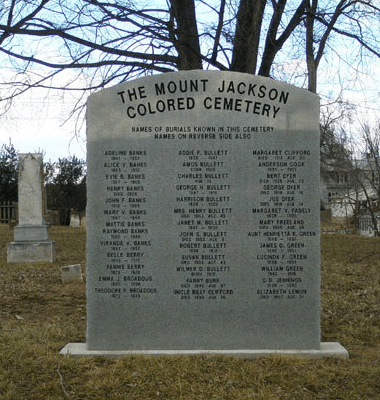
colored cemetery

African American Memorial in Mount Jackson

Hotchkiss, Jedediah. Make Me a Map of the Valley: The Civil war Journal of Stonewall Jackson’s Topographer. Southern Methodist University Press. Dallas. 1973

Sharpe, Hal F. Shenandoah County in the Civil War: Four Dark Years. The History Press. Charleston, S.C. 2012.

Tanner, Robert G. Stonewall in the Valley: Thomas J. ’Stonewall’ Jackson’s Shenandoah Valley Campaign, Spring 1862. Doubleday and Company. Garden City.

http://archives.countylib.org/tour/items/show/62

Many of the photos were provided by Brian Swartz. http://maineatwar.bangordailynews.com/
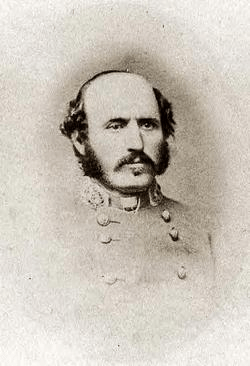
 

The Confederate Yankee: Zebulon York

zebulon york1

State of Maine Native, General Zebulon York, CSA

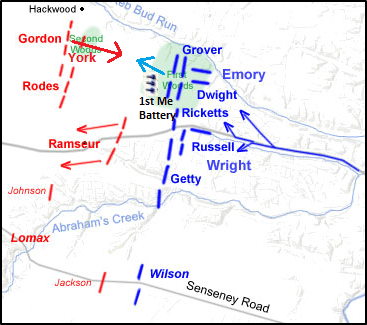
To say that General John Gordon’s Confederate division of some twenty-six hundred souls showed up at the Third Battle of Winchester just in time is, by every standard, an understatement. Gordon’s men appeared in the Second Woods just as the 19th Corps, under the command of Major General William Emory, finished their deployment and began their advance out of the First Woods. Gordon had three brigades in his division. He deployed General Edmond Atkinson’s Brigade on the left of the line, General William Terry’s in the center, and General Zebulon York’s Louisiana Brigade on the right.

Nineteenth Corps commander, Major General William Emory, placed General Cuvier Grover’s Division on the front line. Grover, who was a native of the State of Maine and a graduate of West Point, positioned Colonel Jacob Sharpe’s Brigade on the left, and Henry Birge’s on the right. As soon as they were in place, he ordered them to advance.

Cuvier grover

Brigadier General Cuvier Grover of Maine

As Gordon’s brigades readied themselves for battle at the edge of the Second Woods, army commander General Jubal Early took time to consult with Generals Gordon and Rodes. Early remembered it as “a moment of imminent and thrilling danger.” Believing a good offense at this moment was better than a good defense, Early ordered his division commanders to counter-attack the advancing Union line.

Jubal Early then rode to Zebulon York, as he was finishing deployment his men, and ordered him to meet Sharpe’s Brigade “half way.”  York’s Louisiana Brigade of approximately six hundred and fifty men soon found themselves counter-charging the rapidly advancing blue line. Captain William Seymour of the 6th Louisiana Infantry remembered a “beautiful and rare sight was presented of two opposing lines charging at the same time.”

By 11:40 these two opposing lines came crashing into each other, fighting furiously. The clash was called murderous. The first to blink, though, was Colonel Sharpe’s Brigade. In combination with heavy Rebel artillery fire on their right flank from Major James Breathed’s cannons, and that from their front from Major Carter Braxton’s guns, the area became a killing field. Add to this the effects of heavy musketry fire from Gordon’s men in their front, both Birge and Sharpe were both forced to retire.

3rd Winchester 1

Map Showing Troop Deployment and Position of 1st Maine Battery at 11:40 am.

Gordon’s troops continued their pursuit of both Birge’s and Sharpe’s Brigades. Captain William Seymour of York’s command remembered that “though the Yankees fought unusually well, they could not withstand the impetuosity of our fellows and they were forced back upon their original line which was strongly guarded by artillery.” According to most accounts, it was the opportune appearance of the 1st Maine Battery, at the boundary of the First Woods, that forced the Confederates to reconsider their quest. It is poignant to think that it was a Maine battery which stopped the advance of General York’s Brigade. What is ironic, though, is the fact that General York received a serious wound to his left arm during the charge of his brigade. According to York’s obituary “his left arm was shattered by a charge of grape.” In all likelihood, then, it was this Maine battery which, when brought to bear on the charging Confederates, inflicted the wound on their fellow Mainer, Zebulon York.

York’s injury to his left arm was the most serious he would receive during the war. York was taken to a field hospital where his “frazzled arm” was amputated. “A friend whose elegant home was in Winchester affectionately endeavored to persuade York to remain in the hospital and suffer himself to be captured so as to be cared for at this gentleman’s house.” Zebulon eyed the man and replied: “No, thank you, sir. All that the enemy will ever capture of me is that remnant of an arm before us.”

As soon as his limb was dressed, York mounted his horse and rode out of town. Still bleeding, Zebulon rode horseback from Winchester to Fisher’s Hill, a distance of more than twenty miles. Here he transferred to an ambulance for the journey to Staunton. At Staunton he boarded a train for Richmond where his arm was attended to by a close friend, Dr. Beverly Welford. Recovery, though, would be slow.

What kind of soldier was it that could have his arm sawed off one minute and then mount his horse and ride out of town the next? Well, this Rebel fighter was actually a State of Maine native, born in the town of Avon to Zebulon and Zylphia York on October 10, 1819. The town of Avon is located in the northwestern corner of the state, which is a lot closer to the border between Canada and the United States than the Mason-Dixon Line. Named after the River Avon in England, the town was founded in 1781 and incorporated in 1802. Fruits, grains, and vegetables grew abundantly in the fertile soils along the banks of the Sandy River. At the time of the Civil War the population numbered eight hundred and two people. The current inhabitant count is little more than half of that number.

Zebulon York’s family touted a strong military heritage. His maternal grandfather, Sylvester, was an aid-de-camp to George Washington during the Revolutionary War. Sylvester was present with General Washington when Lord Cornwallis surrendered at Yorktown. Zebulon’s own father had been an army officer during the War of 1812.

York received his elementary education in a one room school house in his home town of Avon. Later he attended Maine Wesleyan Seminary, now known as Kents Hill School, for his secondary education. “Here he proved to be a great reader and such a lover of history and biography that he long cherished the desire of taking part in a battle…”

Wesleyan

Maine Wesleyan Seminary, now Kent’s Hill School in Maine.

At the age of sixteen Zebulon’s father sent him to study at Transylvania University in Kentucky. He graduated with honors from the school. Having acquired “a taste for Southern life”, though, he moved to Louisiana after graduation and began the study of law at the offices of Stacey and Sparrow in Vidalia. In due time he moved to New Orleans to study law at Louisiana University, or what is now Tulane. Once again, he graduated with honors and then moved back to Vidalia to establish his own law practice.

In the 1850’s “any man who was anybody invested his money in plantations and, necessarily, negros.” In partnership with a close friend, Mr. Elias J. Hoover, York purchased “six magnificent plantations.” “Together they paid more in realty taxes than any other party in Louisiana.” Collectively they owned more than fifteen hundred slaves and produced more than forty-five hundred bails of cotton each year.

In York’s obituary it is stated: “A better master to a slave never existed than the gentle and tender-hearted York. Never was an overseer known to strike them without severe admonition, and in most cases a blow to a slave was quickly followed by the discharge of the guilty overseer. Today old slaves meet the general at almost every turn and there is yet to be found one who says anything but that” he “was sure good to us…” He “never ‘loud no one to beat us.”

Following the presidential election of 1860 Louisiana held a convention to decide Louisiana’s stance on secession. Elected representatives were sent to Baton Rouge. Zebulon was chosen unanimously to represent the Concordia region of the state.  York did his duty, traveled to the convention, and voted in favor of secession. On January 26, 1861, the convention passed an Ordinance of Secession by a vote 113 to 17. From this date until February 4, Louisiana was an independent country. It was on that date that the state joined the Confederate States of America.

Following the Secession Convention, York went directly home to Concordia and began to organize an artillery company. The plan was foiled when it was discovered that there were not enough artillery pieces in the South to go around. The unit was forced to transition to a rifle company, which was financed completely by York and his business partner Mr. Hoover. The company was “mustered in for the war” as the 1st Regiment, Polish Brigade. Later it was later merged into the 14th Louisiana Infantry as Company F. The regiment would be commanded by Colonel Valery Zulakowski.

The regiment’s first assignment was in the trenches of Yorktown. The 14th Louisiana was heavily engaged in the Battle of Williamsburg. While helping lead his men Major York was injured in the left arm and left breast by a single bullet which created three separate wounds.

York recovered quickly and returned to his regiment as a newly promoted lieutenant-colonel. He appeared in time to participate in the Seven Days Battles. Once again, his regiment was heavily engaged in most of the fighting. At the Battle of Gaines’s Mill Zebulon led the 14th Louisiana in a bold charge on a Union artillery battery. The battery was taken at a cost to his regiment of one hundred and twenty-seven casualties. Once again York received a minor wound, this time to his right arm, caused by a bursting artillery round.

Shortly thereafter, the 14th Louisiana was transferred to Stonewall Jackson’s Corps. At Second Bull Run York led his command in a charge to seize a railroad embankment held by General James Nagel’s Brigade. The attack was successful but Zebulon received a much more serious injury, “the ball passing through the neck and under the spine, thus threatening paralysis.”

This time York was forced to return home to Louisiana to recover from his injury. During his recuperation he attempted to recapture some of his investments by renting four plantations and planting large crops of sugar and cotton. Unfortunately, Union troops confiscated his crops before they could be marketed, costing him more than three million dollars.

Having been promoted in his absence to Colonel, York returned to the war effort in time to fight with his regiment during the 1864 Overland Campaign. Following the Battle of the Wilderness, with the wounding of General Harry Hays, and the death of General Leroy Stafford, the two brigades were combined into one. The newly promoted Brigadier General, Zebulon York, took charge of the unit. His promotion would date from June 2, 1864.

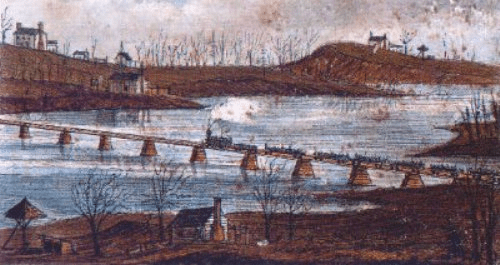
Yadkin River Bridge

Painting of the Yadkin River Bridge

As mentioned at the beginning of this story, General York would fight with his brigade at the Third Battle of Winchester where he was seriously wounded and would have his left limb amputated. Even though his arm had not completely healed, General York was ordered in early 1865 to take his brigade to North Carolina. Here he was tasked with holding the Yadkin River Bridge. It is said that York’s force consisted of about twelve hundred men, including some two hundred “galvanized Irish” that were “recruited from the Federal prisoners.” The remaining men were “invalid soldiers gathered from the hospitals, junior reserves, local citizens, and even a few non-military Confederate government employees.”

The Battle for the Yadkin Bridge would take place on April 12th, 1865, three days after Lee’s surrender at Appomattox. York would successfully defend the bridge while opposed by an equal number of troops under the command of General George Stoneman. The contest was a Rebel victory and one of the last in the eastern theater. The high ground he defended would be forever known as Fort York. (Note: Fort York was listed for years as one of the twenty-five most endangered Civil War sites. The land, which included much of Fort York, was finally purchased for preservation in 2015.)

Following this final clash, General York began to make his way back home. He was captured by troops under General Sherman and paroled on May 6. 1865. With his servant by his side the two made their way home to Vidalia, arriving on May 27th. To his dismay his residence was occupied by Union troops and would remain so for an additional year. When his domicile, the Buck Ridge Plantation, was finally vacated, the occupiers would take with them every piece of furniture and object of value in the household.

Zebulon did attempt to restore his life style once again after the war. With all of his plantations destroyed, he commenced running a boarding house in Natchez which was known as the York House. York would eventually acquire five small steamboats that plied the Black River, in nearby Louisiana, “delivering goods, people and livestock to and from rural areas.” “During the floods of 1882 York led relief efforts for back water people in Louisiana. Sam Clemens even rode one of his little steamboats during one of his many trips into the Black River region and mentions it in his book Life on the Mississippi.”

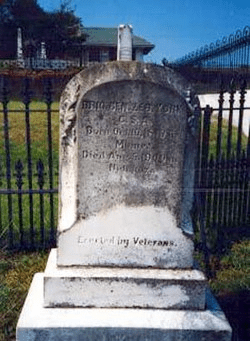
York became ill in January of 1900. He lingered on for several months, passing away on August 5th of the same year. His funeral took place at St. Mary’s Basilica and he was buried in the Natchez City Cemetery. The Times Picayune ran a two-part story on his life on August 6, 1900. Following the war “he returned to his Mississippi home to rebuild his fortunes and died honored and beloved.” His burial plot contains his old business partner, Mr. Hoover, and York’s wife whom he married in 1895. The newspaper proclaimed simply: “Another Hero Passes Away.”

Zeb York stone

York’s Memorial Stone at Natchez City Cemetery in Mississippi.


Early, Jubal. Lieutenant General Jubal Anderson Early C. S. A: Autobiographical Sketch and Narrative of The War Between the States. University of Michigan Library. 1912.

Jones, Terry L. The Civil War Memoirs of William J. Seymour. Reminiscences of a Louisiana Tiger. Baton Rouge: Louisiana State University Press. 1991.

Patchan, Scott. The Last Battle of Winchester. Phil Sheridan, Jubal Early, and the Shenandoah Valley Campaign. El Dorado Hills, Ca. Savas Beatie. 2013.

Sheeran, Rev. James B. Confederate Chaplain, A War Journal. Milwaukee: The Bruce Publishing Company. 1960.

https://www.fold3.com/page/636655872-zebulon-york/stories

https://en.wikipedia.org/wiki/Avon,_Maine

https://en.wikipedia.org/wiki/Louisiana_secession


The Lincoln Connection

Following the Battle of Kernstown, on March 23, 1862, Stonewall Jackson’s tiny Valley District army switched to retreat mode, seeking some of the maneuvering and defensive advantages offered by the upper Shenandoah Valley. During this time the army’s cavalry screen, commanded by Colonel Turner Ashby, skirmished frequently with Nathaniel Banks’s army. Time, however, worked in Jackson’s favor. In the span of less than thirty days, Stonewall’s army grew in size from three to nearly six thousand men.

Turner Ashby on Tom Telegraph

A Sketch of Turner Ashby on his Favorite Horse Tom Telegraph

April 17, dawned bright and clear, with no sign of rain. Jackson’s small army had situated itself on the south side of the North Fork of the Shenandoah River on Rude’s Hill.  The prominence was titled after a Danish Lutheran minister named Anders Rudolph Rude. Situated on this high ground, about a mile south of Mount Jackson, the Rebels had dug in along the crest, endeavoring to secure themselves from the threat posed by General Banks’s army.

By 7:00 am on that April day, Union Cavalry were sweeping through Mount Jackson. Banks’s two infantry divisions were following closely behind. What they discovered upon entering the town, however, were “burning supplies and equipment the rebel army had left behind.”

Jackson had anticipated Banks’s plan and was ready for him. He ordered that anything of military value left behind in the town should be destroyed. He also required that the bridge over the North Fork of the Shenandoah River be burned in order to isolate Union troops, and keep them from entering the upper valley.

Continuing on through Mount Jackson, Union troopers made a rush for the crossing over the North Fork. Turner Ashby was caught in the act of trying to torch the bridge. There was a scuffle with Ashby and several of his men. Outnumbered, Union cavalry quickly dispatched him before he could complete his assignment. Failure to burn the bridge was a serious breach of strategy, placing Jackson’s army in significant jeopardy.

As the morning wore on, General Banks arrived and pushed his men across the captured bridge. He deployed his men in line of battle on both sides of the Valley Pike with the river at their backs. By mid-afternoon, with muskets at the ready and bayonets gleaming in the sunlight, “Union troops were pounding, under a hot sun, uphill through the muck toward Jackson’s camp at Rude’s Hill.” Soldiers remembered the occasion “as one of the more striking military events of the day.” When Banks’s men reached the heights, however, they discovered Jackson had refused battle and sent his legion packing south along the Valley Pike.

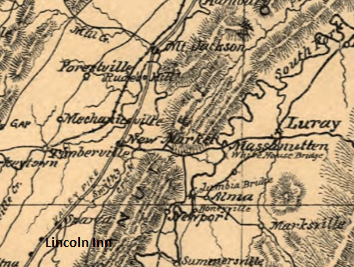
Lincoln Inn Map


Lincoln Inn was Located on the Valley Pike Below Sparta

Jackson’s army retreated throughout the day, passing through New Market and on to the small town of Sparta, or present day Mauzy. A couple of miles up the pike at Lacey Spring was an Inn owned by the Lincoln family. Stonewall and some of his staff, including mapmaker Jedediah Hotchkiss, decided they would seek shelter at the hostel and pass the night in comfort.

DSC_0133

Site of the Lincoln Inn at Lacey Spring on the Old Valley Pike

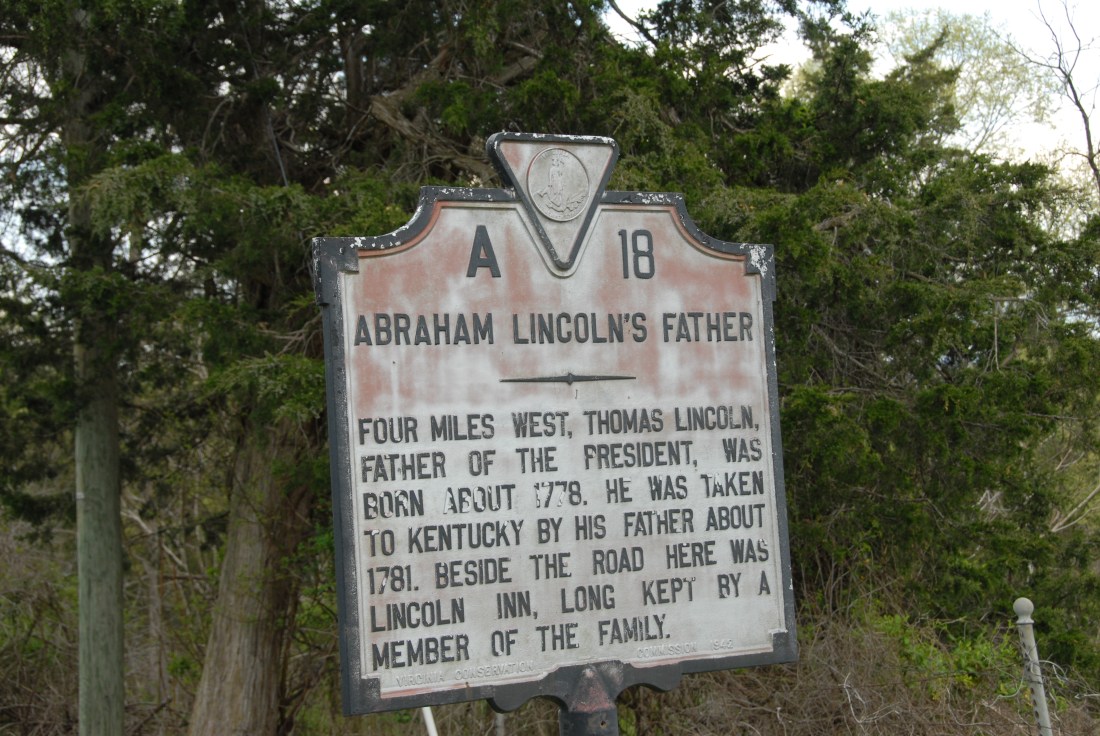
There being no current vestige of the Lincoln Inn remaining in the town of Lacey Springs, the site is presently denoted by a state marker. The structure itself burned down in 1898. The inn had been run by a man by the name of David Lincoln. He had operated out of his home from 1833 until his death in 1849. At the time of the Civil War the establishment was being run by his widow, and, according to Jedediah Hotchkiss, a man named “Abe Lincoln.”

At dinner that evening, while pouring coffee for Stonewall Jackson, Mrs. Lincoln asked if he was related to “Gineril Jackson who used to stop here.” Apparently, President Andrew Jackson had reposed at the inn while sojourning between Washington and his home in Nashville, Tennessee. The town of Mount Jackson had, after all, been named in honor of President Jackson for just this reason.

Stonewall responded that he was “a Democrat and an admirer of ‘Old Hickory’”. He confessed that he did not know if he was related in any way to the President. As a point of curiosity, one would think General Jackson would have been inquisitive regarding the widow Lincoln and whether she was related to the current northern President. There is no record left by Hotchkiss regarding that conversation. Had she been asked; Mrs. Lincoln would have, undoubtedly, shown some embarrassment when she acknowledged that she was related to the northern President by marriage. Her deceased husband, David Lincoln, was the 16th President’s first cousin, once removed.

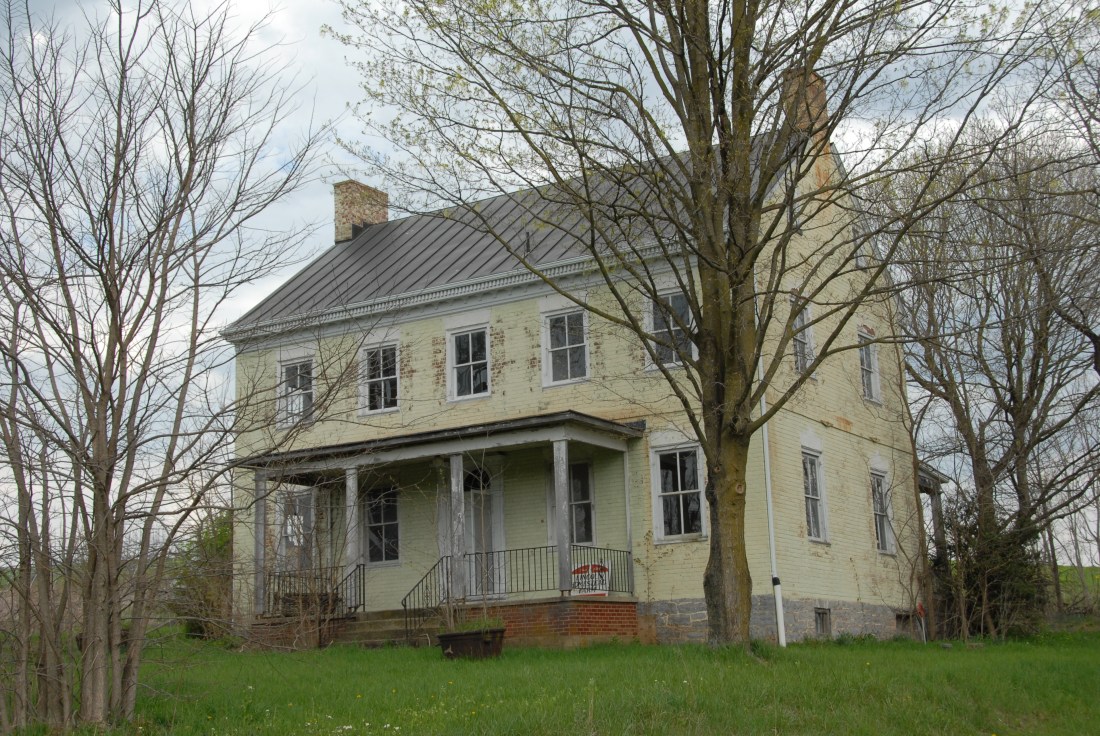
A short four miles away, as the crow flies, is the town of Edom. A parcel of land had been settled there in 1767 by “Virginia John” Lincoln. John, was born in Freehold, New Jersey, where he married Rebekah Flowers. The two of them parented nine children in Berks County, Pennsylvania. In 1768, he relocated the family to the Shenandoah Valley. Here he had purchased six hundred acres for two hundred and fifty pounds.

DSC_0136.JPG

The Lincoln Farm in Edom, Virginia

The yellow house pictured above was built in 1800 by the second of Virginia John’s four sons, Jacob Lincoln. Jacob’s oldest son, Abraham, President Lincoln’s grandfather, built a home just down the road from his father’s. Though that house itself was torn down many years ago, Abraham’s youngest son, Thomas, was born there on January 5, 1778.

In 1781 Abraham Lincoln, in company with his wife and five children, moved to the Kentucky territory. Shortly after his arrival Abraham was ambushed by Indians while working on his farm and was killed. Thomas, himself, would have been slain had it not been for the actions of his older brother Mordecai. Thomas recovered from this childhood trauma and went on to marry Nancy Hanks. On Feb. 12, 1809, a son was born to the family whom they named Abraham to honor his grandfather.

On the same side of the road, north of the Jacob Lincoln house, at the top of the hill, is a small Lincoln family cemetery. Five generations of Lincoln’s lay at rest there, in addition to two slaves. The cemetery contains the final resting places of Virginia John, Jacob, and Jacob’s son Abraham.  Members of the Maupin and Pennybacker families are also buried there.

DSC_0138.JPG

Lincoln Family Cemetery

The President shared much in common with his Virginia relatives during the war, including a familiar generational name with one of his Virginia cousins. Private Abraham B. Lincoln was a Rebel cavalryman who fought in Company F, 1st Virginia Cavalry. Unlike his second cousin, though, he would survive the war and live to the ripe old age of 83. He would be buried at the Lacey Spring Cemetery not far from the site of the Lincoln Inn.

Cousin Abraham

Grave of Abraham Lincoln Company F, 1st Virginia Cavalry

So, perhaps surprisingly, the Abraham Lincoln family had its geneses in Virginia in what would become the Confederacy. These roots ran deep. When civil war came to the nation each family member had to choose sides and they served their country, each in their own way. Once again, it was brother against brother, or in this case, cousin against cousin. The key is, we survived this war and became a nation united, once again. I believe if we can survive the divisions of family and of civil war, we can survive anything, even the divisive politics of our current day. Let us learn from our past that we night create a better future.


Gwynne, S. C. Rebel Yell: The Violence, Passion, and Redemption of Stonewall Jackson. New York. 1973

Hotchkiss, Jedediah. Make Me a Map of the Valley: The Civil war Journal of Stonewall Jackson’s Topographer. 1973

Official Records of the Civil War.

http://civilwarsaga.com/the-confederate-abraham-lincoln/

https://en.wikipedia.org/wiki/Lincoln_Homestead_and_Cemetery

McDowell’s Honored Dead

Tomb of unknown

Marker for the Unknown Soldiers at McDowell, Virginia

General Thomas Stonewall Jackson’s Confederate troops had spent the last several days slogging through the mud on their way to Port Republic while General Richard Ewell’s division had slipped over the Blue Ridge Mountains through Swift Run Gap to take Jackson’s place at Conrad’s Store. Jackson would then cross the Blue Ridge at Brown’s Gap with his army on his way to the Meacham River Station on the Virginia Central Railroad. Stonewall would spend May 4th, riding horseback to Staunton, while his troops followed by train or on foot.  He would setup his headquarters at the Virginia Hotel in town.

With the army reinforced by nearly three thousand troops from General Edward Allegheny Johnson’s Army of the Northwest, Jackson’s army would now number some nine thousand men.  From his camp at West View, which is about five miles west of Staunton, Johnson’s men were staged to act as the vanguard in the coming campaign. Johnson’s men were very familiar with the terrain, having spent the winter defending it.

Jackson’s men were up early on May 7th marching to the northwest along the Parkersburg Turnpike. A short time after their departure they ran into a contingent of General Robert Milroy’s Union Soldiers. Milroy’s force numbered about two thousand men. Sensing he was outnumbered, Milroy decided to retreat back to the town of McDowell, on the West side of Bull Pasture Mountain. He immediately sent an urgent message to Union forces at Franklin pleading for reinforcements.

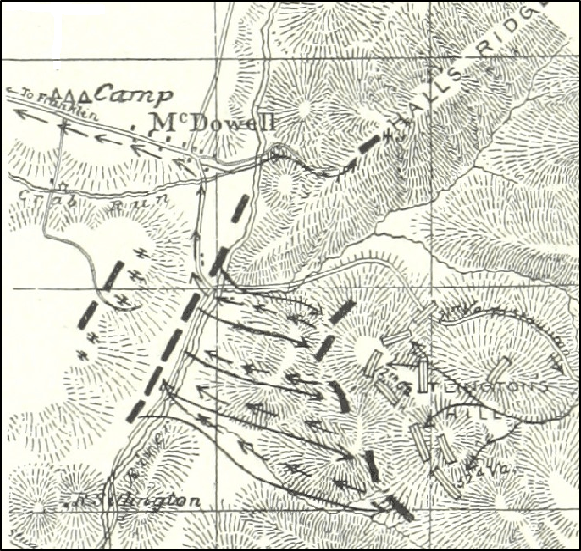
About 10 a.m. on May 8th, General Robert Schenck arrived with supports, increasing the number of Union troops to about six thousand. As Schenck was senior to Milroy, he assumed overall command of the Federal force. The Union commander established his headquarters in town at the Hull House and then deployed his artillery, consisting of eighteen guns, onto Cemetery Hill. Next, he positioned his infantry in a line, about eight hundred yards in length, south along Bull Pasture River. Schenck placed one regiment, the 2nd West Virginia, on Hull’s Hill, east of the river, overlooking the Parkersburg Pike. Three companies of cavalry covered the left flank along the road on the north side of the village.

Meanwhile, on the top of Sitlington’s Hill, which overlooked the town of McDowell, Jackson had begun to assemble Edward Johnson’s troops along the crest. Not expecting to fight a battle so late in the day, he ordered Johnson to position his troops and then began to make plans to launch a flank attack the following morning.

Union Troops had a different idea on how the coming battle would unfold, however. Milroy got permission from Schenck to mount an attack on Sitlington’s Hill before the Confederates could position their artillery on the crest. Milroy assembled some twenty-three hundred troops along the river at the base of the hill and ordered his troops onward and upwards.

As Milroy’s men assaulted Sitlington’s Hill they began to exchange fire with the rebels under General Johnson. The fighting became intense. Jedediah Hotchkiss, Jackson’s mapmaker, recorded that “from 4:30 to 8:30 the firing was terrific.” Union troops would discharge their rifled muskets into the Rebel troops situated on the high ground, perfectly silhouetted with their backs to the setting sun. The rebels would defend their position with smoothbore muskets accurate out to about one hundred yards.

McDowell Map1

Map made by Jedediah Hotchkiss for the May 8th, 1862, Battle of McDowell.

Casualties in the brief fight were significant. Union forces lost thirty-four killed, two hundred and twenty wounded, and five missing. Confederate losses were much greater with one hundred and sixteen killed, and some three hundred wounded. Four were missing. It was one of the few instances in the war where the attackers experienced significantly fewer casualties than the defenders.

The question then is what would have happened to the dead and mortally wounded? According to General Milroy his men wanted to continue the battle and were “anxious to hold on and sent for more ammunition.” Milroy, instead, decided to “draw them down to camp, which was done in good order, bringing off all of our dead and wounded.” According to official casualty reports, however, five infantrymen were still reported as missing.

According to Alvid Lee of the 82nd Ohio, however, not all of the deceased were recovered. Lee stated “the wounded had all been retrieved but there lay the dead, and it seemed too bad to leave them behind. So, two of us picked up one of the bodies and endeavored to bear it away with the retreating line.” “The slain soldier was a young German that had been shot in the head and was left behind.” Finding themselves too exhausted to carry him down the mountain, they had left him “by the stump of a tree, his face upturned to the moonlight.”

Colonel Thomas Williamson, of Jackson’s staff, seems to corroborate this report when he indicated he had observed “only one dead federal when riding over the battlefield the next morning, a boy of fifteen or sixteen years of age.” This could easily have been the “young German” referred to by Mr. Lee.

Jedediah Hotchkiss, on the other hand, indicated that he had revisited the battleground “to examine and sketch the battle-field on Sitlington’s Hill.” He visited the spot where their “men were posted during the engagement, cut into splinters by the bullets of the enemy, a good many of whose dead were still lying about.” It sounds like some soldiers were found near the crest of the hill would have been some distance from where the “young German” was found.

Jed Hotchkiss

Post War Photo of Jedediah Hotchkiss

A Union council of war was held shortly after the battle ended and, within six hours, Schenck’s force was on the move, retreating back to Franklin. The question regarding the removal of the dead is, therefore, somewhat indeterminate. With the battle ending in darkness it seems as though gathering the dead would have been problematic considering the proximity of the enemy. Schenck’s soldiers would have had a great deal of work to accomplish in order to prepare for their retreat and very little time to do it.

So, undoubtedly, several Union dead that were left behind, as mentioned by Hotchkiss, probably finding their final resting place at the cemetery in the center of town. The question is what was the final resting spot for the one hundred and sixteen Confederate dead? Hotchkiss noted that all of the Confederate dead “had been carried down to the turnpike at the mouth of the ravine by which we had gone up and been laid in a row along a grassy place beside the road.” This must have been a temporary resting place as the spot he mentions can be easily visited and there is no indication that it is a current grave site. Certainly, the spot would have been honored by a marker of some sort.

On May 10th, while riding along the road from McDowell to Churchville, Jedediah Hotchkiss noted that he “met many citizens going to look for friends and relatives who had been in the battle.” Additionally, on May 12th, just four days after the fight, while Hotchkiss was riding through the village of Mossy Creek, he took note that the townspeople were “burying the remains of Frank Eruitt and of Harmon who were killed at McDowell.”

Temporary burial duties on the battlefield would have undoubtedly been the responsibility of the Corps of Black Pioneers. These men would have been under the command of Jackson’s staff engineer, Captain Claiborne Maison. Backing them up were four companies of VMI cadets, about two hundred in number, who, in addition to the guarding of prisoners, would have been responsible for supervision of the burial of bodies. They were definitely not employed in combat roles.

It seems as though local citizens were helping with the dispositions of bodies. As with combat casualties, some of the dead would be identifiable and some would have been so badly mangled that their identity could not be determined. Perhaps these are the Confederate soldiers that are buried with the Union Dead in McDowell.

Except for a young “German boy”, the identities of the Union soldiers buried here are unknown. Union and Confederate troops, mortal enemies, are entombed together. The size of the lot is small, maybe four hundred square feet, so there are certainly not hundreds of soldiers buried there, but there could be a dozen or more. Maybe it is just those men who were pronounced as missing. Nevertheless, the spot in this peaceful cemetery is the tomb of the unknown soldiers. The identities of the men buried there are, as far as I can determine, unknown. The hints we find are just that; hints. Still, the burial site is a must see at McDowell. As we gaze upon this hallowed ground we are reminded that though these unidentified combatants are gone, they are not forgotten in their common ossuary.

The battle of McDowell was fought on May 8, 1862. It was the second battle in General Thomas Stonewall Jackson’s famous Valley Campaign and it would register as his first victory.


Sources:

Official Records of the Civil War.

McDonald, Archie P., Make Me a Map of the Valley: The Civil War Journal of Stonewall Jackson’s Topographer, Jedediah Hotchkiss. Dallas, Tx. 1973.