The Continentals

Within a matter of hours news of John Brown’s attack on Harper’s Ferry had gotten out to neighboring towns via telegraph and word of mouth. While attending a ball in Winchester, George Kurtz of the Continental Morgan Guard was made aware of Brown’s raid. Kurtz and Captain Hugh Low gathered their militiamen, departed the celebration, and headed for the train station.

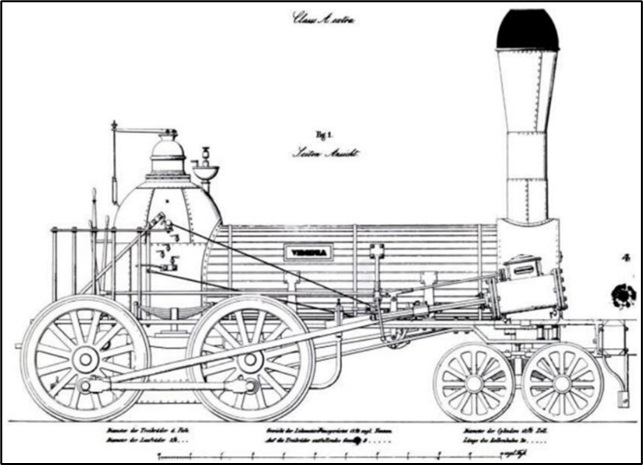
Members of the Continental Morgan Guard militia unit hurried to the corner of Market and Water Street and boarded the passenger cars belonging to the Winchester and Potomac Railroad. Nobody recorded which locomotive was tasked for the journey. Each of the engines had names though including Ancient, Pocohontas, Farmer, President, Virginia, and Potomac. One of these was quickly pressed into service. The chief engineer, Thomas Robinson Sharp, would pilot the train on its thirty-two-mile journey to Harpers Ferry.

Norris 4-4-0 locomotive like the Ancient, Virginia and Potomac locomotive.

Once at Harper’s Ferry the company disembarked from the train and headed for the armory. They quickly surrounded the firehouse where John Brown was holed up. One member of the unit wrote, “we were in a skirmish line with our guns at port, our thumb on the hammer, and finger on the trigger”. They would remain in the town serving as backup to Robert E. Lee and his team of marines who were tasked with the job of securing the firehouse. The marines would punch a hole in the door of the structure, enter the building, and capture Brown and his band of insurrectionists. The squad of militiamen would remain in the area to until after the trial and execution of Brown and his accomplices to ensure nobody would conduct an operation to free the conspirators.

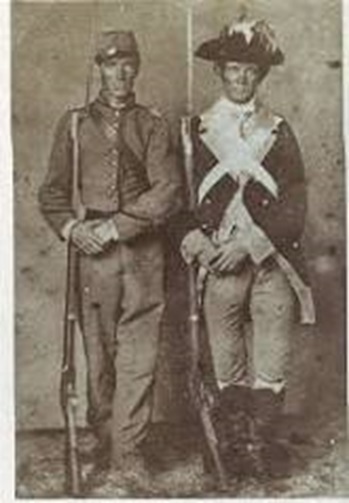
The Continental Morgan Guard, or Company A 31st Virginia Militia, had begun organizing on June 22, 1855, in Winchester, Virginia. The unit adopted uniforms resembling the pattern of the Continental Army. “The coats were made of blue wool with buff casimire trim. They wore white doe skin breeches, black top boots, buff casimire waist coats, and black tri-corner hats. The hats were trimmed with the brass numbers 1776 on them, a powder horn device made of brass on a leather cockade, and a flowing white swan plume. They also wore white ruffled shirts and white gloves to complete the outfit.”

Continental Guard and Soldier in Regular Dress.

Each member was required to secure for himself a uniform within sixty days of his election to the company. “It was an expensive outfit, costing more than some could afford. Much effort was expended in helping the volunteers with expenses, however. On April 3rd, 1857, for example, “the ladies of Winchester held a fair for the benefit of the ‘CMG’. The proceeds were enough to uniform fifteen new members who couldn’t pay for the cost of the uniforms otherwise.”

 On April 18, 1861, just six days after the firing on Fort Sumter, the “Continental Morgan Guards” enlisted in the Confederate Army. “On June 4th, they would become the oldest company assigned to the 5th Virginia Infantry CSA as Company K with 133 officers and men.

The 5th Infantry Regiment would be commanded by 59-year-old Colonel Kenton Harper. Harper had worn many hats including “newspaper editor, soldier, Indian agent, plantation owner, banker and politician.” He was also an officer of the Virginia militia which was then the U.S. Army during the Mexican War.  Eight days after having been given command of the 5th Virginia he helped General William H Harman lead a force of 2,400 men to seize the U.S. Army arsenal located at Harper’s Ferry. Four thousand muskets and thousands of tools were taken and sent to Tredegar Iron Works in Richmond to aid the war effort.

As far as the makeup of the regiment eight companies of the 5th Virginia Infantry would come from Augusta County and two from Frederick. On April 27, 1861, the 2nd, 4th, 5th, 27th, and 33rd Virginia infantry regiments, along with the Rockbridge Artillery Battery, were combined into what was to be called “Virginia’s First Brigade” and placed under the command of Brigadier General Thomas J. Jackson. During the war, the members would serve under Generals Thomas Jackson, Richard Garnett, John Winder, Elisha Paxton, John Walker, and William Terry.

Four companies from the regiment, including Company K, saw their first action at the Battle of Hoke’s Run, also known as the Battle of Falling Waters or Hainesville, which took place on July 2, 1861, in Berkeley County. The fighting was more a skirmish than a battle. Losses were light with the regiment suffering a total of eight casualties. Company K had just one of its members wounded.

In mid-July the 1st Brigade was ordered to join the main confederate army at Manassas. Outsmarting and outmaneuvering their Union adversary, General Robert Patterson, the unit departed from Winchester on July 18, marching thirty miles to Piedmont. Following breakfast, the soldiers were loaded onto railway cars belonging to the Manassas Gap Railroad for the thirty-four-mile train ride to Manassas. Disembarking at the junction the brigade marched to the battlefield and went into camp near Blackburn’s and Mitchell’s Ford, occupying the Confederate right flank along Bull Run.

Map of Bull Run Battlefield showing the 5th Virginia on the right of Jackson’s Line.

As the fighting began to heat up on the Confederate left flank on July 21, the 5th Virginia was sent to the right to reinforce Longstreet while the rest of the brigade marched two miles to the left of the line. When it became clear that the action at the fords was a feint, the 5th trooped to Henry House Hill and fell in on the brigade’s right flank. Jackson’s “instructions were to wait, fire, and charge the enemy as they appeared over the crest, about fifty yards in front.”  

Soldiers from Generals Bee and Evans’ Brigades were eventually forced to retreat from their advanced position. As they did so General Barnard Bee’s big moment came as he attempted to halt the retreat of his own soldiers. One story says Bee questioned Colonel Kenton Harper of the 5th Virginia asking: “What troops are these?” Harper replied, “Fifth Virginia Regiment, Jackson’s Brigade.” Bee turned and shouted to his men: “Rally men, rally! Look! These Virginians stand like a stone wall.” In doing so he gave the Brigade and Jackson their famous moniker.

About 2 p.m. Griffin’s and Ricketts’ Batteries were sent to an exposed position on the right of the Union line. A duel ensued between these guns and those belonging to General Jackson. The 33rd regiment advanced toward the guns and released a volley that devastated the union gunners. Jackson presently ordered a charge with the bayonet. “Yelling like furies” the 5th Regiment joined the rest of the brigade charging toward the enemy.

When the charge was ordered on the Union artillery in their front every company in the 5th Virginia claimed to be the first to reach the guns. Undoubtedly the members of Company K were mixed in with the crowd. The assault marked the climax of the Battle of Bull Run. The regiment suffered moderate casualties in the fighting. Of the 570 members of the regiment on the field that day there were 39 casualties. Eleven were killed and twenty-eight were injured. Company K suffered just four wounded.

Accounts from the battle tell us there were grey and blue uniforms worn by both adversaries during the battle. Both sides had contingents that sported colorful Zouave uniforms. “Many of their units donned all-gray outfits; many other poorer companies wore civilian clothes. Brigadier Generals Thomas Jackson and Barnard Bee, for example, dressed in their U.S. Regular Army dark blue uniforms.” “The thick black smoke made it extremely difficult for the commanders to identify the enemy. Rather than identify the gray clad regiments, officers ordered their men to fire.” “Friendly fire thus killed or wounded many Soldiers,” maybe even Brigadier General Bee.

What we do know from records left behind, the members of Company K were dressed in their unique Revolutionary War garb during this their first major battle. We cannot be certain, however, if the tradition carried on throughout the war. What we do know is the company would fight with Jackson in his famous Valley Campaign at Kernstown, 1st Winchester, and Port Republic. They would participate in all the campaigns of the Army of Northern Virginia throughout the war. The company would surrender fewer than a dozen of the 92 men left in the regiment at Appomattox Court House. Regardless of how they were clothed, members of Company K gave their all for the cause in which they believed.

5th Virginia Infantry. H. E. Howard, Inc. Lynchburg, Va. 1988.

https://en.wikipedia.org/wiki/Winchester_and_Potomac_Railroad#:~:text=The%20greatest%20use%20and%20value,and%20the%20Manassas%20Gap%20Railroad.

Page Valley War, Part 3: Impact of Death and War

 In the previous two parts of this series, we chronicled the case of a lost Hoosier horseman and the murder/execution of John F. Haines and Samuel Beyler.  This latter event is an example of the internecine war that the American Civil War was noted for.  Two men, in their sixties, being killed for no other reason than an affinity for the Union, was a reprehensible but common occurrence.  Just as common were the injustices perpetuated by Unionists upon supporters of the Confederacy.  It is easy to forget, however, that there are survivors from each of these atrocities and they had to continue to live after the events.  So it was for the families of Haines and Beyler.

Post Killings

For Harriett Haines, devastated by the death of her husband, her sorrow was alleviated somewhat by the arrival of her son Ellis, from California.  We don’t know if Ellis returned because of the long exile from home, the war, or some other reason.  We do know that Ellis returned to Milford just days after the family learned of his father’s death.

Ellis realized that staying in Milford would be dangerous for him.  As a known Unionist of military age, he could be arrested and suffer the same fate as his father or conscripted into the Confederate army.  Though painful for him and his family, after just a few days at home, he left for Winchester.

Just weeks before, a Luray native, John Sailor, had been in town as a member of Company K, 10th Virginia Infantry.  A veteran of a year in the army, he was part of Jackson’s army.  A fellow member of Company K was Thornton Beyler, the eldest son of Samuel Beyler.  The day after the deaths of Thornton’s father and John Haines, May 23rd, Sailor was reported to have “deserted to the cavalry.”  This was a common occurrence, especially when a young man could get a horse and horse equipment. 

Sailor was a married man and worked as a wagoner before the war.  He was prosperous enough to own a slave boy, age 10 in 1860.  Having fought at First Manassas and McDowell, the visit to his home may well have afforded him the opportunity to outfit himself and head out to join the cavalry.  

It is also likely that he knew John Haines, given his occupation.  As a wagoner, essentially a hauler of goods for other people, it is possible that he would have hauled items to or from Haines’ mill.  Regardless, the date of his desertion will gain more significance later in our narrative. 

So three young men, tied together by locale and events beyond their control continued on with their lives in the chaos of war.

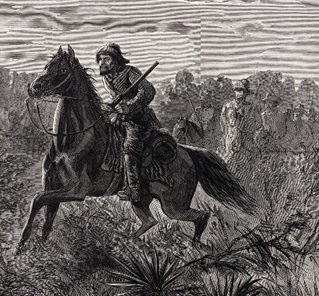
Ellis Haines was seething with anger and yearned to avenge his father’s death.  Knowing the roads, pathways, and people of the Page and Shenandoah Valleys were vital skills needed by both sides.  The knowledge that he was the son of a Unionist who had been killed while in Confederate hands made it easy to believe that his sentiments were with the Union.  Just days after leaving Milford, he was hired as a scout for the Union cavalry at Front Royal.  “Scout” was a generic term for guide, scout, or spy.  Oftentimes they wore Confederate gray and passed themselves off as members of the confederate army or as partisans.

Moving quickly into his role, in late June, 1862, he received a flesh wound to his calf around Front Royal.  For the following months, he served as a scout for General William Averell’s Union cavalry division.  In June, 1863, while reporting to the commander at Winchester, General Robert Milroy, he was badly wounded in the hip and groin in a skirmish near the town.

Union Scout

Apparently, Haines success and notoriety as a scout was well known by Confederates in the area.  While recuperating from his wounds in Winchester’s Taylor Hotel, a Confederate named Overall (perhaps a former neighbor from Milford) unsuccessfully offered a man $500 to unlock Haines’ room door so that Overall could kill him.

For Thornton Beyler, his war continued after learning of his father’s death on his brief visit home in May, 1862.  By the middle of 1863 he had fought at Port Republic and Cross Keys, marched across Virginia and fought in the Seven Day’s battles, Cedar Mountain, 2nd Bull Run, Fredericksburg, Chancellorsville, and Gettysburg.  So far, he had escaped injury and stood resolutely in the ranks, perhaps to make amends for the Unionist feelings of his father.

John Sailor, the young man who deserted the day after the killing of Haines and Beyler, may have had good reason to take off.  There is no record of which cavalry unit Sailor joined, or whether he joined.  He was heard to say that he had left Confederate service because his unit had been disbanded.  In all likelihood, he may have joined any number of “partisan” groups that roamed the Valley.  Regardless, his disappearance may have been for a far more sinister reason.

Months later, at a holiday party at Landon Racy’s home in Frederick County,  Sailor bragged about being a part of the group that had killed Haines and Beyler.  He also boasted of taking part in the murder of captured Union “Jessie” scouts.  Word got back to General Milroy in Winchester and a squad was sent out to arrest Sailor before he left the area.  He was captured and imprisoned in Winchester, there to await trial.

On February 5, 1863, a military commission was sworn in and the trial of John Sailor began.  Over the next two weeks, the commission heard testimony from four individuals.  Philip Byers gave the only testimony that pointed to Sailor being a killer in Luray.  The following is Byers’ trial transcript.

(Q)      Were you ever acquainted with John F. Haines and Samuel Bealer?

(A)      I was intimately acquainted with John Haines, but I was not with Bealer.

(Q)      Where did Haines reside?

(A)      In or about Milford in Page or Warren County.

(Q)      Is he living or dead now?

(A)      I heard he was dead.        

(Q)      From whom did you hear that Haines is dead?

(A)      I heard it through different sources.  Sailor told me so.

(Q)      Did he tell you how he came to his death?

(A)      Sailor said we took him out and killed him (Haines) and also Bealer.

(Q)      Did he state for what cause(A)   He said they were Union men?

(Q)      Did he state why Bealer was killed?

(A)      I (was) speaking of both, Sailor said they were Union men.

(Q)      Where was this conversation had?

(A)      It took place just after holidays at the house of Landon Racy’s in Frederick County.

Byers also spoke of the murder of 8 Union scouts.

“He (Sailor) said that 8 Federal scouts had been captured and he said we took them out and shot them and I think he said they were shot before Jackson came up.  He said the scouts plead (pleaded) for mercy.  I asked him how he could shoot men who begged for mercy.  He said I or we ( I’m not sure which) shot them like dogs and I believe he said like damned dogs.  ”

When queried as to the identity of the scouts, the witness reply, “They were Jessie scouts.”

 In further testimony by Byers, it was intimated that Sailor had been involved with the party host’s wife.

(Q)      Are you acquainted with Sailor’s character as a quiet and peaceable Citizen and, if so, is it good or bad/

(A)      So far as my own knowledge is concerned I have seen nothing  amiss except his being too intimate with Landon Racy’s wife which I know and warned him of and he still persisted and she went off with him.  I understand through some of Sailor’s wife’s friends that Sailor is inattentive to his family.

This provoked the only questions from Sailor during the entire trial. 

(Q)      (Asked by the Defendant)  Did you ever know of Racy’s wife leaving Racy before?

(A)      She did leave him before.

(Q)      (asked by Defendant)  State whether she left on my account that time?

(A)      She left before I knew Sailor was in the neighborhood.

(Q)      (asked by Defendant)  Did you hear she left to meet Kline?

(A)      I did not.

(Q)      (asked by Defendant)  Was Kline and Mrs. Racy intimate?

(A)      I heard so.  I do not know.

(Q)      (asked by Defendant)   Did Kline stop at your house pass himself off as Orndorff?

(A)      He did.

(Q)      (asked by Defendant)   Have you any proof I killed those scouts?

(A)      I have no proof except what you told me.

(Q)      (asked by Defendant)   Do you remember that I told you that the Louisianans took and killed Haines and Bealer?

(A)      I do not.  I remember that you told me that the Louisianans killed Clen(?) at the fort.

The commission adjourned and delivered their verdict on February 22.

            “The undersigned detailed by your order to act as a Military Commission to examine into, and report upon the case John W. Sailor late of Page County, was charged with the murder of John F. Haines and Samuel Bealer, late citizens of Page County Va.; and eight members of the Corps of the United States army denominated Scouts.  Beg leave to report, that they assembled in Winchester according to your order and after being duly sworn in presence of said Sailor and no objections being  made by him to any Member of Said Commission, they proceeded to hear Such evidence as could be procured (a copy of which evidence is herewith returned) and upon a careful Consideration thereof do find that Said Haines and Bealer came to their death by violence at the hands of Said Sailor and his confederates unknown to this commission.  And that the only reason thereof was their attachment to the Constitution and the government of the United States, that they were murdered sometime in the summer of 1862 in the county of Page and State of Virginia.  We further find that Said Sailor aided by others unknown to this Commission did sometime in the summer of 1862 while they were prisoners of war, kill and murder eight soldiers in the Service of the United States, belonging to that Corps denominated Jessie Scouts this being done in the county of Page or Frederick Va.  They further find That Said Sailor was prior to December25th, 1862 in service of the rebel army.

Therefore the said court finding John Sailor alias John W. Sailor, guilty of aiding and assisting in the crime of murder of the said John F. Haines, Samuel Bealer, and the said Scouts as he stands charged, do sentence him, the Said Sailor to suffer Death by hanging at such time and place as may be directed by the President of the United States.”

Of interest is the location of the Jessie scout murders.  Page and Frederick counties are not contiguous.  This lack of specificity is striking, given the severity of the charges.  It could have been written “the murders were committed somewhere within a 25-30 mile radius of Front Royal at an unknown time by the defendant and other unknown individuals.”  Yet, he was found guilty of these murders.

As stated in the last sentence, the final arbitrator of the sentence was the President of the United States, Abraham Lincoln.  Lincoln was well known to find all kinds of reasons to commute death sentences, particularly in military law cases.  However, this was more than sleeping on duty or harming oneself to avoid service.  Sailor was found guilty of participating in the murder of 10 men, two of them civilians well past military age.

When the Judge Advocate General of the United States Army, Joseph Holt, met with Lincoln, he was troubled by the scanty evidence and various legal improprieties exhibited in the trial transcript.  Having been appointed in September, 1862 Holt felt that any sentence of death had to held to high legal standard.  Lincoln, of a similar mind, agreed with Holt.  On March 16, Holt issued this remarkable ruling:

“This record is regarded as fatally defective.  It does not appear that the general order convening the commission was read to the prisoner or in his hearing or that he had an opportunity to object to any members of the commission nor does it appear that the charge against him was in writing or that he had in advance of the examination of the witnesses any knowledge of the offense for which he was to be tried; Nor is it shown that the prisoner was allowed to plead to the charge against him, as recited in the General Order convening the Commission.  In a proceeding involving Life, such irregularities are wholly inexcusable and make the execution of the death sentence legally impossible.”

                                    Holt

                                    Judge Adv Genl

Report approved.

  1. Lincoln

Sailor had escaped a death sentence.  It is highly likely, however, that he realized he was a marked man, for within two months he had enlisted in the UNION army.  Why would he join his enemy and the prosecutor of his murder sentence?  Was it a condition of his release?  Given his history, why didn’t he desert from the Union army at his first opportunity?  We may never know the answers to these questions. 

We do know that Thornton joined the 3rd West Virginia Mounted Infantry which was later designated the 6th West Virginia Cavalry.  He was quickly identified as having scout potential and assigned to the Union Second Cavalry Division, commanded by Brigadier General William Averell. 

So, by mid-1863, the sons of Haines and Beyler were enlisted and fighting for their respective causes.  John Sailor, the convicted murderer of their fathers, was free and fighting for the Union after starting the war as a Confederate soldier.  Ellis Haines was serving in a similar capacity as Sailor and Beyler continued in the ranks of the 10th Virginia Infantry.  As 1864 began, these three lives changed, once again.

End of War

Ellis Haines had become an accomplished scout.  Serving with Milroy and the Union forces in the lower Shenandoah Valley, he transferred to Averell’s cavalry command.  Remarkably, quartermaster records indicate that Haines and Sailor were paid by the same quartermaster in West Virginia for a short time.  It is unknown if either knew of the connection between them. 

In June, his unlucky month, Ellis Haines received his third wound of the war while scouting in Abb’s Valley, West Virginia.   A minie ball shattered both right forearm bones.  Haines’ wound ended his active military service.  He was discharged from his duties in November, 1864 and paid $400 upon separation.  However, he was briefly re-enrolled and served at Army of the Shenandoah headquarters from April through June, 1865.

John Sailor continued to serve the Union cause and appears to have been effective.  Payroll records show Sailor being paid as a scout throughout 1863 and 1864.  When the war ended, the 6th West Virginia Cavalry was ordered to Kansas for duty on the western frontier until their three year enlistment ended.   Sailor, since he was on detached duty, did not make the trip to Kansas but was mustered out in Washington D.C. in 1866.

Thornton Beyler’s Confederate service came to an end at Spotsylvania Courthouse on May, 1864 where he was captured in the terrible fighting around the infamous “Mule Shoe” salient.  Within days, he had been transferred to Point Lookout, Maryland, a prison camp on the very tip of Maryland’s Eastern Shore where the Chesapeake Bay meets the Atlantic Ocean.  A godforsaken piece of land, Beyler decided to accept an alternative to harsh life in prison.

It was fortuitous for Beyler that the United States Army was recruiting from Confederate prisoners for the 1st United States Volunteers.  In total, six regiments were raised and sent to the western frontier to protect families and United States interests.  The 1st U. S. Volunteers’ first duty, however,  was along the North Carolina coast where they did face their former comrades on the battlefield.  General Ulysses Grant never did fully trust the former prisoners of war fighting their former friends.  When the cries for protection on the western frontier became incessant, he gladly sent the U.S. Volunteers west.

Beyler would march west with the 1st United States Volunteers as a “Galvanized Yankee” –  a term to describe Confederates in gray putting on the Yankee blue.  Thornton served in Minnesota and Kansas before muster out in November, 1865 as a sergeant.

Post War

Harriett Haines, our heroine in part one, left Milford and, for a time lived in Washington DC.  In the 1870’s she filed a claim Southern Claims Commission, a government entity charged with re-imbursing “Southern Loyalists” for damages incurred during the war.  Ironically, the wife of a murdered Unionist and mother of a Union scout was denied payment.  In her later years, Harriett lived with her son Ellis near Winchester.  In her final years, she moved to Woodstock with her daughter, Harriett, the young chronicler of her father’s death back in 1862.   She died there in 1882 and is buried in the Reformed Cemetery in Woodstock.

Ellis Haines had been badly injured during his time as a scout.  His arm was so badly damaged as to make the limb nearly useless.  His wound from 1863 in the hip and groin caused him constant pain.  Despite this, Ellis married in November, 1865 and was named Jailer of the Frederick County jail. 

Looking for something more substantial for support, he turned to the national government in hopes of employment.  In 1867, he applied for the superintendency of the National Cemetery being established in Winchester.  His recommendations were impressive, coming from Generals Robert Milroy, William Averell and Alfred Torbert.  Citizens of the community chimed in with their support, but to no avail.  Haines was denied the post on a technicality.  The letter rejecting his application stated that he did not meet the criteria of being a former enlisted or commissioned officer in the Union army.  Ellis’ service had always been as a civilian.  For a time, he later engaged in the harness making business. 

Ellis also looked for support from another source. As early as 1867, Haines was pursuing a pension from the United States government.  A Congressional act provided him $8 a month which was increased to $14 in 1871.  He settled down, got married and raised six children.  He died in 1909.

Mt. Olive United Methodist Church Hayfield, Va.

Thornton Beyler served quietly on the frontier and withstood the severe winters of Minnesota and the constant threat of Indian attack.  When he came back from his service as a Galvanized Yankee he decided a fresh start was needed.  Perhaps he was concerned about his reception back in Luray after serving in the Union Army.  He eventually settled in Wirt County, West Virginia, got married and raised 11 children while farming.   He died there in 1902 at the age of 61.

Beulah Humble Presbyterian Church Elizabeth, WV

John Sailor found civilian life boring and enlisted in the 5th U.S. Cavalry in 1867.  He served in the Army on the western frontier for a number of years before returning to Winchester around 1881 and marrying a local woman. Interestingly, there is no record of a divorce from his first wife.  During his last years, he drove a bus for the Taylor Hotel and was known as quite a storyteller from his time out West.  John died in 1906 and was buried in the National Cemetery in Winchester.

Winchester National Cemetery, Winchester, Va.

It seems plausible that Ellis Haines and John Sailor would have known of each other as Winchester was not a large city at that time.  I can’t help but wonder if they bumped into each other, perhaps swapping stories from their times as scouts.  Did Ellis know of the charges and conviction of John Sailor?  Were either or both members of the GAR? 

Finally, there still remains the ultimate questions.  Who really killed John F. Haines and Samuel Beyler on May 22, 1862 in Luray?  Was it ordered?  By whom?  Were the killings committed by local vigilantes?  The quest for the truth continues.

As we come to the end of part 3, I hope you enjoyed this journey through little known events of the Civil War in the Page Valley and some of the individuals whose lives were so impacted by this tragic era of American history.  My thanks to Peter Dalton for allowing me to tell the story.  It is a story that I will continue to research and, Peter allowing, will update you with any new information about the protagonists in Page County War in a future blog posting.

Sources for part 3 include obituaries of the individuals, Court Martial records, Quartermaster records,  and individual service records in the National Archives, contemporary newspapers, and family histories.  If you wish to know the source of a particular piece of information contained in any of the three parts, contact me at jagoecker@yahoo.com for the source.  Likewise, if you have information about this tragedy, feel free to contact me.

Jim Goecker is the author of “Hoosier Spies and Horse Marines:  A History of the 3rd Indiana Cavalry, East Wing,” available from McFarland Publishing or your online book source.

Page Valley War, Part 2: Murder or Execution.

In the first installment of this series, I told of a Hoosier cavalryman lost in the Page Valley.  For twenty-four hours William Watlington wandered about encountering guerilla bands, Mosby’s men, and the kindness of a rare Unionist woman who provided him vital help in eluding guerillas.  His savior was a middle aged woman, Harrett Haines, who Watlington eulogized in his 1925 edition of his memoirs.  Twelve years prior in 1913, he had visited Milford in the Page Valley in hopes of finding and thanking Harriett for her help 50 years ago.  To his sorrow, he learned that Mrs. Haines had died in 1882.

There the story could have ended until research about Harriett revealed much more.   The story of how Harriett Haines came to be in Milford and her Unionist views reveals a more sordid history.  One has to go back to the fall of 1860 and the election of Abraham Lincoln to understand Harriett’s motives.

Harriett Haines was born to a Pennsylvania Quaker family as Harriett Frye.  She married John F. Haines and moved to the tiny burg of Milford, Virginia (present day Overall).  This small cluster of houses was located in the Page Valley on the border between Warren County and Page County.  There, the family grew and prospered.  Census records of 1850 show Haines with real estate valued at over $1,500 and a growing family – Ellis, William, Harriett, and Daniel.  Also living with them was Phoebe Fadeley, a teenage free black girl.

By 1860, the Haines were running a mill in Milford.  The eldest son, Ellis, age 20, had left home with a cousin for California. William, 17, Harriett, 15, Daniel 13 were still at home helping with the mill.  Phoebe, now 25, still lived with them along with her two children, Andrew, 3, and Bird, 3 months.

We know little of John Haines’ involvement in the political fever in the years before secession.  We know that he had started life as a Quaker but had converted to Methodism.  The fact that a young freed black woman lived with the family as early as 1850 may speak to John and Harriett’s Quaker upbringing.  

The presidential election of 1860 featured several candidates from the splintered Democratic Party and the new Republican Party.  Lincoln was seen in the South as a radical candidate.  County election returns of 1860 for Warren and Page counties showed little interest in the upstart political party or its candidate.  Not one vote was cast for Lincoln in either county.

Yet, John F. Haines had seen something in the Republican platform and Abraham Lincoln for, in February, 1861, he departed Milford for Washington D.C. and the inauguration of Lincoln.  Meanwhile, several southern states had formed the new Confederate States of America.  As Haines traveled north to Washington, delegates were convening in Richmond to consider the question of joining the breakaway states. 

Upon arrival in the capital, Haines was now over a hundred miles from home in an increasingly volatile political environment.  Back in Page County, word had spread about where Haines had gone and for what purpose.  His family became targets of local secessionists who warned them that John had better not return home.  If he did, they were told, the elder Haines would pay for his support of the Union and Lincoln.

Harriett was able to get word to John not to return due to the threats.  As John waited in Washington, Virginia was exploring its options.  On April 4, the convention in Richmond held its first vote on secession and it was defeated. The delegates from Warren, Page, and neighboring Shenandoah counties voted for secession – the only Valley county delegates to do so.  Two weeks later, after the attack on Fort Sumter, everything had changed.  Lincoln called for volunteers to put down the rebellion – just the type of radical behavior the delegates in Virginia feared. On April 17, a second vote for secession was held and passed.  Virginia was leaving the Union.  All around the Valley, men rallied to the secession cause and military units began to form.  In Luray, Company K of the 10th Virginia Infantry was mustered in early June.

For what was hoped to be a short time, John F. Haines continued to live in Washington, hoping to be able to return home.  Instead, the war grew more violent and widespread with no end in sight.  Over 16 months after leaving home, however, the opportunity to return seemed eminent.  

Union troops had had success in the western theater of war.  McClellan and the Army of the Potomac had advanced up the Peninsula to within a few miles of Richmond.  In the Valley, “Stonewall” Jackson was stopped at First Kernstown in March of 1862 and retreated south.  Union troops were following him and Haines took the chance to return home after an absence of over a year.  Moving to the Valley (probably Winchester) he learned that a Union column would be marching up the Page Valley.  Haines attached himself to the Union division commanded by Brigadier General James Shields in hopes of reaching home.

Brigadier General James Shields

On May 10, 1862, John was finally reunited with his family in Milford.  One can only imagine their elation after being separated for nearly 16 months.  Likewise, it is difficult to imagine the shock when, four days later, Shields and his men came marching back north and down the Valley.  

This abrupt change in fortune was precipitated by Shields’ division being ordered to Fredericksburg.  Shields stopped for a couple of hours to visit with Haines on the return march and encouraged him to go back north with the Union forces.  The general knew that if Haines stayed in Milford, it would be hard for him.  Haines thanked the general but stated that he would stay one more night as he had a cold.  This decision would prove to be fatal.

Secessionist retribution came swiftly.  His daughter would later write in a letter to a relative:

“…when Gen. Shields’ Division moved down this Valley, father thought he would leave with them; but thought he would stay till morning, as it was raining all day and he did not feel well, and all of Shields’s force had not got to Front Royal before eighteen of the rebels rode up here, arrested father, and guarded him all night.  They would not let any of us go out of the house.  Next morning they took him to Luray…”

The arresting group was also described in another source as “Louisiana Tigers”.  Confederate General Richard Ewell’s command, in Luray at this time, did indeed, include the famed Louisiana Tigers.  Another source says that the group was commanded by a Lieutenant Cox.  Separately, about the same time, Samuel Beyler of Oak Hill was arrested and taken to Luray.

Little is known of Beyler.  What we do know of him pre-war includes his surprise election as a local official in January, 1860.  A report in an Alexandria newspaper stated “…Captain Beyler is an Old Line Whig and a man of fine talents.  There were three strong Democrats running against him…(He) got a majority over all his competitors combined.  The excitement was very great, he being the first Whig as was ever elected in this district.”

This “man of fine talents” seemed different than the one described in the divorce proceedings from his wife.  Within the record posted the same month as his election, she alleged Beyler had beaten her, threatened to kill her, and imposed psychological and verbal abuse.  The divorce decree indicated that Beyler’s wife was the owner of their land as a gift from her father.  The land, as was customary for the times, were held in trust and was administered by a trustee.  Samuel found himself with little to show for their 25+ years of marriage.

Beyler’s son, Thornton, had enlisted in Company K, 10th Virginia Infantry in June 1861, indicating that not all of his family were northern sympathizers.  It is unknown if Thornton was a secessionist or swept up in the fervor of war and the pressured to join his friends. He did, however serve faithfully in the ranks having fought at First Manassas and in the Valley with Jackson.  Among Thornton’s company mates was local wagoner John Sailor (an important figure in Part 3).  Thornton and his comrades of the 10th Virginia Infantry had a homecoming in Luray in mid-May.  

After defeating the Union army of John Sigel at McDowell on May 8, Jackson consolidated his forces around Luray and New Market.  The connecting New Market Gap allowed him the option of moving north through the Page Valley or the Shenandoah Valley.  

In the meantime, Union General Nathaniel Banks’ army was inching its way south from Winchester.  Learning that Banks was as far south as Strasburg, Jackson saw an opportunity to defeat Banks.  Jackson intended to march down the Page Valley – out of sight of Banks – rout a small Union force at Front Royal, race north to the Valley Turnpike, cut Banks off from Winchester, and bag the entire Union army.  Jackson’s men started south flowing through the Gap to consolidate the army.

The short distance from Milford and Jackson’s first target of Front Royal was barely 10 miles. That Haines would be detained made military sense.  He had arrived back home after 16 months in enemy territory in the company of an invading army.  He was known to have sympathy for the enemy.  Given his local knowledge, it is probable that Haines had given Shields information about the geography and roads of the area.  Having someone like Haines along one’s invasion route was dangerous.  Being detained by the military made sense. 

There was no known application of civil law.  No charges were filed, there was no trial, the men saw no judge – at least there is no record.  Ultimately it appears that Haines and Beyler were held for military expediency.  Though their ages – Beyler was 64 while Haines was 62 – made it unlikely for them to pose a threat individually, their knowledge and previous actions required them to be sequestered for the immediate future. 

On the morning of May 22, barely 24 hours after Shields’ departure from Luray, Jackson began his march to Front Royal.  Left behind were the two civilians in the Luray jail.  No longer needed for military purposes, the prisoners would have reverted to civilian control.  By that evening, no Confederate troops remained in Luray.

Colonel Turner Ashby

What happened next is confusing and includes several different versions of events.  Some family members believed that the order of execution had come from Colonel Turner Ashby. In letters to relatives, reprinted in the Baltimore American and Sunbury (PA) Gazette,  Haines’ daughter stated:

“…and by order of Col. Ashby, three of his men took father and another man out in the night and shot them, never burying them until Shield’s Division came up again…”

“…Jackson’s army passed down this valley and Col. Ashby ordered him (Haines) to be shot, and another Union man; and they took them out after night and shot them – did not even bury them…”

The Philadelphia Inquirer reported a different version of events based on an interview with one of John Haines’ sons:

“The General (Shields) has information that, at a meeting of several citizens of Luray, the question was discussed what should be done with these men, and a vote taken to put them to death.  One of the men, who demanded the key of the jailor and was concerned in the murder, is named Gibbons.  (Gibbons was the father of the colonel of the locally raised 10th Virginia who had been killed at McDowell.)  He formerly lived neighbor to Haynes…”

As to who did the killings, again, there are varying stories.  As mentioned above, one story was that the elder Gibbons was behind the murders.  Another account written by Lt. Colonel Franklin Sawyer of the 8th Ohio Volunteer Infantry appeared in the Fremont (OH) Intelligencer and described the killings in detail:

“They were taken out of the jail at midnight under pretense of being sent to Richmond, marched about two miles into the woods, and there told that they were to be shot.  They were in charge of five citizens of Luray, one of whom was a Baptist preacher.  Haynes asked for permission to pray and did so.  His prayer was so affecting that the hearts of two of the murderers failed, and one of them seeing this, stepped up and shot Haynes while on his knees, and another one immediately shot Beeler.  The bodies were left unburied until our army went up there. Our chaplain, Dr. Freeman, visited Mrs. Haynes yesterday, and tells me that she has not left her bed since the murder of her husband was learned by her.”

Lt. Colonel Franklin Sawyer

Other post war accounts pointed to other individuals.  Who did the execution/murder?  Were they ordered by military authority?  Was there a civil trial condemning them to death?  Was it vigilantism?  There is no conclusive answer.  What is known is that John F. Haines, age 62, and Samuel Beyler, age 64, on the night of May 22, were taken out of the jail, marched out of town southwest about a mile to the “Boneyard Woods” and shot.  Their bodies were left where they fell, unburied, to be ravished by nature. It was not until the return of General Shields’ division over two weeks later on June 7 that the families learned the fate of Haines and Beyler. 

Shields –  livid about the killings – momentarily considered burning Luray down in retaliation before being dissuaded.  Having just visited the Haines family on the way to Luray and learning of John’s arrest, he had promised to release the elder Haines when he reached Luray.  Now, he wrote a personal message of condolences to the family and dispatched the quartermaster of the 1st Rhode Island Cavalry to inform the family and deliver the note.

The remains were retrieved and given proper burial, though it is not certain where.  It is certainly possible that they were buried at the execution site, given the probable condition of the corpses.  There is a stone simply marked “S.B.” – which might be Samule Beyler –  that stands in a small family cemetery near Oak Hill.    There is no record of any stone in Page County for John Haines.  If buried by the family, it is probable he was buried near the family home in Milford.  The truth is, nobody knows.

While we do not know about the Beyler family, we know that the Haines family was devastated.  Harriett – William Watlington’s future savior – was prostrated by grief.  Again, we return to the Haines’ daughter, 15 year old Hariett for the raw details of her mother’s grief.  In a letter to a relative, Harriett reported:

“…My poor mother is lying very low.  It has almost killed her.  She was insensible for more than an hour and half the other day.  Gen.  Shields has been very kind to us.  He sent a doctor fifteen miles to see mother.  The doctor thought she was somewhat better.  All the soldiers have been very kind to us.  It was very hard for me to give up my dear father; I hope God will support us in this great affliction, and enable me to bear up under it, for the sake of mother; and that God will spare her to get well again, as she is my only hope.  From you cousin, Harriett”

The story of the killings was reported widely in the northern press as far away as Cleveland, Ohio, Louisville, Kentucky, and Boston Massachusetts.  Several Union soldiers remarked on them in letters home or in post-war reminiscences. 

So what happened in Luray in May, 1862?  That it was unusual for this time is, unfortunately, not true.  There are other killings based solely on Union fealty recounted in these same letters and newspaper articles.  What makes this one stand out is the breadth of coverage and the intimate details of its impact on the families – the Haines, in particular. 

In the third and final part of our series, we will follow the impact of the killings on the Haines and Beyler families as well as the convicted murderer/executioner who received a presidential pardon.  How the killings effected their lives and the intersections of their paths are a microstudy of the complicated history of war and post-war in the Page Valley.

The Haines family ordeal was well documented in a number of contemporary newspaper reports after the return of Shields’ division. Other sources consulted include census records, family histories,  Page County court records and election results, the Official Records of the Rebellion, and histories of the Civil War in the Valley.

Page Valley War, Part 1: Lost and Alone in the Valley

Valley Civil War history is almost always about the Shenandoah Valley and its vital Valley Turnpike.  Whenever the parallel, smaller Page Valley is mentioned, it is seen as a sideshow to what was happening in the more well-known, larger Shenandoah.  Jackson’s Valley campaign in spring of 1862, when he marched from Luray to Front Royal in 1862, is one of the few Page Valley only operations that garners much attention.  The Page Valley however, on the south side of the Massanutten Mountain, has its own rich Civil War history. 

William Watlington

William Watlington found his own unique history within the Page Valley.  His story highlights the unique terrain and dangers that inhabited the region.  But first, some context.

September, 1864 was an eventful time in the lower valley.  The battle of Third Winchester had seen the Union army of Philip Sheridan throw Jubal Early’s Confederates out of Winchester in panic and confusion.  Early’s men scampered south to the impressive heights of Fisher’s Hill just south of Strasburg.  Sheridan had been frustrated by his Third Division of cavalry’s inability to get around the Confederate right flank and block the Valley Turnpike at Third Winchester.  Brigadier General James Wilson’s division was the smallest of Sheridan’s three cavalry divisions and a lackluster attempt to turn the Confederate flank had foiled Sheridan’s plan to bag Early’s entire army.

Sheridan, however, saw another opportunity to “put the cork in the bottle” once again as he approached Fisher’s Hill.  He ordered his Chief of Cavalry, Major General Alfred Torbert, to send horsemen down the Page Valley to Luray.  From there, Torbert was to ride through the New Market Gap and block Early from proceeding further south at New Market. 

Wilson’s division led the way and by September 20 they were skirmishing with Williams Carter Wickham’s small Confederate cavalry brigade just north of Front Royal.  The next day, Wickham’s force stymied the Union advance at Gooney Creek, about six miles south of Front Royal.  Torbert and the 1st Division caught up with Wilson and the plan was to resume the advance and breakthrough Wickham’s roadblock at Gooney Creek and race towards Luray.

Except Wickham wasn’t there on the morning of September 22.  The Confederate cavalry had retreated a few miles further south to the small village of Milford (present day Overall).  Here the valley narrowed considerably, and the Confederate position was formidable. After a few attempts to flank the Confederate position, Torbert called an end to fighting and retreated about four miles north of Milford.  The next morning, the Union horsemen continued their retrograde movement, crossing the North Fork of the Shenandoah River, seven miles from Strasburg around noon.  Torbert decided to report to Sheridan about this turn of events.  

The 3rd Indiana Cavalry was a veteran unit that had been re-organized into two companies upon the completion of its three years of service.  The two companies consisted of men who had reenlisted as well as recruits who had not yet served their three years of service.  Too small for combat assignment, the companies had been assigned as the escort for Third Division commander James Wilson.  Oftentimes, the escort was ordered to carry orders and messages between commands.  Three men from the escort were assigned the duty of carrying the report, William Watlington, Robert Gray, and a man named Ward. 

A recruit who joined the regiment in October, 1863, Watlington had also been under enlistment back in July when John Morgan made his raid through Indiana.  Armed with a sixteen shot Henry carbine while members of the regiment in Virginia were armed with single shot Gallagers and Sharps, he had been part of a home guard unit that protected Madison, Indiana during Morgan’s Raid.  Now a veteran of a year of service, Watlington would undergo a harrowing adventure in the Page Valley.

Initially, all went well.  Leaving the column, the three men moved quickly to Strasburg where they were told of the battle of Fisher’s Hill and that Sheridan had moved up the Valley to Woodstock.  Watlington recalled, “With a smooth pike now before us we pushed forward at a more lively gait.  At no time since leaving the command had we come down to a walk.”  This rapid pace had taken its toll on their mounts and Watlington and Robert Gray finally stopped at Fisher’s Hill to rest their horses while Ward rode ahead with the message.  After resting their mounts, Watlington and his companion rode back to Strasburg where they bivouacked with a group of infantry and four members of their cavalry division.

Having been given no orders beyond the delivery of the message, the six cavalrymen decided to return to their division.  Assuming that the command would be conveniently located where they had left it the day before, the squad moved out on the morning of September 24.  Reaching the banks of the North Fork around noon, they were startled to find that the command was not there. 

In between their leaving on the mission and their return, Torbert had learned of the victory at Fisher’s Hill and realized that it was vitally important for him to get to New Market as quickly as possible.  On the morning of the 24, he reversed the command and headed south again, this time encountering no opposition at the ford as his horsemen raced south towards Luray and the New Market Gap.

This change of events put the little band of Union cavalrymen in a fix.  They were alone in an area notorious for Mosby’s men and guerilla bands.  Both groups were known to trail advancing Union columns to scoop up stragglers.  For Mosby, the captures provided military information and sowed fear in the Union ranks. His captives were typically sent up the chain of command and to Confederate prisoner camps. For the guerillas, they provided booty and oftentimes death as they held no firm allegiance to any course other than their own.  Prisoners only slowed them down.

The men decided that, if the Union troops had moved out that morning, they should be able to overtake the command in ten to fifteen miles.  They were not sanguine about their chances, however; “With this hope in view we pushed forward at a rapid gait, but not without some misgivings as to our success,” admitted Watlington.

As they neared the crossing of the south fork of the Shenandoah River, they rode to a nearby cabin and asked the “Virginia Widow” living there as to when the cavalry had crossed.  Being told by the woman that the command had crossed the night before, the men now realized that their comrades had to be at least 20 miles up the Luray Valley to Luray itself.

Realizing their danger, they once again held a short council of war.  No one wanted to be captured by Mosby’s men and sent to a prisoner camp.  Nor did anyone relish an encounter with any of the guerilla gangs that resided on the mountainsides of the Blue Ridge.  Examining and priming their revolvers, they unslung their carbines and moved them to a more ready position across their saddles.  Resolutely, they moved out.

They had traveled but a few hundred yards before turning at a sharp bend in the road and saw two men in Confederate uniforms.  They duo made a short run for some bushes along the road.  In the meantime, seeing that the men appeared unarmed and outnumbering them, the cavalrymen shouted for them to halt, which they did.  Riding up to the pair, the Union men questioned their captives.  The men claimed to be deserters from Early’s army and were returning to their homes down the valley.  Not wanting to be burdened with prisoners, the cavalrymen wished them well and sent them on their way.

About a ½ mile further on, the small band came upon a camp site, recently used by their command.  As was often the case, horses unable to continue had been released and replaced by captured horses.  Watlington’s own mount was struggling to keep up and he observed one of the abandoned mounts that looked in better shape than his own.  After examining the horse, he quickly transferred his saddle and equipment. The men moved out once again.

Two miles later they struck the Front Royal and Luray Pike.  Almost simultaneously, Watlington’s mount revealed why he had been abandoned.  “The horse I had taken up was one that had been abandoned because of a weakness in his back and loins, and his sudden breakdown in the road was the same effect as if his back had been broken.”  Watlington, not wanting to be a burden to his companions, told them to move on and he would make do.

Now afoot in dangerous territory, Watlington hid his saddle and other horse equipment in a sink hole near the road, keeping only his revolver and carbine.  As he completed his task, he was startled by the sound of several carbine and revolver shots.  Running up the mountainside, he crept back towards the Pike to the origin of the shots and found nothing.  He guessed that his friends had encountered a band of Confederates and either ran them off or been captured. Coming back out on the Pike, an eerie quiet prevailed. Now even more alarmed, Watlington moved slowly up the Pike.

Rounding another of the innumerable curves on the road, he spotted someone on horseback approaching him.  Realizing there was only one, he fought the urge to dart into the bushes and moved toward the individual.  The person was in fact a 10- or 12-year-old boy who was returning home from the mill with a peck of corn meal.  The boy reluctantly dismounted when ordered and Watlington, once more mounted on “an old Yaller horse”, rode up the Pike much relieved to be mounted once again.  He reasoned it shouldn’t take a great deal of time for him to overtake his comrades.

Having ridden about ¼ of a mile, Watlington was shocked to see a small group of men standing in the road about a half mile off.  Some wore Union blue and all seemed to be in an intense discussion. 
The conversation was so intense that the group did not see Watlington on his steed.  Reasoning it was better to leave the Pike, he dismounted and headed up the mountain, away from the river.  In front of him was an open field that ran along the Pike for 150 yards and leading up to a road that trailed up into the Blue Ridge Mountains.  Beyond the field, only trees could be seen.  If he could reach the tree line, his plan was to cross the mountain road, continue south and strike the Pike later near Milford.

His plan worked well as he crossed the open field furtively, darting from one small bush to another until he was into the woods.  Once he entered the forest, his adrenalin pushed him deeper into the trees until he became so disoriented he didn’t know which direction he was traveling.  After some time wandering around, he espied a clearing ahead with a small house located several hundred yards downslope.  Beyond the clearing he could see a mountain range.   Scattered across the mountain side were several wisps of blue smoke indicating a cabin or guerilla camp.  He also saw a road to his left that passed along the edge of the woods and within a few yards of the cabin. 

Watlington was so confused that he decided to risk approaching the cabin in hopes of determining the way to Milford.  He decided the best approach was the direct approach and boldly climbed a fence and approached the cabin across the open clearing.  As he approached the cabin, he observed a “very old man” sitting on the porch.  In the adjoining room he could also see an old woman.  Reaching the cabin, he asked for water.  A younger woman stepped out of the entry way and showed him a bucket of water.  After slaking his thirst, he asked the woman the way to Milford and the most direct way there.  In reply, the woman said it was about 4 miles in the opposite way from Watlington’s most recent path.  He had been traveling north instead of south.

Thanking the woman, he headed back across the clearing.  He had gone but 100 yards when he heard several voices behind him.  Turning, he saw several heads over the top of the fence headed his way.  In a moment or two, he would be in plain view of the men.

Realizing it was too late to run, he frantically looked for any kind of cover.  A few feet away was a small cedar tree.  With only seconds to spare, he dropped behind the bush and tried to make himself as small as possible.

The group continued down the road and were absorbed in conversation.  Passing only a few yards from his scant hiding place, Watlington slowly moved around the bush to keep it between himself and the group.  As they passed, he realized that they were the same men who had forced him to give up his horse to escape their notice earlier.  As the men disappeared from view, Watlington jumped up and ran the 100 yards to the woods, bounded across the fence, and crashed into the trees running for some distance before he dared to stop and rest.  As he regained his strength, he assessed his situation and location.

He reckoned that he was 2-3 miles from the Pike on the Blue Ridge Mountain side.  Walking south, he struck a road that seemed to lead in the right direction and was able to reach the Pike.  Surmising he was only about a mile from Milford, he marched south.  Arriving in the village about an hour before sundown, he headed to the first house he saw hoping for a drink of water.

As he approached the back of the house and before he could request a drink, a middle-aged woman met him and asked fearfully if he was a Union soldier.  When Watlington responded in the affirmative, she responded, “For God’s sake, hide yourself as quickly as possible.”  She hurriedly informed him that a guerilla gang was camped nearby.  Of the worst kind, they attacked the rear of the Union columns to rob and murder “having no use for prisoners and consequently never took any.”  More alarmingly, a party of them had been in Milford only a short time before and threatened all kinds of vengeance on Union soldiers.

Watlington was struck by her manner and was surprised to find someone so concerned for a lost Union soldier in such a dangerous area.  The woman was so distraught and urgent in her warnings that he believed in her desire to keep him from harm.  He felt he had no choice but to place his life in her hands.

After a quick drink of water, he asked the woman the best place to hide until dark.  Pointing towards the river, the woman showed him a path down to the shore.  Finding an old tree on the riverbank so undermined by the river that its roots were exposed, he crawled under and remained there until dark.

In his hideaway, Watlington had time to truly assess his situation.  Because of all of his detours and misdirected marching, he figured he had only made 5 miles that day.  Being mounted, the column would have made at least 10 miles.  The only way to catch up was to travel that night.  He resolved to continue his walk south as soon as it was fully dark.  Deciding to march as lightly as possible, he left his carbine in his hiding place and ventured out to the Pike.

Hiking quickly, he moved rapidly for about 2 miles before the events of the day, lack of food, and adrenaline subsidence forced him to slow his pace.  As he passed cabins along the road side, any that showed light from within were passed as quietly as possible so as to not arouse the occupants.

Around midnight, he reached a fork in the road.  In the dimly lit road, he got down on his hands and knees and felt the ground for horse tracks.  Both paths had had horse traffic but he determined that the right fork seemed to have been traveled by a larger body of cavalry.  Trusting his instincts, he took the right fork.

In less than a ¼ mile he reached a small cluster of buildings.  Warily approaching the little hamlet, he entered.  With a few different roads and paths leading out of the town, he briefly became disoriented and felt he was going in circles.  Backtracking to the fork, he chose the left fork and continued on his way.  As he traveled throughout the night, an occasional campfire could be seen up on the mountainside indicating a guerilla camp.  He was tiring quickly and had to make frequent stops to rest but would not lie down for fear of falling asleep.  The continued flare of campfires along the mountainside served to spur him on even as he staggered south.

By dawn, his drowsiness had abetted somewhat and he began to pick up the pace.  Suddenly, he was electrified to hear the familiar “saddle up” bugle call of the Union cavalry.  “I assure you I made good use of my time and ‘let no grass grow under my feet’ while I was making for the command a mile beyond.”  Running hard, he reached the Union camp.  Watlington was safe.

This wild adventure had many twists and turns.  The five other Union cavalrymen Watlington had left with from Strasburg had indeed been captured shortly after his horse broke down.  Fortunately for them, it had been Mosby’s men who captured them and were sent to prison camps.  Thomas Gray, the other 3rd Indiana Cavalry member, was sent to Richmond to sit out the rest of the war as a prisoner of war.

As William Watlington aged, this experience in the Page Valley was never far from his mind.  Having kept a journal throughout his service, Watlington wrote and re-wrote his war memoirs over the next 60 years.  Several versions of his memoirs were developed during this time, but these September 1864 events never wavered in their details.  Those 24 hours alone in the Page Valley left an indelible mark on his memory.  What particularly stuck out for him was the woman in Milford who had risked her life to help him.

Though not a veteran of Gettysburg, Watlington accompanied other 3rd Indiana Cavalry comrades to the 50th anniversary of the great battle.  Upon the conclusion of those events, he – like many veterans – visited other sites from their military service.  One he most wanted to visit was Milford.  His hope was to find the woman who had shown him such kindness as to warn him away and directing him to a place to hide.

When he reached Milford, he found the woman’s house consisted of nothing more than the foundation.  Fortunately, a neighbor directed him to Mary E. Larrick, a granddaughter of the woman.  From her, he was able to finally learn the woman’s name:  Harriett Haines.  He also found out that she had left the area after the war and moved to Woodstock in the Shenandoah Valley. She died there in 1881.

At the age of 83, the 24 hours lost in the Page Valley had grown to almost mythical proportions.  Mrs. Haines had become his savior in his time of need.  He regretted never having been able to thank her for her help.  Watlington, in April, 1925, 61 years after the event, penned this tribute to Harriett Haines. 

“In this reminiscence of the occurrence herein recorded I – no doubt – was saved from being captured, and I ever afterward felt thankful to Mrs. Haines for her kindness in my behalf, on that 24th day of Sep 1864.  Many times I have regretted that I never had the privilege of meeting her afterward, and expressing to her my gratitude and thankfulness for what she did for me that day…In Mrs. Haines we find a woman with the most noble traits of character – strong in her convictions of right, and as she saw the right, she had the courage and conviction of upholding it – under whatever conditions she might be surrounded.”

In my research for my history of the 3rd Indiana Cavalry, I found Watlington’s story compelling.  In a 1923 typewritten version of his memoirs, he devotes 12 pages to those 24 hours in Page Valley.  Later, I began to research Harriett Haines.  What I found was a much bigger and more complex picture of life as a Page Valley Unionist.  In future installments, I will tell the story of an execution, a Lincoln pardon, scouts and spies, and Galvanized Yankees – all connected to Harriett Haines and her family.

Copies of William Watlington’s various versions of his journal can be found at the Indiana State Archives and the Indiana Historical Society.

Jim Goecker is the author of “Hoosier Spies and Horse Marines:  A History of the 3rd Indiana Cavalry, East Wing,” available from McFarland Publishing or your online book source.