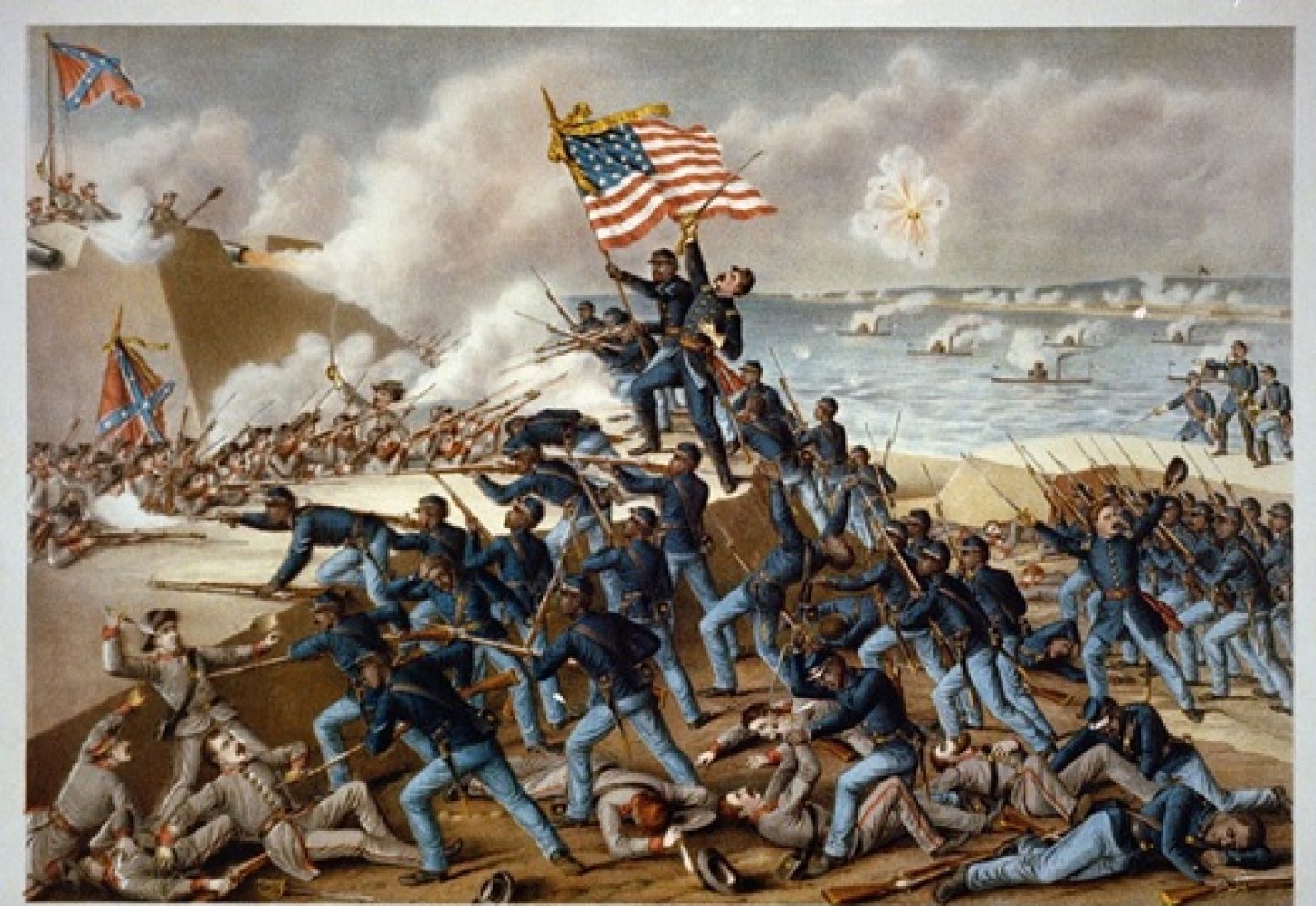

Maria Lewis was born in Albemarle County, Virginia, near Charlottsville around the year 1846. Unfortunately, historical records do not specify an exact town, or plantation. Lewis was one of the area’s prominent founding surnames. Explorer and historic figure Meriwether Lewis is a prime example. In 1860, however, African American Virginians made up over 54% of Albemarle County’s population. The Lewis surname was highly prevalent among both enslaved individuals and newly freed families.
At the age of seventeen, though, Maria Lewis “self-emancipated herself from slavery” by camouflaging herself as a “darkly tanned” white man. Maria adopted the name George W. Harris, perhaps after the character from Uncle Tom’s Cabin, who similarly escaped by passing himself for a dark-skinned Spanish man. Harris, himself, was an escaped slave from Kentucky whom many believed was the “real-life inspiration for George Harris, the wily runaway slave character in Harriet Beecher Stowe’s novel Uncle Tom’s Cabin.” Maria had originally planned to use her new identity to travel North to freedom. In October 1863, however, she determined she might enjoy the life of a soldier better and used her disguise to join company C of the 8th New York Cavalry.
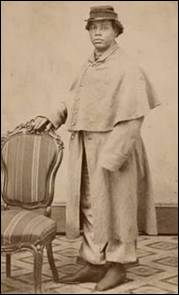
There are no Known photos of George W. Harris (aka Maria Lewis). Dressed in a Soldier’s Uniform though She may have Looked Something Like This.
The exact date in October of 1863 that Harris joined the 8th New York Cavalry is somewhat of a mystery. During most of the month of October the regiment was engaged in the Bristoe Campaign on the Rapidan River in Orange County, Virginia, which was some distance from the Shenandoah Valley. The 8th New York did, however, participate in an active reconnaissance and skirmish in the vicinity of Snicker’s Gap on October 27, 1863. This brought the regiment withing the boundaries of the Shenandoah Valley. Perhaps it was here that George Harris “jined the cavalry” as Jeb Stuart was fond of pronouncing.
What is most noteworthy is what she would have been involved in for the next nine months. The regiment was active in the Mine Run Campaign in late November and early December of 1863. Lieutenant Colonel William H. Benjamin took over command of the regiment in March 1864. At the time they were attached to 2nd Brigade, 3rd Division, of the Cavalry Corps, in the Army of the Potomac. As such Harris would have fought in the Overland Campaign, the Wilderness, Yellow Tavern, Cold Harbor, the Wilson-Kautz Raid, and at Ream’s Station, to mention just a few.
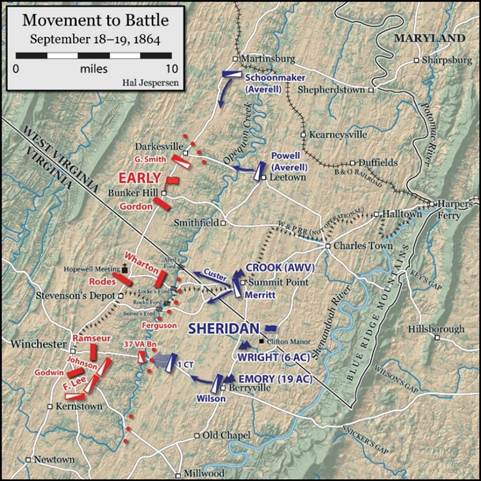
Shenandoah Valley Battlefield Map Prepared by Hal Jesperson.
The 8th New York was later attached to General George Chapman’s 2nd Brigade of James Wilson’s 3rd Division Cavalry Corps in the Army of the Shenandoah in August 1864. This New York regiment would be involved in several lesser engagements including Charlestown, Berryville, Locke’s Ford, and Snicker’s Gap. On September 19, 1864, however, Wilson’s Cavalry would spearhead the attack at the 3rd Battle of Winchester helping to secure Spout Spring Ford across Opequon Creek for Sheridan’s Army. They also would have assisted in clearing the Berryville Canyon for the VI Corps’ advance, pushing up the Berryville Pike to the gates of Winchester. Throughout the day, Wilson’s men would probe Confederate positions and cover the Union left flank.
Three days later, during the Battle of Fisher’s Hill, Union commander Philip Sheridan sent Major General Alfred Torbert with four cavalry brigades, including the divisions of Wilson and Wesley Merritt, through the Luray Valley. The horsemen would ride south, screened by Massanutten Mountain, aiming to reach New Market Gap. The cavalry intended to recross the mountain and block Confederate General Jubal Early’s retreat along the Valley Turnpike. Significantly outnumbered, Confederate cavalry checked this flanking force at Milford, or present day Overall. The mission failed to cut off the Rebel retreat.
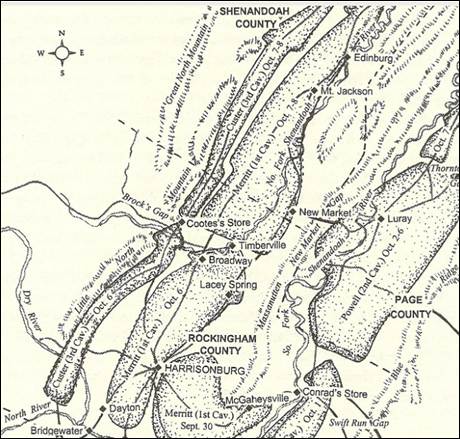
Movements of Sheridan’s Cavalry During the Burning of the Valley. George Harris would have Travelled along the Back Road with General Custer.
On September 30, George Armstrong Custer took command of Alfred Torbert’s 3rd Cavalry Division. The 8th New York was now part of Colonel William Well’s 2nd Brigade. During the burning of the Shenandoah Valley in October 1864, Custer’s Division operated along the Back Road from Bridgewater to Strasburg. The command of George Armstrong Custer systematically destroyed the region’s agricultural infrastructure and deprived the Confederate army of its primary food supply. Harris helped destroy more than two hundred farm buildings as well as dozens of flour and grist mills. Cavalrymen slaughtered thousands of sheep for rations and seized or drove away herds of cattle, horses, and hogs. They also confiscated or destroyed standing crops, fields of grain, and household provisions, including thousands of bushels of wheat, corn, and flour. A 70-mile long by 30-mile-wide swath of the Shenandoah Valley was turned into what residents called a “blackened wasteland.”
On October 9 Wells’s brigade and the rest of Custer’s division engaged General Thomas Rosser on the west side of the Tom’s Brook battlefield in the shadow of Little North Mountain. When the Rebel line broke two of Custer’s brigades, including Well’s, pursued the retreating Confederates for nearly 20 miles south to Mount Jackson. This rout would famously be known as the “Woodstock Races.”
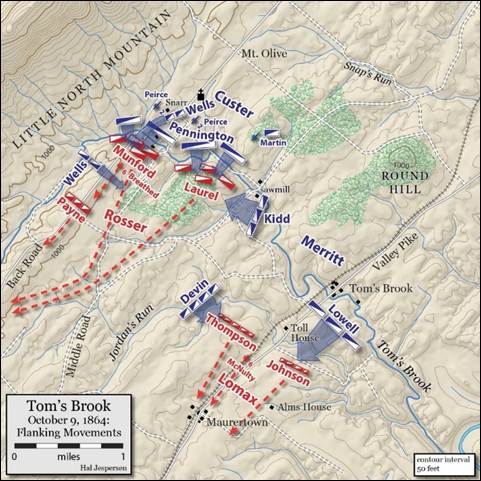
Map of the Battle of Tom’s Brook (Map Prepared by Hal Jesperson for the SVBF).
On October 19, 1864, following the surprise morning attack by Confederate Lieutenant General Jubal Early at the Battle of Cedar Creek, Wells and his cavalry brigade helped rally and spearhead the afternoon counterattack led by Major General Philip Sheridan. Wells’s brigade played a considerable role in routing the Confederate army, capturing 45 out of the 48 Confederate artillery pieces lost by Early’s retreating forces as well as dozens of Rebel infantrymen. For his gallantry and leadership during the valley campaigns, including Cedar Creek, Wells would be promoted to brigadier general.
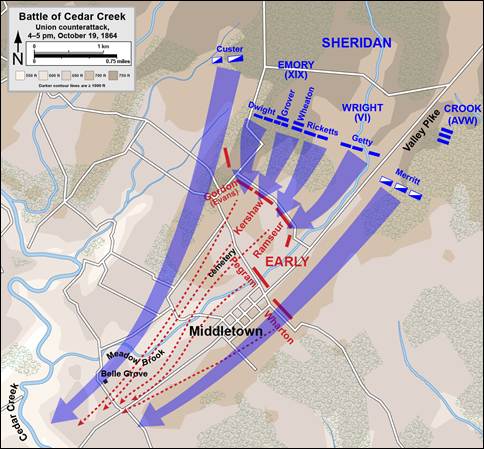
Map of Sheridan’s Counterattack by Hal Jespersen (www.cwmaps.com).
During a freezing winter expedition in December of 1864, Union Brigadier General George Armstrong Custer and his cavalry division were surprised and defeated by his former West Point classmate, Confederate Brigadier General Thomas L. Rosser, at Lacey Spring. It is rumored that Custer narrowly escaped capture by donning a captured confederate uniform captured from General Rosser at the Battle of Tom’s Brook. The engagement forced Custer to abandon his mission and retreat north, concluding all military operations in the Shenandoah Valley for the winter.
On February 27, 1865, however, General Sheridan decided to shift his army from Winchester, south, with the intention of joining General Grant at Petersburg. It was Sheridan’s goal to destroy the Virginia Central Railroad as well as the James River Canal. Opposing him were the remnants of the Army of the Valley District under General Jubal Early.
On March 2nd, with Union Cavalry leading the van of the army, General George Custer encountered videttes from Early’s Confederate forces at Fisherville. Custer quickly dispersed this contingent pushing them back into Waynesboro. Here General Early had determined he would make his stand.
General Early had chosen his defensive position poorly. Early had stationed his men atop a low ridge just west of Waynesboro. Earthworks had been constructed which would shield his entire front. “Brigadier General Gabriel C. Wharton had remnants of infantry consolidated into a small division-strength force. On his extreme right, he positioned the three guns of Kirkpatrick’s Amherst Artillery; on his right-center he placed one of his infantry brigades. In his center Early posted his small cavalry force and another infantry force to their left. Milledge’s Georgia Regular Battery and Snead’s Fluvanna Artillery are to the left of them with a small infantry brigade on the left butting up against a forested area.”
Custer pushed on into Waynesboro and ordered an immediate assault without waiting for a reconnaissance of the enemy position. He sent three regiments into the woods on the Confederate left flank. His other two brigade’s faced off directly opposite General Early’s main battle line. An artillery duel began shortly after Custer’s men arrived on the town’s outskirts at about 2:00 pm. Custer sent Colonel Willaim Wells’ Second Brigade forward to probe the enemy position, which was promptly discovered to be relatively strong.” Shortly thereafter, Custer learned of a gap between the Confederate left flank and the South River. He ordered General Alexander Pennington’s dismounted cavalry, which included the 2nd Ohio and the 3rd New Jersey, to attack the undefended left of the Confederate line.
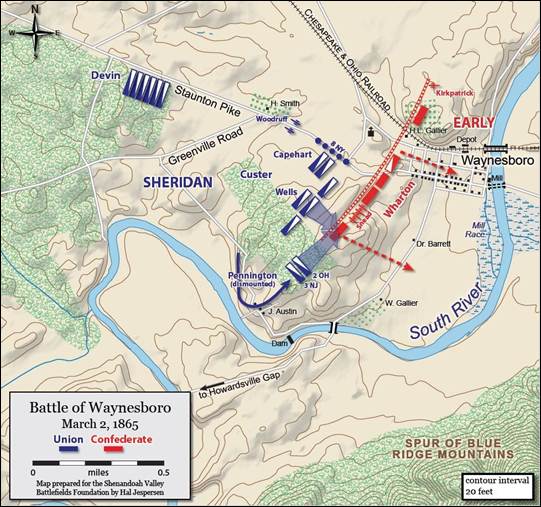
Map of the Battle of Waynesboro (Courtesy SVBF Map by Hal Jesperson)
At 3:30 pm, the signal to attack was given. “A section of Custer’s horse artillery rolled into action and engaged the attention of the Confederates. Minutes later, Pennington’s flanking force, led by the 2nd Ohio, dismounted, and armed with Spencer Carbines, rushed out of the woods and rolled up the startled Confederates’ left flank. Just as the Confederates were reforming to face this new threat, Wells’ and Capehart’s brigades rushed the Confederate center. In a matter of minutes, Early’s army was thrown into panic.”
“It was a battle where the Eighth New York Cavalry, under the gallant leadership of Major Hartwell B. Compson, earned undying fame. The major himself performed wonderful feats of bravery and set an example which electrified his men and inspired them to deeds of splendid heroism. At the head of his troops who were selected to make the attack, he charged down the highway into Waynesboro. The enemy had five pieces of artillery in the roadway and had thrown up earthworks on each side of the road; behind these breastworks infantry was posted. He was at the head of his command with a color-bearer on one side and a bugler on the other, when they struck the Confederate forces and a hand-to-hand fight took place.”
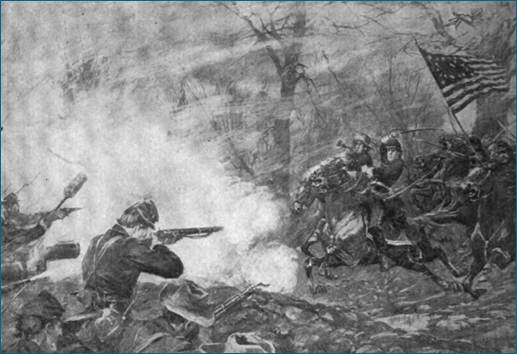
“With a Color Bearer on One Side and a Bugler on the Other.” The Charge of the 8th New York Cavalry at the Battle of Waynesboro.
Regarding the capture of Early’s headquarters flag one 8th New York cavalryman remembered: “Coming upon Early’s headquarters battle-flag he ordered the bearer to surrender. A fierce fight at close quarters ensued and finally a heavy blow with the sabre knocked his opponent from his horse and the flag was captured.”
Jubal Early and his forces were stunned by the weight of the attack. The Confederate line broke and was completely routed. In the fighting that ensued more than 1800 men were captured, along with 200 wagons, 14 artillery pieces, and 17 Confederate battle flags. While Jubal Early was able to escape, his small army was destroyed. General Sheridan’s victory was complete. Jedediah Hotchkiss would call this battle “one of the most terrible panics and stampedes I have ever seen.”
Custer’s men pursued the routed Confederates for several miles before darkness brought an end to their chase. Union officers would claim the capture of 16 stands of colors including a recaptured Union flag. Despite Early’s admonishment, evidence suggests that Union claims were very close to the truth. Regardless of the exact figures, all sources agree that General Early lost all his artillery, and wagons and his infantry was too shattered to form an effective fighting force for the remainder of the war.
The following week, the cavalrymen who had captured battle flags at Waynesboro were sent to Washington, D.C. On March 19, 1865, they were allowed to present their battle trophies to Secretary of War Edward Stanton. “Selected by General Philip Sheridan, Custer led a procession of cavalrymen from the 3rd Cavalry Division directly into the Secretary of War’s chambers. Custer’s wife, Libbie Custer, also attended the ceremony.” Lewis, having distinguished herself amongst her fellow soldiers in the fighting, was appointed as a member of the honor guard assigned to present the captured rebel flags.
Union soldiers bestowed the captured enemy flags to the Secretary of War. “The notoriously stern Secretary Edwin Stanton was delighted by the display. He praised Custer as a ‘gallant officer’ and formally thanked the soldiers on behalf of the President and the American people.” The collection included General Jubal Early’s own headquarters flag, which was seized during the chaotic Confederate retreat. It was the largest quantity of battle flags ever captured in a single engagement during the entire war. The troopers also returned a recaptured Union flag belonging to General George Crook’s Corps, which had been lost at the Battle of Cedar Creek. For their bravery in capturing these battle colors, fifteen Union troopers were awarded the Congressional Medal of Honor. Among these men was Private George Pforr (alias Charles W. Anderson) who is recorded as the only enemy deserter ever to receive the Medal of Honor. In addition to the nation’s highest military decoration, Secretary Stanton also granted each of the flag captors a highly coveted 30-day furlough.
Following the war, George Harris left the cavalry and traveled to the family of 2nd Lieutenant Lewis V. Griffin, a comrade of hers from the 8th New York regiment. She identified herself still as George Harris to his sister, Julia Wilbur. She later confessed her identity and expressed the desire to return to “womanly ways & occupations.” Though surprised to meet a black woman who had served as a Union cavalry soldier, Julia wrote in her diary that she “helped Maria as she had helped many other freed slaves. Making plans to find her a job, Julia gave her a chemise, petticoat, and hoops.” The family found a place for her to work, and she later received “lessons from Julia’s sister, Frances, presumably learning to read and write, which had been barred to enslaved people prior to the civil war.”
Julia Wilbur first wrote about meeting Maria on April 4, 1865. The last time she mentions her in her diary is on Sunday, April 23rd of the same year. Little is known about Maria’s life after the war. Still, Maria stood out among her fellow soldiers displaying great courage or she would not have been chosen to escort Union cavalrymen and their captured flags to Washington.
The exact number of women who disguised themselves as men to serve specifically in the Union cavalry is unknown. An exact count is impossible to determine because women hid their identities. Still research indicates several hundred women fought for the Union. Hasty recruitment, and inconsistent medical examinations allowed numerous women to maintain their ruses for months and in this case for more than a year and a half. The number of escaped female slaves who served, however, might easily be reduced to just one. George Harris (AKA Maria Lewis) is the only documented case of a black female soldier who served, undetected, in the American Civil War while disguised as a man. Maria’s accomplishments during the war are remarkable and, quite probably, without precedent. She deserves to be remembered as a woman who fought against the institution that had denied not only Maria but millions of others their freedom.
Sources and recommended reading.
Duffield, Henry M. Deeds of Valor: How American Heroes Won the Medal of Honor. The Perrien – Keydel Company. Detroit. 1907.
Hotchkiss, Jedediah. Make Me a Map of the Valley. The Civil War Journal of Stonewall Jackson’s Topographer. Texas A&M University Press. College Station, Tx.1973.
Tarnapol, Paula. A Civil Life in an Uncivil Time: Julia Wilbur’s Struggle for Purpose. Potomac Books. 2017.
Norton, Henry. Deeds of Daring: History of the Eighth New York Volunteer Cavalry. Hansebooks. Norderstedt, Germany. 2019.
(https://en.wikipedia.org/wiki/Battle_of_Waynesboro,_Virginia.)
(https://shenandoahcivilwarhistory.blog/2019/11/06/battling-along-the-back-road/)
(https://shenandoahcivilwarhistory.blog/2020/09/09/the-battle-at-lacey-spring/)

