
Percy Wyndham was born in England on September 22, 1833, on board a ship called the Arab in the Downs near the town of Deal. Not much is known of his early life, but he reputedly began his military career at the age of fifteen, fighting in the Students’ Corps during the French Revolution of 1848. In July of that same year, he transferred into the French Navy as a marine ensign. The term ensign refers to the lowest rank among commissioned officers, equivalent to a second lieutenant. A fifteen-year-old serving in this capacity would have been very unusual. Regardless, his stay in the navy was brief and he soon shifted to the British Royal Artillery serving there for less than two years. The next six years were consumed functioning as a cavalry officer in the Austrian Army’s 8th Lancers Uhlans Regiment.
In 1860 Wyndham traveled to Italy and served under Giuseppe Garibaldi during the Second War of Italian Independence. Wyndham fought with Garibaldi in the battles of Palermo, Nuloggo, Rager, and Capua. One must assume he served with distinction as he was soon promoted to lieutenant-colonel and given command of a brigade. Shortly thereafter King Victor Emmanuel would honor him with knighthood in the Military Order of Savoy. The Order of Savoy was a celebrated military order established in 1815 by King Victor Emmanuel I and awarded by the Kingdom of Sardinia to recognize acts of bravery in battle.

Colonel Sir Percy Wyndham
Now Sir Percy Wyndham, he continued to command his Italian brigade until October 8, 1861. Following the outbreak of the American Civil War, he was given leave to offer his services to the Union Army. “As the demand for military experience was greater than the supply in the early years of the war finding a command was not difficult.” It was often noted “if one were remotely knowledgeable, and made the right connections, whether the resume was padded a little was not considered.”
Former Congressman William Halstead had raised the 1st New Jersey Cavalry in August of 1861 and was appointed the regiment’s first commander. The sixty-seven-year-old Halstead would remain in command of the unit until February 18, 1862, when he was discharged due to an “adverse report of a Board of Examination.” Major General George B. McClellan, who was familiar with Percy Wyndham’s reputation as a fighter, recommended to the governor of New Jersey, Charles Smith Olden, that he be appointed to the command of the regiment.
Although the governor of New Jersey issued the commission to Wyndham as colonel of the regiment in February 1862, not everyone welcomed the Englishman with open arms. A community newspaper questioned, “Have we no material in New Jersey out of which to manufacture competent colonels without resorting to foreigners to fill up the list?” Despite these doubts McClellan was able to convince the governor of New Jersey “that he was the man of the hour” and he was given command the 1st New Jersey Cavalry.
Wyndham’s popularity was not widespread even with the men in his command. One of his fellow New Jersey cavalrymen voiced the opinion, “This officer was an Englishman, an alleged lord. But lord or son of a lord, his capacity as a cavalry officer was not great. He had been entrusted with one or two independent commands and was regarded as a dashing officer… He seemed bent on killing as many horses as possible, not to mention the men.”
Wyndham’s regiment would spend the spring of 1862 in the defenses of Washington, D.C. By May of 1862, however, Wyndham and the 1st New Jersey Cavalry were assigned to General George D. Bayard’s cavalry brigade in General Irvin McDowell’s Department of the Rappahannock. The 1st New Jersey, and 1st Pennsylvania Cavalry, along with the 13th Pennsylvania Reserve Regiment, or Bucktails, were then temporarily allocated to General John Fremont’s command on May 30, 1862, near the town of Strasburg, Virginia.
The regiment’s first fight occurred on June 2nd when the regiment ran up against the rear guard of Stonewall Jackson’s Army just north of Woodstock. The attack was vigorous and supported by two sections of guns from the 2nd Maine Battery commanded by Corporal James Hall. A last-minute defense mounted by General Turner Ashby with a ragtag collection of infantry, cavalry, and artillery managed to hold the line and repel the Union attack. Though beaten, the 1st New Jersey had seen the elephant and experienced their first combat action.
The chase was on, and Wyndham was hot on the trail of General Turner Ashby. On the afternoon of June 6, Wyndham and a detachment of the 1st New Jersey Cavalry were acting as the vanguard of General John Fremont’s army as they approached Harrisonburg and turned east along the Port Republic Road. Everyone was aware General Stonewall Jackson’s Army was close at hand.
Wyndham’s target, General Turner Ashby Jr., was an interesting character as well. Ashby was a native Virginian born at Rose Bank Plantation near Markham on October 28, 1828. An accomplished horseman at an early age, Ashby often participated in tournaments winning many awards and accolades. Henry Kyd Douglas, a staff officer serving under Stonewall Jackson, described him fittingly. “Riding his black stallion, he looked like a knight of the olden time, galloping over the field on his favorite war horse. Ashby augmented his style with a battle costume that included spyglass, gauntlets, and fox-hunting horn —all the accoutrements of a Virginia-born gentleman.”
As captain of a volunteer cavalry troop, the Mountain Rangers, Ashby had led his men to Harpers Ferry in the aftermath of John Brown’s raid. He and his militiamen would also perform guard duty at Charles Town during Brown’s trial and execution. Two years later, he returned to Harpers Ferry, this time leading a force of Virginians launching a surprise attack on the federal arsenal there. Such was his popularity in the lower Shenandoah Valley that by June of 1861 he was commissioned as the lieutenant colonel of the 7th Virginia Cavalry and mustered into Confederate service.
With the outbreak of the Civil War, Ashby and his troopers were assigned to the command of General Thomas Jackson. Although Jackson owed much to Ashby’s able reconnaissance and screening, he was often criticized by Jackson for the poor training and discipline of his men. Jackson had attempted to address these issues at one point by stripping Ashby of his cavalry command and assigning them to infantry brigades. Ashby was deeply offended by this demotion and threatened to resign in protest. Faced with the potential loss of his cavalry and a possible mutiny, Jackson backed down and reinstated Ashby to command. Still, despite all the controversy and his perceived shortcomings, on the afternoon of June 6, 1862, General Turner Ashby found himself positioned near Good’s Farm on the Port Republic Road commanding the rear guard of Stonewall Jackson’s retreating army.
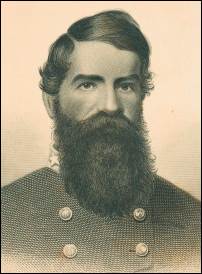
General Turner Ashby
Wyndham’s 1st New Jersey Cavalry Regiment had trotted into Harrisonburg about three p.m. on that hot June day led by Lieutenant Colonel Virgil Broderick. The command turned east along the Port Republic Road and as they did, they spotted a few of Ashby’s cavalrymen who had seemingly become detached from their unit. Ashby’s men had ensconced themselves behind a stonewall on both sides of the road. “Seeing that the force was too great for him to charge, he wheeled and retired.”
Returning to Harrisonburg, Broderick was soon joined by Colonel Wyndham and reinforced by members of his own regiment as well as companies from the 4th New York, 1st Pennsylvania, and 6th Ohio. In total his command numbered a little more than four hundred men. General Bayard, however, had specifically ordered Wyndham to do no more than “deploy pickets and vedettes.” Reports that a squadron of Ashby’s cavalry was resting their horses just a half a mile outside of town, however, proved overly tempting to the colonel even though his orders forbid him from engaging the enemy. When informed by one of his scouts there were only “forty of fifty rebel troopers and infantry who were too tired to run or fight,” Wyndham ignored his instructions and ordered his command forward asserting, “We’ll have a little fun then.”
Colonel Percy Wyndham’s blood was up, believing his clash with General Stonewall Jackson’s cavalry commander, Brigadier General Turner Ashby, was imminent. Wyndham had sworn, publicly, that he intended to “bag him” and he believed this was the day he would do it. New York Times Reporter Charles Webb was riding with the Union Cavalry as they advanced along the Port Republic Road. As they galloped forward Webb determined “the whole thing began to look so much like a trap that I couldn’t make up my mind to enter it.” Undeterred, Wyndham’s “impulsive bravery led him on.”
Turner Ashby, on the other hand, had seized this moment to dismount his cavalry command, giving his men and their horses a well-deserved breather. Their mounts had become appreciably worn by Stonewall Jackson’s ongoing valley campaign and were in need a momentary respite. Ashby had drawn his men up along a ridge loaded with chestnut trees. With him were elements of the 1st Maryland Infantry and the 6th, and 7th Virginia Cavalry.
In column of fours Wyndham ordered “his force forward with drawn sabres, all of them wild with the excitement of the race. As providence would have it, though, it was at this very moment when Colonel Wyndham spotted his opponent. A small body of rebel cavalry was identified “drawn up across the road.” Wyndham yelled “Form platoons.” “Catching, with moistened hand, a firmer grip on his sabre,” Wyndham was ready “to pluck the budding honors on his crest to weave them on his own.”
General Ashby’s command responded quickly to their predicament, remounting their horses, and preparing to repel the Union assault. Ashby ordered Major Oliver Funsten to make ready, and as he rode past him yelled: “Follow me.”
Ahead of Ashby and Major Funsten, however, rode Captain Edward H. McDonald. Leading a small detachment of the 7th Virginia Cavalry, he too had spotted Federal troopers as they assembled on the hill opposite them. McDonald knew he must act quickly and had done so. He hastily instructed his men to remount and charge the Federal Cavalry.
The Rebel response to the order was quick in coming. Captain McDonald, racing down Chestnut Ridge, recalled “as we approached them in our charge they began to break away from their line and ran.” Only their commander, Colonel Percy Wyndham, and a few of his men had reacted decorously to the command to charge. While his men were still forming into line Wyndham yelled “Gallop! Charge!” and down the slope Colonel Wyndham rode, all by himself.
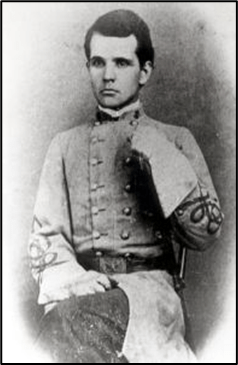
Private Holmes Conrad
Private Holmes Conrad remembered: “After proceeding about a hundred yards I discovered that the Federal officer [Wyndham] was continuing his advance at a rapid gait but entirely alone; his command remained where I had seen it from the top of the ridge. Then too I discovered for the first time that none of those who had been with me on the summit of the ridge had attended me in my charge.” The two men were racing toward each other, unsupported.
According to Conrad: “The sun was shining full on the advancing officer whose sabre, which he handled with a master’s hand, shown like a circle of light. We each approached the narrow ravine between our respective ridges…. A sunken rail fence about 3 rails high in the bottom of the ravine was between us…. When each of us was about 8 or 10 feet from this place…. I dropped my sabre from my hand and let it hang from the sword knot on my wrist and drawing my pistol held it down by my side. The officer had reached the fence which he for the first time saw and halted.”
“The fore legs of his horse were over it. His sabre was held with the point down. He was peering over the horse’s head down at the fence which had impeded him. I gathered rein tightly in my left hand, stuck both spurs into my horse and in a moment had the muzzle of my pistol against the side of the big red nose of the fiercest looking cavalryman I ever confronted. He had an enormous tawny moustache that reached nearly to his ears; large eyes of the deepest blue and these were fastened upon me with a clear, strong gaze without the lease indication of fear.”
“Unwilling to betray my own nervousness by a faltering voice I was content to return his stare for a minute in silence and then said to him ‘Drop your saber!’ I did not tell him to ‘return.’ I was unwilling that the point of that formidable blade should be removed, even for a second from its earthward direction. He did not instantly obey. I said: ‘If you don’t drop it I’ll shoot.’ He dropped it. I told him then to unbuckle his sabre belt and hand it to me. He did so. I buckled it around me with scabbard and pistol that were on it. I ordered him to dismount which he did and to hand me his sabre which I returned to its scabbard. I then took him back up the hill, he holding to my stirrup leather….”
J.R. Crawford, who was a witness to the event, noted: “Maj. Holmes Conrad, of Gen. Ashby’s staff, rode swiftly, and demanded his surrender; but Sir Percy at first defiantly twirled his sword as though he were ready for combat. But Major Conrad rode close to him, with his pistol ready to pull the trigger, and Wyndham, seeing that Conrad had the ‘drop’ on him, said, ‘I am your prisoner,’ and handed Conrad his handsome sword which Garibaldi had given him. Major Conrad holds that sword as evidence that he alone captured Col. Wyndham….”
The Englishman who had boasted he would “bag” Ashby, failed to achieve his crowed threat. In addition, twenty-three New Jersey cavalrymen as well as their regimental colors had been captured. The turnabout would cause a considerable stir on both sides. Major Roberdeau Wheat of the Louisiana Tigers, upon spotting Wyndham, embraced the embarrassed captive, exclaiming, “Percy, old boy!” The two of them knew each other, having served together under Garibaldi in Italy.
In the years since the war several men would claim credit for the capture of Percy Wyndham. Some would say Turner Ashby had accomplished the feat himself. Jacob Crisman, a Frederick County farmer and veteran of Ashby’s cavalry, would claim credit for the feat as well. Still, the most accepted account of the event was that of private Conrad.
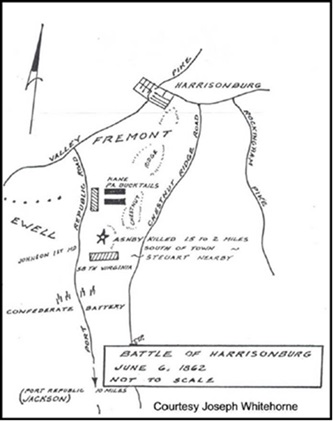
Map of the Battle of Good’s Farm or Chestnut Ridge
In the fighting that would take place later that day, a battle variously named the Battle of Harrisonburg, Chestnut Ridge, and Good’s Farm, the combat would prove costly for the Confederacy. Though the skirmish would be a victory for the Confederates, Turner Ashby would have his horse shot out from under him while resisting an attack by a detachment of Pennsylvania Bucktails. Back on his feet he was immediately struck by a bullet and killed. Jedediah Hotchkiss believed he may even have been the victim of friendly fire.
Ashby’s body was quickly removed from the battlefield and his corpse was draped across a horse in front of one of his cavalrymen. The men accompanying the body were observed “crying… like children.” The soldiers placed his body in the front parlor of the Frank Kemper House, which is the Museum currently operated by the Shenandoah Valley Battlefields Foundation. Ladies from the town prepared his body for burial. One of the women placed a rose over the spot where the bullet had entered his body.
A brief funeral service was held at the Kemper house. General Jackson would, afterwards, enter the room to pay his final respects. According to the Reverend Major Robert Dabney, Jackson “remained for a time in silent communication with the dead, and then left him, with a solemn and elevated countenance.” Ashby’s body would be transferred by ambulance for burial in Charlottesville. After the war it would be moved and interred at the Confederate Cemetery in Winchester.
Following the battle Colonel Percy Wyndham was mounted on a horse and escorted to Port Republic. His ride must have been mortifying for instead of “bagging Ashby” he himself had been bagged. After crossing the bridge over the North River, he and his escort were redirected to Jackson’s headquarters at Madison Hall. Jackson would intercept the Englishman enroute at the Lee Hotel on Main Street. Stonewall would inquire of him why “he had come to fight Confederates when most Englishmen were pro-Southern.” Wyndham replied that General Ashby “had become so famous he had joined the Union Army with the intention of capturing or killing him.”
Colonel Wyndham, described as “handsome, dashing, with luxuriant mustache, and a natty uniform,” “voiced his loud disgust” as he was transferred to Jackson’s headquarters at Madison Hall. Bleeding from a minor head wound, he gave his parole and was given the honor of sleeping on a hardwood floor during his brief stay at Port Republic. Shortly thereafter he was transferred to Libby Prison in Richmond. His time in Confederate hands would be brief as he was exchanged shortly after his capture on August 17. It is said that his temperament and discourse was so irritating to Confederate guards and authorities that they were anxious to have rid him.
Following the swap, Wyndham returned to the 1st New Jersey Cavalry where he would lead his regiment at the Battle of Thoroughfare Gap in August 1862. At 9:30 a.m. Wyndham’s troopers encountered Longstreet’s vanguard while attempting to fell trees across the road on the east side of the gap. Though Wyndham dispatched a courier for reinforcements he was forced to meet the Confederate advance alone. Outnumbered and outflanked Wyndham was soon driven from the ravine. As a result, Longstreet’s Corps was allowed to join Jackson at the 2nd Battle of Manassas.
Later that year Wyndham was promoted to brigade command, which included his own 1st New Jersey, the 12th Illinois, 1st Pennsylvania, and the 1st Maryland Cavalry. In early 1863, while his brigade was headquartered at Fairfax Court House, Wyndham was given the task of running down John S. Mosby’s guerrillas. Wyndham had publicly insulted Mosby by referring to the Confederate partisan’s men as “a pack of horse thieves.”
The accusation incensed the Confederate cavalryman. In retribution, Mosby decided a personal response was in order. When a deserter from the 5th New York Cavalry disclosed the location of Wyndham’s headquarters, Mosby decided he would launch a raid on the town and capture Wyndham.
In the early morning hours of March 9, 1863, Lieutenant John Singleton Mosby led 29 Confederate rangers east along the Little River Turnpike in northern Virginia, quietly passing through a gap in the Union lines and soon arriving at Fairfax Courthouse. Mosby entered the heavily guarded town a little after 2 a.m. in order capture Wyndham. Unfortunately, Wyndham had gone into Washington for the evening and was spared the humiliation of being apprehended for a second time. Still, Mosby was able to capture the slumbering Brigadier General Edwin Stoughton, several infantrymen, and a large quantity of horses.
On June 9, 1863, while serving as the 2nd Brigade commander under General David Gregg, Wyndham led a charge on the Confederate right flank on Fleetwood Hill at the Battle of Brandy Station. During the heavy fighting that ensued he suffered a serious leg wound. During his recovery, he was reassigned to duty in Washington, D.C., and he never again returned his brigade.
Subsequently, Wyndham’s application for promotion to Brigadier General was denied even though Major-General Joseph Hooker praised him greatly. Hooker had said of him “I found him capable, prompt, and efficient… and with an enemy in his front, enterprising and brave”. The rejection occurred following a fellow officer’s accusation “of disloyalty and of considering transferring to the Confederate Army.” Though Wyndham would continue to draw his army pay for some time, he officially retired from Federal service on July 5, 1864.
Wyndham would take part in several ventures following the Civil War. He relocated to Calcutta, India, and later to Rangoon, Burma. On February 3, 1879, his obituary appeared in the London Times. In part it read: “News of a sad accident comes from Rangoon. Colonel Percy Wyndham, a gentleman well known in Calcutta and Rangoon, announced an ascent in a balloon of his own construction. After attaining a height of about 500 feet the balloon burst, and the unfortunate aeronaut fell into the Royal Lake, whence he was extricated quite dead.” He was buried in Cockermouth Cemetery, in Allerdale Borough, Cumbria, England.
Holmes Conrad would also survive the war. In 1865 he began the study of law in his father’s office in Winchester, and on his admission to the Virginia bar in January 1866, joined his father’s practice. In 1878, he was elected to the Virginia legislature, serving until 1882. Over the next few years, he became a prominent member of the Virginia bar and acquired an influential position in the Democratic Party. In 1893 President Grover Cleveland appointed him Assistant Attorney General of the United States, and in 1895 he became Solicitor General. Following his death in 1915, he was buried in Mt. Hebron Cemetery in Winchester, Virginia.
Sources:
Cozzens, Peter. Shenandoah 1862: Stonewall Jackson’s Valley Campaign. University of North Carolina, Chapel Hill. 2008.
Hotchkiss, Jedediah. Make me a Map of the Valley: The Civil War Journal of Stonewall Jackson’s Topographer. Southern Methodist University Press. 1973.
Krick, Robert. Conquering the Valley; Stonewall Jackson at Port Republic. William Morrow and Company, Inc. New York. 1996.
Pyne, Henry. The history of the First New Jersey Cavalry, (Sixteenth Regiment, New Jersey Volunteers). Public Domain. 2018.
Robertson, James I. Stonewall Jackson: The Man, the Soldier, the Legend. MacMillan Publishing. New York. 1997.
Sherwood, W Cullen and Ritter, Ben. Americas Civil War. November 2006.
Wert, Jeffry. Mosby’s Rangers: The True Adventures of the Most Famous Command of the Civil War. Simon and Schuster Paperbacks. New York. 1990.
Winchester Evening Star. Edward H. McDonald. May 1904
Col. Sir Percy Wyndham
https://en.wikipedia.org/wiki/Percy_Wyndham_(soldier)
 Shenandoah Valley's Civil War History