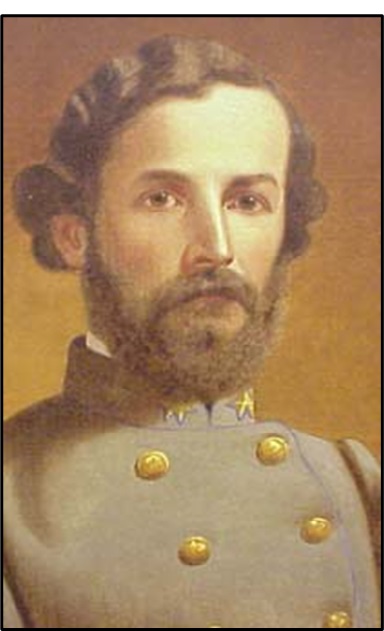
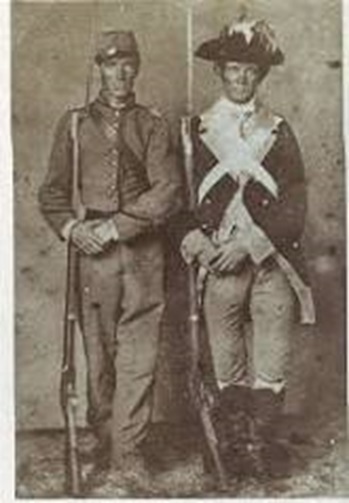
George Pforr Vs. Charles W. Anderson

In early February 1863, a young Maryland native named George Pforr, journeyed from Baltimore, Maryland to his sister’s home in Staunton, Virginia. Professing Confederate sympathies, George felt drawn to support the Southern war effort. It is here that he meets Captain John H. McClanahan and decides to join a newly formed artillery battery which had been christened McClanahan’s Mounted Artillery. The unit is promptly assigned to support the 62nd Regiment of Mounted Rifles, and General John Imboden’s independent cavalry command in the Shenandoah Valley.

Pforr would participate in the famed Jones-Imboden Raid into West Virginia in April and May 1863. Raiders claimed success as they severely damaged several railroad bridges, an oil field, and destroyed other critical Union infrastructure. Attackers also captured valuable supplies. General Jones estimated that about 30 of the enemy were killed and some 700 prisoners were taken. Four hundred new recruits were added to their ranks, as well as an artillery piece, 1,000 head of cattle, and some 1,200 horses. From a political standpoint, however, the raid failed, for it had no effect on pro-statehood sentiment. West Virginia was admitted into the Union as the 35th state the following month.

During the Gettysburg Campaign, Imboden’s brigade served under Major General J.E.B. Stuart guarding the left flank for General Robert E. Lee’s Army during his drive north through the Shenandoah Valley. Though his brigade did not participate in Stuart’s foray around the Union Army, it instead raided the Baltimore and Ohio Railroad between Martinsburg, West Virginia, and Cumberland, Maryland.

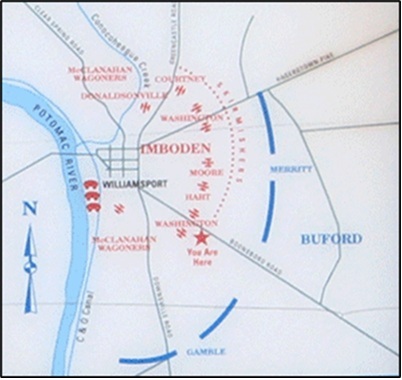
During the Battle of Gettysburg, General Imboden’s men remained in the rear guarding ammunition and supply trains. Throughout the Confederate retreat, though, Imboden was ordered to escort the army’s wagon trains, containing thousands of wounded soldiers, back to Virginia. On July 6, 1863, with the Potomac in flood, he found himself trapped with his wagon train at Williamsport, Maryland. Imboden hastily put together an effective fighting force which included McClanahan’s Artillery Battery, and those wounded soldiers who could still manage a musket. This hurriedly organized force turned back several attacks from Union cavalry details under both Generals John Buford, and Judson Kilpatrick. Imboden’s efforts saved the wagon train and thousands of wounded soldiers from capture. Robert E. Lee would praise him for the way in which he “gallantly repulsed” these attacks.

Imboden’s Defense of the Wagon Trains at Williamsport (Civil War Trails Map)

General Imboden returned safely to the Shenandoah Valley, bringing thousands of Union prisoners and Confederate wounded with him. The general would continue to fight in the Shenandoah Valley serving as a major distraction to General Mead’s Army in eastern Virginia. George Pforr, and McClanahan’s Battery, would minister admirably to this cause.

In turn, on February 27, 1864, Charles W. Anderson, during one of the most severe cold spells to ever hit the Shenandoah Valley, rode to Kernstown and into the camp of the 1st New York Cavalry, also known as the Lincoln Cavalry. “The slightly built man reins his horse up in front of the regimental headquarters tent. To the soldiers idling in front of the tent he says he wants to enlist.” Though the regiment has its origin in New York City the unit has “members from throughout the Union, with one company from Pennsylvania, and another from Michigan. The regiment had been in the field continually since early 1861, and it was not uncommon for civilians to walk up and offer to join the regiment.

The regiment’s Sergeant Major greets Charles. With the weakened state of the cavalry regiment, all the companies in the unit desperately need replacements. Here was “a healthy-appearing young man who even has his own mount.” Charles claimed that he was born in New Orleans on March 15, 1841. He is 5’ 7” with grey eyes and black hair. “He says he is a local farmer who has stayed out of the war until Rebels foraged through his land, stealing crops and livestock. Now he wants revenge.”

The sergeant Major was initially suspicious of the recruit. “It is obvious the man’s hair is dyed and he doesn’t sound like he is from Louisiana. Still, he extends his hand and says, ‘Welcome to the 1st New York.’” Sign on the dotted line my friend. Charles Anderson is quickly registered and assigned to Captain Edwin F. Savocool’s Company K.

For the next year Private Anderson and his 1st New York Cavalry spar with Confederates up and down the Shenandoah Valley. “Anderson proves himself a competent, able soldier. Not foolhardy, he none the less pushed boldly forward while others hold back. He quickly develops a well-deserved reputation for coolness under fire.”

May 13, 1864, Cavalry Clash at New Market. (Peter Dalton)

On May 13, 1864, Private Anderson and his comrades experience a disastrous encounter at New Market. Among the Confederate units on the field is McClanahan’s Battery. The confrontation with Colonel William Boyd’s New Yorker’s is ruinous, and losses are significant. “The wonder was that the whole of Boyd’s command was not captured. Hemmed in between mountain and river, with superior forces on all sides, it was individual determination that saved those that escaped.” Colonel Boyd lost more than 125 men. The majority of these were captured. Most of the rest were left hiding on the slopes of Massanutten Mountain. Nearly 200 horses were secured, all of which would serve as much needed replacements for worn Confederate mounts. Charles Anderson was fortunate to escape.

The fighting was virtually constant throughout the remainder of 1864. During the 3rd Battle of Winchester Charles fought in General William Averell’s Division and was part of the largest Cavalry charge of the Civil War. During the burning of the Valley, he helped destroy farms in the Page Valley from Port Republic to Front Royal. He was also present for the last major battle in the Shenandoah Valley at Cedar Creek.

On February 27, 1865, however, General Philip Sheridan decided to shift his army from Winchester, south, with the intention of joining General Grant at Petersburg. It was Sheridan’s goal to destroy the Virginia Central Railroad as well as the James River Canal system. Opposing him were the remnants of the Army of the Valley District under General Jubal Early.

On March 2nd, with Union Cavalry leading the advance of the army, General George Custer collided with videttes from Early’s Confederate forces near Fishersville. Custer quickly dispersed this contingent and pushed them back into Waynesboro where General Early determined he would make his stand.

General Early had chosen his defensive position badly. General George Custer quickly pushes into Waynesboro and orders an immediate assault without waiting for a reconnaissance of the enemy position. Custer sends three regiments, including the 1st New York, into the woods on the Confederate left flank. His other two brigade’s faceoff directly opposite General Early’s main battle line.

At 3:30 pm, the signal to attack was given. “A section of Custer’s horse artillery rolled into action and engaged the attention of the Confederates. Minutes later, Pennington’s flanking force, led by the 2nd Ohio, dismounted, and armed with Spencer Carbines, rushed out of the woods and rolled up the startled Confederates’ left flank.” “Just as the Confederates were reforming to face this new threat, Wells’ and Capehart’s brigades rushed the Confederate center. In a matter of minutes, Early’s army was thrown into panic.”

Modified Hotchkiss Map of the Battle of Waynesboro

Among the men charging in on the Confederate left flank is Private Charles Anderson. “Riding hard through the rain-soaked timber Anderson spurs his horse onward. He bears down on a Rebel color guard, gives a yell, and fires his revolver into the air. Anderson grabs the enemy flag. He pulls it toward him. A brief tug-of war ensues. Anderson wins. He quickly stuffs the Confederate flag into his shirt and rejoins his comrades in rounding up enemy stragglers.”

Jubal Early and his forces are stunned by the weight of the attack. The Confederate line breaks and collapses. In the fighting that ensues more than 1800 men are captured, along with 200 wagons, 14 artillery pieces, and 17 Confederate battle flags. While Jubal Early escapes, his small army is destroyed. The victory is complete. Jedediah Hotchkiss calls this battle “one of the most terrible panics and stampedes I have ever seen.”

The following week, the cavalrymen who had captured battle flags at Waynesboro were sent to Washington, D.C. On March 19, they are allowed to present their battle trophies to Secretary of War Edward Stanton. It is the largest quantity of battle flags ever captured in a single engagement during the Civil War. As a reward for their bravery each man is given a thirty-day furlough and awarded the Medal of Honor.

When Charles Anderson finally rejoins the 1st New York, General Robert E. Lee has already surrendered his army at Appomattox. A few days later the 1st New York is sent to Washington to be mustered out. “On June 27, 1865, with a Medal of Honor in his pocket, Charles receives an honorable discharge.

Anderson determined he is going to trek back to Baltimore to seek employment. Charles finds job hunting very discouraging and disappointing. Without any apparent employment prospects, he decides he will return to the occupation he knows best. He impetuously enlists in Company M (Maddog Troop) of the 3rd U. S. Cavalry on January 11, 1866.

Charles will spend the next twelve years battling Indians in the Desert Southwest and on the Northern Plains. He will fight against the “Mescalero Apache, Jicarilla Apache, Navajo, and Ute Indians in New Mexico.” On March 17, 1876, elements of the 3rd Cavalry would fight at the Battle of Powder River. The 3rd US Cavalry was forced to withdraw when frostbite crippled their ranks. Sixty-six troopers suffered from this condition, including Charles, who suffers a frostbite injury to his nose.

During the summer of 1876, the regiment will also participate in the Little Big Horn Campaign against Sioux and Cheyenne Indians. Following General Custer’s infamous defeat at the Battle of Little Bighorn, General George Crook would lead an expedition to chasten the perpetrators of the massacre. “Assembling a force of infantry, cavalry, and native scouts, Crook set out with insufficient rations.” This would lead to “one of the darkest chapters” in the history of the 3rd Cavalry, the “Horsemeat March.” “Cavalrymen were forced to eat their horses, their shoes, and anything else they could find.” The march came to end near Slim Buttes, South Dakota where they caught up with the Sioux and defeated them decisively. 

After twelve years of “fighting Native Americans, poor rations, and disease,” Anderson decided he has spent sufficient time in the army. He writes to his sister, who lives in Staunton, Virginia, and requests she apply to the army on his behalf for a hardship discharge. Her efforts are successful, and Charles receives his release on April 4, 1878.

With absolution in hand, Charles travels back to Staunton to the home of his sister. Anderson determines he will settle in Staunton and decides to change his name back to George Pforr. That same year, on September 18, he marries Sally Smith Garber. Farmer, and soon to be father, Pforr sets down roots and becomes a praiseworthy member of his community. He and his wife will raise eleven children to adulthood over the next several years.

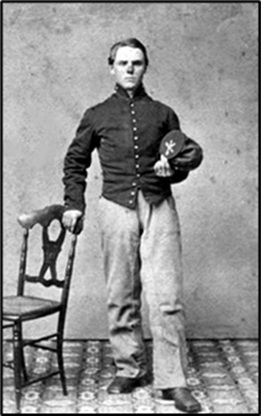
Photo of George Pforr, AKA Charles Anderson. George froze his nose while serving in the 3rd U. S Cavalry. Notice the discoloration of his nose in the above photo.

In 1905 George decided to apply for a federal pension for the time he served in the Federal Army. In his application he claims that he was born in Baltimore, Maryland. He admits that when he joined the war effort, he first enlisted in Captain Jonathan McClanahan’s Confederate Battery. He acknowledges that in February 1864, he deserted his Confederate unit and rode north to where he volunteered to serve in the 1st New York Cavalry. Sergeant James W. Blackburn, formerly of McClanahan’s Battery, confirmed Pforr’s story.

Based on accounts confirmed by soldiers in both armies, George Pforr, AKA Charles Anderson, was awarded a pension in 1906. His name, though, is listed as Charles W. Anderson according to U. S. army records. His Medal of Honor citation, awarded to him on March 26, 1865, reads: “Capture of unknown Confederate flag.”

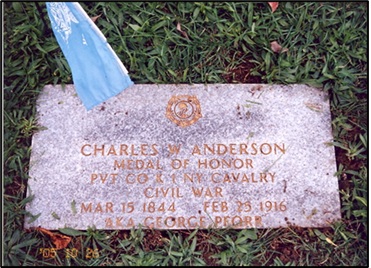
Charles W Anderson, also known as George Pforr, died on the 25th of February 1916 at the age of 71, at his farm in Annex, Virginia. He is buried in the Thornrose Confederate Cemetery in Staunton. Charles was one of seven 1st New York Cavalry soldiers to be awarded the Medal of Honor for bravery during the Civil War. While his memorial marker reads George Pforr, the Medal of Honor plaque reads Charles W. Anderson, AKA George Pforr. George is, and remains, the only enemy deserter in U. S. military history to earn the Congressional Medal of Honor. He has the only Medal of Honor memorial stone, anywhere, with the letters AKA on it. It is the only burial plot in Thornrose Confederate Cemetery in Staunton, Virginia, or in any Confederate cemetery in the United States, that has a Medal of Honor soldier buried within its boundaries. Now you know the rest of the story.

George Pforr’s Memorial Stone

Charles Anderson’s Medal of Honor Stone

1st New York Cavalry roster.

ANDERSON , CHARLES.—Age , 21 years. Enlisted February 27, 1864, at New York city; mustered in as private, Company K , February 27, 1864, to serve three years; awarded a medal of honor by Secretary of War ; mustered out with company, June 27, 1865, at Alexandria, Va.

Sources:

Blue and Gray Magazine. The Strangest Hero of All. December 1988. Pg. 26.

Driver, Robert J. The Staunton Artillery – McClanahan’s Battery. University of Michigan. 1988.

Stackpole, Edward J. Sheridan in the Shenandoah. The Telegraph Press. Harrisburg, Pa. 1961.

The Brothers Goldsborough

This is the story and Civil War journey of five brothers, William, Charles, Leander, Lewis, and Eugene Goldsborough, all of whom were born in the town of Graceham in Frederick County Maryland. They were the sons of Leander and Sarah Goldsborough. The Goldsborough’s were a prominent family in Maryland with a long history, particularly in Frederick and Talbot Counties. Many participated in state and local politics, and in Maryland society. Several members of the family held prominent positions, including Robert Goldsborough, who was a U.S. Senator, and Phillips Lee Goldsborough, who served as governor of the state.

Leander and Sarah Goldsborough were both geographically and diplomatically active. The family crossed the country with their young household “behind an ox team” along the California Trail when gold was discovered at Sutter’s Mill in early 1848. Integrated into their adventure was a trip down the Mississippi River, a meeting with Kit Carson, and encounters with the Mormons in Salt Lake City. Their exertions at prospecting, however, were downright disappointing and two years later they returned to Maryland sailing around Cape Horn and resettling in their native state.

In the early 1850s the Goldsborough family was keenly involved in the Lopez expedition to liberate Cuba. The goal of this excursion was to annex the island to the United States. The expeditions were largely supported by pro-slavery factions in the South and were aimed at overthrowing Spanish colonial rule and establishing Cuba as a slave state. This may speak volumes regarding the family’s stance on slavery.

Son Charles had been born on December 16, 1834. Following the family’s failed trip to the West Coast and the Lopez expedition he began to study medicine in his father’s office and at the University of Maryland in 1855. On March 4, 1857, he married Mary Neely, and moved to Hunterstown, in Adams County, Pennsylvania. The couple had two daughters: Grace Annie, born January 8, 1858, and Mary McConaughy, born March 4, 1860. His wife Mary expired six days after the birth of their second child from complications originating in childbirth. Their daughter Mary perished from disease just six months later

When the Civil War broke out, Charles journeyed back to his home state and joined the 5th Maryland Infantry as a surgeon in September of 1861. The regiment was initially assigned to Camp at LaFayette Square in Baltimore. In late October of that year, following the Battle of Ball’s Bluff, Charles was “assigned to duty at the old barracks at Frederick City, Maryland, to assist in establishing a division hospital for Gen. Bank’s boys, who were about to go into Winter quarters in and around that place.”

Dr. Charles Goldsborough of the 5th Maryland.

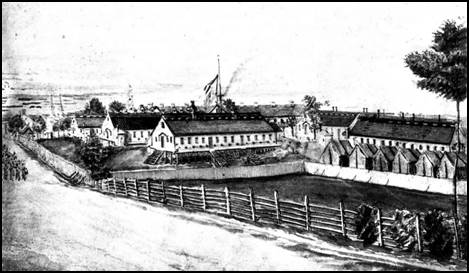
The Frederick military hospital was established on the old Hessian Barracks grounds on South Market Street. Charles noted, “It was not a great while before our hospital had grown to considerable size, with a fine medical staff in attendance, as an open Winter created a large amount of sickness in the various camps, some of which were very unfavorably situated.”

“The existing structures on the property consisted of a pair of stone buildings and at least five frame buildings, set on four acres of ground and enclosed by a board fence.” In June 1862, the hospital was officially designated as the United States General Hospital #1. By then, additional hospital ward buildings had been added. William W. Keen, an Assistant Surgeon at the hospital, noted that the new barracks were “finely ventilated using a ridge-ventilation system, and could accommodate eighty patients.”

Charles chronicled that “the boys had a nice time during the Winter of ’61-62 (barring the mud, that was generally knee deep) attending balls and parties and making love to…THE PRETTY GIRLS OF MARYLAND, and not a few captures were made from our ranks by the dear creatures.” He also observed that “it was a hard Winter upon the troops, as smallpox, measles and typhoid fever raged with considerable severity, and many a poor fellow got no farther in his effort to suppress the rebellion than the little cemetery on the hill beyond the barracks.”

U.S. General Hospital #1 in Frederick, Maryland where Dr. Charles Goldsborough was stationed.

As spring returned to Maryland Charles was still serving at the hospital in Frederick when “Gen. Banks commenced his memorable campaign up the Shenandoah Valley, followed by his equally memorable retrograde movement out of it into Maryland again, which we consoled ourselves was one of the most masterly retreats in the annals of warfare.” All this was provoked by General Stonewall Jackson’s “masterly” Shenandoah Valley Campaign.  

According to surgeon Goldsborough: “The summer passed away, and the bloody battles on the Peninsula had been fought and Pope defeated, and our hopes and fears were chasing each other from zero to blood heat and back again like the mercury in the thermometer. Our hospital was no longer a division, but a general hospital, and one of the very best in the country.”

On Sept. 5, 1862, Charles was Officer of the Day at the hospital. At this time General Robert E. Lee was preparing to cross the Potomac with his army. It was hoped in so doing they could recruit native Marylanders to the Confederate cause. “Near midnight that day Charles received a dispatch from General Nelson (Dixon) Miles at Harper’s Ferry stating Lee’s army will enter Frederick tomorrow. Any property that you do not want to fall into the hands of the enemy had better be destroyed. Our communications will soon be destroyed.”

The following day Dr. Goldsborough recalled “there was a commotion at the entrance of the grounds among the group of watchers as a single horseman clad in butternut dashed through the gate, up to and in front of where we were sitting, reined up his horse, brought his carbine to his shoulder, covering Dr. Heany, who had risen to his feet and stood at the head of the stairs with his badge as Officer of the Day over his shoulder…” The Confederate cavalryman declared: “I demand the surrender of this post in the name of Gen. Lee and the Confederate States of America, still covering Dr. Heany with his carbine.”

“The Doctor turned to me and asked, ’What had I better do?’”

Goldsborough responded saying, “If you are prepared to defend the place, tell the man so; if not, surrender it.”

“Then I surrender, sir,” Dr. Heany replied hurriedly.

The Confederate cavalryman “smiled at the Doctor’s embarrassment and informed us he belonged to White’s 35th Battalion of Virginia Cavalry. He explained he was the advance of General Lee’s Army. He advised us to keep within the grounds until the army had passed and taken possession of the city, and then rode off, after promising to send a guard.”

“On Tuesday we were paroled and permitted to go upon the streets and to our hotels; but what a change had come over the city. Everywhere was found the butternut instead of the blue. The general behavior was good and rarely did any act of outrage or disturbance occur. The strictest discipline was enforced in every case. In fact, the common soldier appeared too wretched and inanimate to care for anything but to eat and sleep.”

Charles remembered that the Confederates “threw themselves down anywhere and slept. They ate anything and everything that was offered them, and about 800 staid in the hospital when the army moved away. How men famished and footsore could fight as they did was a question, I asked myself over and over again…the discipline was perfect and cruel towards the private soldier.”

“Just as suddenly General Ambrose Burnside’s infantry swarmed through the city, driving the Confederates before them toward South Mountain. Soon thereafter commenced the series of terrible battles of this campaign at South Mountain and Antietam”.

Following the Battle of Antietam, Dr. Goldsborough spent an extended period tending to wounded soldiers at the general hospital in Frederick. There is a hint he may have been sent briefly to Fredericksburg following the fight there, but I was unable to confirm that. What I can validate is that Charles was reassigned to the 5th Maryland Infantry and spent the late winter and spring of 1863 on Maryland Heights at Harper’s Ferry where his regiment performed guard duty while recovering from their “terrible losses” sustained at Antietam. On June 2nd, 1863, they were transferred to General Robert Milroy’s command at Winchester, Virginia.

Brother number two, William Goldsborough, was born October 6, 1831, in Frederick County, Maryland as well. “From early manhood the career of Major Goldsborough was replete with the stress and storm of arms. As a lad he ran away from home to enlist for the war against Mexico but was overtaken in Baltimore and taken back home.” He was fifteen years old at the time.

Prior to the Civil War, William was a member of the Baltimore City Guard Battalion which was a prominent militia unit in Baltimore. It was part of the Maryland Volunteer Militia’s First Light Division, 53rd Infantry Regiment, Second Brigade. In 1859 elements of the City Guards, under the command of George Steuart, participated in the suppression of John Brown’s raid on Harpers Ferry. Militiamen forced John Brown to abandon his positions in the armory forcing them to fortify themselves in “a sturdy stone building”, the fire engine house, which would later be known as John Brown’s Fort. William, an officer in the Baltimore City Guard Battalion, would be one of the first to enter the armory at Harper’s Ferry.

Major William Goldsborough

William worked for a time as a printer in Baltimore before the war. In May 1861 30-year-old William enlisted as a private in Captain Edward R. Dorsey’s Company C of the First Maryland Confederate Infantry. The regiment arrived at Camp Bee, one half mile northwest of Winchester on Apple Pie Ridge, and was brigaded with the 10th and 13th Virginia as well as the 3rd Tennessee on June 27, 1861. Colonel Arnold Elzey, being the senior colonel, was appointed as the brigade’s commander. At the Battle of First Bull Run private William W. Goldsborough and the 1st Maryland would see the elephant for the first time. They would fight at Chinn Ridge late in the afternoon of July 21. Here they would assist in routing Colonel Oliver O. Howard’s Brigade from the field and join in the pursuit of the Union Army.

Promoted to Captain in Company A of the 1st Maryland, William would participate in Jackson’s 1862 Valley Campaign. His regiment would fight against the 1st Maryland Union Regiment on May 23, 1862, at Front Royal. (Reports asserting that William captured his brother Charles at Front Royal are obviously false as he was clearly stationed at the hospital in Frederick, Maryland.) This is the only time when two units, designated by the same numerical order and state, fought each other in a battle. Two days later his battalion would participate in the attack on the left flank of General Nathaniel Banks Division at the Battle of 1st Winchester and on June 6th, the Marylanders would fight a successful rearguard action at the Battle of Harrisonburg, or Good’s Farm, where cavalry leader General Turner Ashby was mortally wounded. Forty-eight hours later they were part of General Richard Ewell’s defensive line at the Battle of Cross Keys.

The regiment also participated in the Battle of Gain’s Mill and Malvern Hill during the Peninsular Campaign. Stonewall Jackson while on his march to Pope’s rear at Manassas, in August 1862, placed Colonel Bradley T. Johnson in command of General John Jones’ Brigade in the Stonewall Division. “General Jones having been disabled Johnson assumed command and put Captain William Goldsborough in command of the 48th Virginia Regiment. At Second Manassas Jone’s brigade “reduced to about 800 effectives, for nearly two days fought desperately and heroically at the railroad cut against Fitz John Porter’s Corps, holding its ground to the end, repulsing many attacks in heavy force and often making counter charges.”

During the Battle of Second Manassas, Captain Goldsborough was severely wounded with what was believed to be a mortal injury. “Careful nursing by hospitable Virginians in the Bull Run mountains restored him in time (in the latter part of 1862) to secure the captaincy of Company ‘G,’ 1st Maryland Battalion, being shortly afterward elected major, under Lieutenant-Colonel James R. Herbert.” The 1st Maryland Infantry would, however, muster out at Richmond at the end of its term of service on August 17.

After the disbandment of the 1st Maryland Infantry, the soldiers of the former regiment found themselves in a precarious position. They were unable to return home to Maryland, having effectively committed themselves to the Confederacy for the duration of the war. With little choice many joined artillery, or cavalry units, while others waited to form a new Maryland Infantry Regiment. This new unit was initially known as the 1st Maryland Battalion until it was officially designated as the 2nd Maryland Infantry in January of 1864.

In early summer 1863, the1st Maryland Battalion was assigned to General George H. (Maryland) Steuart’s Third Brigade in Major General Edward “Allegheny” Johnson’s division. This was part of General Ewell’s 2nd Corps of the Army of Northern Virginia. On June 12, 1863, the Marylanders crossed the Blue Ridge Mountains through Chester Gap on their way to Winchester. 

The third brother, Eugene, born in 1844, is somewhat of a mystery. I can place him as a seventeen-year-old private in Company A of the 1st Maryland Infantry. I know he is with the regiment at 1st Bull Run and participated in both Jackson’s Valley Campaign and the Peninsula Campaign in 1862. When the 1st Maryland Infantry was disbanded, Eugene left Confederate service. In March of 1863, however, he re-enlisted in Company C of Harry Gilmor’s 1st Maryland Cavalry Battalion. He would have participated with Gilmor’s cavalry unit at the 2nd Battle of Winchester and at Gettysburg.

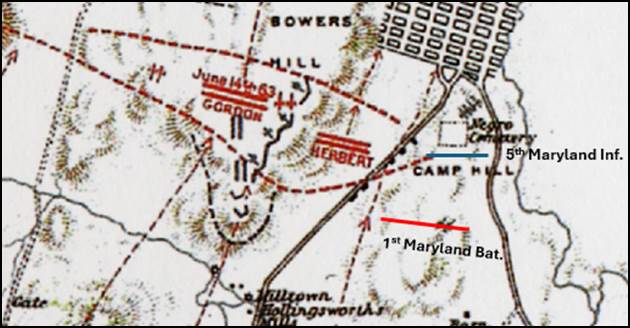
Position of the 5th Maryland, Union, and 1st Maryland Battalion, Confederate, at Winchester on the Afternoon of June 14.

By the afternoon of June 13, 1863, the combat at the 2nd Battle of Winchester had become widespread. Charles recalled that “the enemy now sent forward their infantry, and we met a foe that we could retaliate upon. With variable success we fought them during the day. At times we pushed them back and then were compelled to give way. Gordon had charged Elliot on our right and forced him back to Winchester, and our brigade took a position on the south of the town, in a cemetery, which we held when night came upon us.” The cemetery was locally known as Camp Hill. “The 2d Md. of the enemy had fought in the immediate front of the 5th Md, of our army, and was in some cases brother against brother.”

“At early dawn on the 14th the rain ceased and the sun clear and beautiful on that Sabbath morning; but the infantry soon commenced their firing along the whole line with a repetition of yesterday’s results the 2d Md. returning to the 5th Md. on our side.” Charles, aware that his brother William had been promoted to Major in the 2nd Maryland, borrowed a spyglass from a friend, and “examined the rebel line as it came to the attack”, and thought he recognized William leading the assault on a “sorrel horse.” As the officer appeared to be in command, he believed it could not be him. The officer “rode along the rebel line on this horse several times, and our boys behind the gravestones were taking deliberate aim at him in firing. Presently the sorrel horse and rider went down, and a shout went up along our whole line, and we saw nothing more of the sorrel horse or rider.” It was evident to Charles that the wounded rider was not his brother William.

William recalled the enemy withdrew “until they reached a stone fence about two hundred yards from the town, when the fight was renewed, and continued several hours the enemy holding a position in a cemetery lot. This the Marylanders finally drove them from with loss. We afterwards ascertained it was the Fifth Maryland we had encountered.” At no point does William acknowledge that his brother Charles was a member of that Maryland regiment.

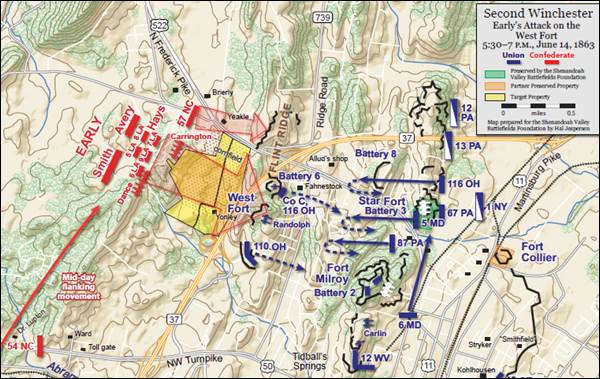
Meanwhile General Jubal Early had secretly moved the brigades of Harry Hays, Avery, and Smith and a sizable number of artillery pieces out to the west of Milroy’s forts. About 5:00 p.m. Early was satisfied that all the necessary preparations had been completed, and he ordered his artillery rolled out of the woods and commenced bombarding West Fort. Including Griffin’s guns, twenty artillery pieces opened on the fortification. The fire continued for about forty-five minutes. Charles noted “the battery on Flint Hill worked savagely but was overmatched.” Cornelia Peake McDonald’s home which was located directly beneath the track of the artillery fire coming from Griffin’s guns, recorded in her diary: “It seemed as if shells and cannon balls poured from every direction at once.”

A little after 6:00 p.m. General Harry Hayes ordered his Louisiana Tigers to charge the fortifications. Most of these men had fought at the 1st Battle of Winchester under General Stonewall Jackson. The 6th, 9th, and 7th Louisiana Infantry was in the front line followed by the 5th and 8th. Bolting out of the trees down the hill they went stopping only occasionally to discharge their muskets. Inside the fortifications before them was the 110th Ohio each man armed with Henry repeating rifles.  Undaunted, they charged on until they reached their entrenched foe. Finally, “the Federals began to give way, and pretty soon the Louisianians with their battle flag, appeared on the crests charging the redoubts.” “Early had taken two of the forts and tuned their guns on the remaining two still held by the enemy.”

Jubal Early’s Attack on West Fort Led by the Louisiana Brigade. (SVBF)

Charles began to make his way to the forts and he recalled he had barely reached his “destination when Hays made his charge, and our forces fell back in some confusion, artillery and infantry– supports all in one mass, while the rebels gave us shot at short ranging from our own guns.” The 5th Maryland was part of an unsuccessful counterattack which failed to retake West Fort. “The infantry firing now ceased, but heavy cannonading continued until 10 o’clock at night, when all became quiet.”

At about 9 p.m. a formal council of war was held. Milroy and his officers made the decision to try to “cut their way through” to Harpers Ferry on the old Charles Town Road. At about 1 a.m. the retreat commenced with General Washington Elliot’s Brigade leading the withdrawal, followed by Colonel William Ely’s Brigade, and then Colonel Andrew McReynolds. “The head of the column had reached Carter’s house, about 4 miles outside of town on the Martinsburg pike, before the tail end had got out of the fortifications.”

Sometime around 3:30 a.m. on June 15, General Edward Johnson’s skirmishers bumped into the van of Milroy’s retreating column near the intersection of the Valley Pike and Charles Town Road. Milroy faced his column to the right on the pike and prepared to fight his way through by attacking the enemy. Meanwhile Johnson deployed his regiments along Milburn Road as they came up and advanced them to the railroad tracks. Here he placed two artillery pieces from the 1st Maryland Artillery CSA on and around the Charles Town Road railroad bridge.

Charles recalled: “Elliot was met by some of Johnson’s Division that had been pushed around from the south of town and immediately opened fire upon us. Many of Elliot’s Brigade was already past and continued on. Col. Ely formed his brigade as well as he could considering the confusion ensuing, while the Ohio regiment and a West Virginia regiment and the 67th Pa. also formed a line and charged the guns that were playing upon us over a clover field, but Walker’s Brigade supporting them, we were driven back. In the meantime, our line was melting away by squads, as everyone knew it was a forlorn hope. Milroy showed his courage to the last by riding up and down the line addressing the men in language more forcible than elegant.”

“A second charge was made, but the clover was high and tangled, the men tired and worn out from fighting and marching, and it lacked spirit; but the men fought notwithstanding. It then become a rout, and sauve qui peut (meaning a general rout) was expressed on most faces, if not spoken. It was now getting towards morning, and the 5th Md., 18th Conn., and 87th Pa., or such of them that remained together, finding themselves cutoff, surrendered; also, an Ohio regiment just across from us in a woods. These regiments had been the nucleus of the battle on our side while the rest were leaving. My recollection of the last I saw of Milroy was after the last repulse. He galloped from the field with some others off to the left, with the most painful expression of face I ever saw. I hoped he might escape, knowing the bad feeling towards him by the rebels, and he did, though I thought at the time his show was a poor one.”

Charles was captured near Carter’s Woods. (Map courtesy SVBF)

“At daybreak of the 15th Major Goldsborough put his skirmishers in motion and proceeded cautiously through the streets of Winchester without encountering the enemy. The Second Maryland skirmishers, apart from that portion of Company A under command of Lieutenant George Thomas, immediately took possession of the Star Fort, capturing some two hundred prisoners.” “The Star Fort for the day was made a receptacle for prisoners.” William was undoubtedly in Winchester, possibly at Star Fort, when his brother Charles was captured four miles to the east at Stevenson’s Depot.

Charles was apprehended near the Carter Farm and marched back to Winchester. Here he found his rebel brother, William, who had been appointed Provost Marshal of the town “for gallantry displayed in the fight.”  A provost marshal’s responsibility was to inventory captured supplies and register prisoners. Since the 2nd Maryland did not fight at Stevenson’s Depot this is undoubtedly how the two brothers met. The report that William physically captured Charles is without doubt inaccurate.

The fighting at Winchester had produced nearly six hundred wounded which would have kept doctors from both sides busy. Charles recalled “obtaining a pass and parole” and setting “about collecting our wounded from the field and moving them to the Taylor Hotel.” “Surgeons and chaplains were allowed to go about at will.” Not being regarded as prisoners they were “sheltered in nearby houses” in Winchester.

On the morning of June 20th Charles, along with the remaining surgeons and chaplains, were ordered to gather at Winchester’s Union (Ion) Hotel and “await further orders.” The entire assembly was soon put into march column and pushed south along the Valley Pike. They were told their destination was Richmond. One of Charles’ fellow captives, Reverend George Hammer of the 12th Pennsylvania Cavalry, recorded that many of the men were “half-clad, many shoeless and hatless and unfed.” “Nothing to eat but what we begged or bought off citizens who hated us intensely…”

The journey to Staunton covered ninety-six miles and took four and a half days to complete. The exhausted, dust covered, and foot sore men were segregated into groups of eighty and loaded into freight and cattle cars belonging to the Richmond Central Railroad and shipped off to Richmond. The passengers were not given any rations, received very little water, and they were not allowed any stops to relieve themselves. The trip would take twenty-four hours to complete.

Charles and the other surgeons had been led to believe they would be quickly “passed through to the United States.” Instead, they marched to Libby Prison where they were registered and examined by the prison inspector. All their possessions were taken from them, even the ones that might be used to ease the suffering of the sick and injured. Charles would remain here for the next four months, all the while trying to negotiate with his captors an exchange of surgeons currently confined to both Union and Confederate prisons. He would linger in Libby Prison until October.

William, on the other hand, was able to continue his journey north with the rest of the 2nd Corps. Lieutenant Colonel James Herbert commanded the 1st Maryland Battalion which would bring some 400 men to Pennsylvania and to the field of battle at Gettysburg. Major Goldsborough was second in the line of command.

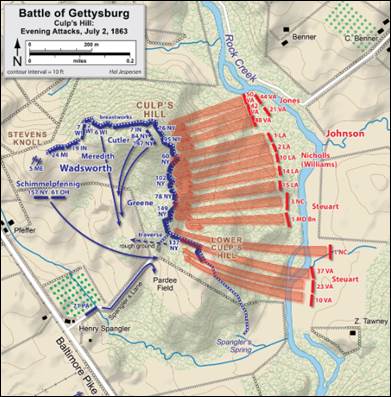
General Johnson’s July 2nd Attack on Culp’s Hill at Gettysburg. (Wikipedia)

The 1st Maryland Battalion would not be involved in the fighting on the first day at Gettysburg. On July 2nd, however, Confederates attacked Culp’s Hill, with the 1st Maryland, the 10th, 23rd and 37th Virginia regiments, and 3rd North Carolina, assaulted Union breastworks, defended by General George S. Greene’s Brigade of the 12th Corps. The Confederates were initially able to breach the works and drive out Green’s men and hold their position until the following morning. Lieut. Col. Herbert was wounded three times on July 2nd as the battalion captured the lower defenses on Culp’s Hill. Major William Goldsborough would then take over command of the unit.

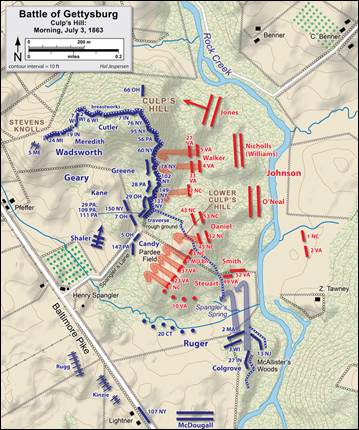
General Johnson’s July 3rd  Attack on Culp’s Hill at Gettysburg. (Wikipedia)

The next day the Marylander’s launched a second attack on what is now called the Pardee Field. Late on the morning of July 3, General Johnson ordered a bayonet charge against the well-fortified enemy lines. “Steuart was appalled, and was strongly critical of the attack, but direct orders could not be disobeyed.” “I saw in an instant the object of the movement, and told Captain Williamson, “It was nothing less than murder to send men into that slaughter-pen. Captain Williamson agreed with me, and, moreover, said that General Steuart strongly disapproved of it, but that the order from General Edward Johnson was imperative.”

The battalion’s attack on the Pardee Field failed. “The Third Brigade attempted several times to gain control of Culp’s Hill, a vital part of the Union Army defensive line, and the result was a ‘slaughterpen’, as the First Maryland and the Third North Carolina regiments courageously charged a well-defended position strongly held by three brigades, a few reaching within twenty paces of the enemy lines.”  Ironically, one of the units opposing them was the 1st Maryland Eastern Shore Regiment, once again a situation forcing brother to fight brother. A noteworthy example was cousin versus cousin as Color Sergeant Robert Ross of the Union 1st Maryland Eastern Shore regiment fought against his cousin, Color Sergeant P. M. Moore of the Confederate 1st Maryland regiment. Moore was wounded several times during the struggle.

So severe were the casualties among his men that Steuart is said to have broken down and wept, “wringing his hands and crying my poor boys”. At Gettysburg the 1st Maryland Battalion lost 52 killed, 140 wounded, and 15 missing, totaling 207 casualties of the 400 men engaged. 

Major Goldsborough, who had taken over command and led the unit in combat on July 3, was among the wounded. A bullet “ripped into the left side of his chest entering at the third rib, passed through his lung and exited out his back.” When the Confederates were pushed back, his comrades carried him to a private residence with three other wounded officers and left them there. Most, including Lieutenant George Booth, “took their last farewell of Herbert and Goldsborough, whose wounds seemed to forbid any hope of recovery.” Following the battle Major Goldsborough and Lieut. Col. James Herbert were both captured and transferred to Camp Letterman along with some 6800 other confederate wounded. Both were later transferred to Fort McHenry in Baltimore for further treatment and then on to Fort Delaware as prisoners of war.

Meanwhile, Charles, who was still serving time at Libby Prison in Richmond, had repeatedly petitioned his captors for parole so that he could effectuate an exchange of captured surgeons. In October he finally received the following parole:

“Richmond, October 20, 1863.

“Dr. Charles E. Goldsborough has permission to go North, upon his giving his parole to honor to return to Richmond Va., withing forty days, if he does not secure the acquiescence of the Federal authorities in the following propositions, to wit: That all surgeons on both sides shall be unconditionally released, except such as have charges preferred against them.  Such a proposition is to be understood as embracing not only those already in captivity, but all surgeons who may hereafter be captured.                 

                                                                                                                 Ro. (Robert) Ould,

                                                                                                             “Agent of Exchange.”

Charles officially accepted his parole and the accompanying conditions and traveled north to Washington D.C. “Aided by Secretary Salmon P. Chase and others, Charles succeeded in affecting the release of about 100 Federal surgeons confined in Libby prison as well several more Confederate surgeons confined in Fort McHenry. Unfortunately, General Ulysses S. Grant and Edwin M. Stanton opposed the exchange, which was unable to do anything toward affecting a general exchange of prisoners.”

Subsequently, Charles returned to his home in Hunterstown, Pennsylvania which is located just five miles northeast of Gettysburg. He arrived in time to attend the “consecration of Gettysburg” on November 19, 1863. He chronicled the scene in his memoir. “This seems strange and almost remarkable, but the great throng was there more to see Mr. Lincoln than to hear what he had to say.” He recalls “the day was an ideal Indian Summer Day, with just enough crisp in the air to make fall clothing comfortable.” The “consecration” he witnessed, of course, included Lincoln’s famous Gettysburg Address. Ironically, the event took place only a short distance from the spot where his brother William had been wounded on July 3.

In December 1863, Charles was assigned to the medical staff at Fort Delaware. The fort was a former harbor defense facility, designed by chief engineer Joseph Totten and located on Pea Patch Island in the Delaware River. During the Civil War the  United States Army used Fort Delaware as a prison for Confederate POWs. By the time Charles arrived there in December 1863, there were more than 11,000 prisoners on the island. 

When Charles disembarked at Fort Delaware, he soon discovered his brother William, who as we mentioned before had been severely wounded and captured at Gettysburg. He also encountered his brother Eugene, who as a member of Harry Gilmore’s Battalion of cavalry, had been captured earlier during an expedition into West Virginia. Both were prisoners of war. It was a remarkable coincidence. It is said that Charles, later in life, would often enjoy telling the story of his unusual family get-togethers and reunions.

In the spring of 1864 Dr. Goldsborough went with his regiment to Bermuda Hundred, on the James River, joining forces commanded by General Benjamin F. Butler. Here he attended to the wounded and assisted in the siege of Petersburg. Charles was himself wounded on July 6, 1864, and sent to Chesapeake Hospital in Hampton, Virginia. This facility was meant for officers, while the larger Hampton General Hospital, consisting of “a network of structures and tents, was primarily for treating enlisted men.” 

Following his recovery, it was determined he was unfit for field duty due to a disability acquired in the line of duty. Charles was assigned to Lincoln Hospital, in Washington, D.C., where he remained until August 1865. He then returned to Hunterstown, Pennsylvania where he resumed his medical practice and engaged extensively in farming. 

Charles would, on November 14, 1866, marry Miss Alice E. McCreery, and would father ten children. “In politics Dr. Goldsborough, although descended from old Federal stock, early in life embraced the faith of Jefferson and Jackson and always espoused Democratic principles.”  “Charles was a member of the Corporal Skelly Post, No. 9, G. A. R in Gettysburg. He died on October 18, 1913, aged 78 years, and is buried at Evergreen Cemetery in Gettysburg.”

In July 1864 William’s life would take a noteworthy detour. In June of that year the Confederate Army had imprisoned five generals and forty-five Union Army officers in the city of Charleston, South Carolina, using them as human shields to stop Union artillery from firing on the city. In retaliation, Secretary of War Edwin M. Stanton ordered fifty captured Confederate officers of similar ranks to be taken to nearby Morris Island. The Confederates landed on Morris Island in late July of that year where they were to be utilized for the same purpose. The scheme worked as it would enable the exchange of all fifty officers on August 4, 1864.

Major General Samuel Jones, commanding the Confederate Department of South Carolina, Georgia, and Florida, then brought 600 additional prisoners to Charleston from Andersonville and Camp Oglethorpe prisons in Georgia, to compel a larger prisoner exchange. In retaliation for the treatment of Federal prisoners, General John Foster asked for a like number of Confederate detainees brought to Morris Island. These men were withdrawn from Fort Delaware and sent south. They would be forever known in the South as the Immortal Six Hundred.

Stockade for Confederate Prisoners on Morris Island.

In late 1864, Major William Goldsborough and 599 other prisoners were ordered to be transferred to Morris Island. Bound for Charleston, the 600 Confederate officers, “faced the worst conditions that they had yet encountered as prisoners.” “Forced to lie shoulder-to-shoulder in the ship’s hold below the water line, one prisoner said that they lay in ‘total darkness, without any clothing and drenched in perspiration’ from the summer heat which was intensified by the ship’s boilers.  As the Crescent City rolled in rough seas, all of the prisoners became seasick, leading one on board to describe the ship’s hold as ‘a veritable cesspool’ which the Union guards refused to hose down.”  In this environment the Rebs were fed just a “few crackers with a bit of salt beef or bacon” per day.  Drinking water was likewise scarce, said one prisoner, and it “had a disagreeable smell and a very sickly taste.”

The Confederate officers were placed in an open stockade on Morris Island in the line of rebel artillery fire. The regiment assigned to guard them during their stay was the 54th Massachusetts, a noted black regiment. Originally commanded by Robert Gould Shaw, they were currently headed by Colonel Edward Needles Hallowell. Hallowell had suffered three wounds in the assault on Fort Wagner but had recovered and would command the regiment for the rest of the war.

Lieutenant Colonel Herbert and Major Goldsborough of the 2nd Maryland “were among the six hundred Confederate officers, prisoners of war, who were placed within range of the Confederate batteries at Charleston, S. C., during the fierce Federal assault on that city; suffering many hardships and privations, having often killed and eaten cats and other animals! What could have been more cowardly and despicable than such treatment to such heroes!”

This standoff continued until a yellow fever epidemic forced Confederate Major General Jones to remove Federal prisoners from Charleston. The Rebel prisoners were transferred from the open stockade at Morris Island to Fort Pulaski at the mouth of the Savannah River in Georgia. On October 23,1864, over five hundred “tired, ill-clothed, men arrived at Cockspur Island.” Early on the emaciated troops received extra rations and were promised extra blankets and clothing. Crowded into the fort’s casemates for forty-two days, a “retaliation ration of 10 ounces of moldy cornmeal and one-half pint of soured onion pickles was the only food issued to the prisoners. Despite the best intentions of the fort’s command, the prisoners never received sufficient food, blankets or clothes” even during winter months.

In March 1865 the survivors were shipped back to Fort Delaware, where twenty-five more succumbed to illness. Major Goldsborough was among the survivors remaining there until after the war ended. The last members of the Immortal 600 were not released until July 1865.

Soon after the war William Goldsborough established the Winchester Virginia Times and the weekly edition of The Evening Star, which published its first issue on Sept. 7, 1865. William sold the paper in 1869 and traveled to Philadelphia to reside. Goldsborough was with the Philadelphia Record from 1870 to 1890. In 1890 William “migrated to the Northwest, settling at Tacoma, Washington. Here he met what was regarded as the roughest gang of printers on the Pacific Coast. Prior to his arrival no one had dared to run counter to them; but as foreman of the Tacoma Daily Globe, he cleared out the gang, unionized the office and made it one of the best on the slope. This feat gained for him the title ‘Fighting Foreman.’”

Upon the sale of Globe, William relocated to Everett, Washington, where he worked for a time at the Everett Herald, and later started the Everett Sun. “About 1894 he returned to Philadelphia, contributing war articles to the Philadelphia Record.” William was obliged to retire in 1896 after being run over by a bicycle.  “William’s thigh was crushed, and he was forced to walk with the aid of crutches for the rest of his life.”

After the war, William wrote a book about the wartime service of the Maryland Line which was published in 1869. The 2nd Maryland’s participation in the Battle of Gettysburg gets a good deal of positive coverage between its covers. William died on Christmas Day in 1901. His last request to his wife was “don’t bury me among the damn Yankees here.” His wife honored his wishes, and he died “an unrepented Confederate soldier.” He is buried on Confederate Hill at Loudon Park Cemetery in the city of Baltimore, Maryland.

Unfortunately, Private Eugene Goldsborough continued to reside at Fort Delaware as a prisoner of war. In Early 1865 he became sick and died from disease on February 21, 1865, at the age of 21. He was buried in the Confederate section of Finn’s Point National Cemetery in Pennsville, New Jersey. Originally purchased by the federal government for the construction of a battery to protect the port of Philadelphia, the land became a cemetery in 1863 for Confederate prisoners of war who died while in captivity at Fort Delaware.

Disease was rampant at Fort Delaware throughout the war and nearly 2,700 prisoners died from malnutrition or neglect. Confederate prisoners interred at the cemetery total 2,436 and are buried in a common grave in what was then a huge pit in the northwestern corner of the site. It was officially made a National Cemetery on October 3, 1875, by request of Virginia Governor James L. Kemper, a former Confederate General, who had criticized the poor maintenance of the Confederate grave sites.

Tablet Listing Eugene Goldsborough at Finn’s Point National Cemetery.

Leander Goldsborough, who was born on October 12, 1836, is listed as a Contract Surgeon during the Civil War. During the war, contract surgeons were civilian doctors hired by the army to serve under contract, rather than as commissioned officers. Leander probably served in this capacity during much of the war. The only mention I can find of him is as a member of “U. S. Volunteers at Camp Schofield in Winchester, Va.” He was stationed there until sometime in 1869.

After the cessation of hostilities, Winchester had been placed under the control of the First Military District of Major General John Schofield, beginning in January 1865. This military presence was part of the larger effort to maintain order and enforce federal authority in the South during the early stages of Reconstruction. Leander would have been serving here while his brother William was establishing his newspaper in the town.

Brother five, Lewis Goldsborough, born on February 22, 1840, is listed as a wartime journalist for the Baltimore Sun. Several of his stories can be accessed online which were written by him on several of the major battles fought during the war. Little more is known about him.

The narrative of the Goldsborough family epitomizes the phrase “brother against brother.” Theirs is the story of internal strife and divided loyalties within families, particularly in border states, where brothers were compelled to fight each other due to their allegiance to the Union or the Confederacy. Fortunately, these siblings were never compelled to harm one another though their lives intercepted several times both during and after the war. Undoubtedly the individual journeys and adventures these brothers participated in went far beyond what they ever could have imagined. Still, they persevered and were later able to see the humor amid the tragic circumstances of their reunions especially that at Fort Delaware. Long live the memories of these and all soldiers who fought in the American Civil War.

Sources

Booth, George W. A Maryland Boy in Lee’s Army. Personal Reminiscences of a Maryland Soldier in the War Between the States 1861 to 1865. University of Nebraska Press. Lincoln, Nebraska. 2000.

Gilmor, Colonel Harry. Four Years in the Saddle. Reprinted By Butternut and Blue. Baltimore, Md. 1866.

Goldsborough, William W. The Maryland Line in the Confederate Army. 1861-1865. Guggenheimer, Weil, & Co. Baltimore, Md.1900.

Murray, John Ogden. The Immortal Six Hundred: A Story of Cruelty to Confederate Prisoners of War. The Confederate Reprint Company. Atlanta, Georgia. 2015.

Wittenberg, Eric and Mingus, Scott. The Second Battle of Winchester: The Confederate Victory that Opened the Door to Gettysburg. Savas Beatie. California. 2016.

Percy Old Boy

Percy Wyndham was born in England on September 22, 1833, on board a ship called the Arab in the Downs near the town of Deal. Not much is known of his early life, but he reputedly began his military career at the age of fifteen, fighting in the Students’ Corps during the French Revolution of 1848. In July of that same year, he transferred into the French Navy as a marine ensign. The term ensign refers to the lowest rank among commissioned officers, equivalent to a second lieutenant. A fifteen-year-old serving in this capacity would have been very unusual. Regardless, his stay in the navy was brief and he soon shifted to the British Royal Artillery serving there for less than two years. The next six years were consumed functioning as a cavalry officer in the Austrian Army’s 8th Lancers Uhlans Regiment.

In 1860 Wyndham traveled to Italy and served under Giuseppe Garibaldi during the Second War of Italian Independence. Wyndham fought with Garibaldi in the battles of Palermo, Nuloggo, Rager, and Capua. One must assume he served with distinction as he was soon promoted to lieutenant-colonel and given command of a brigade. Shortly thereafter King Victor Emmanuel would honor him with knighthood in the Military Order of Savoy.  The Order of Savoy was a celebrated military order established in 1815 by King Victor Emmanuel I and awarded by the Kingdom of Sardinia to recognize acts of bravery in battle.

Colonel Sir Percy Wyndham

Now Sir Percy Wyndham, he continued to command his Italian brigade until October 8, 1861. Following the outbreak of the American Civil War, he was given leave to offer his services to the Union Army. “As the demand for military experience was greater than the supply in the early years of the war finding a command was not difficult.” It was often noted “if one were remotely knowledgeable, and made the right connections, whether the resume was padded a little was not considered.”

Former Congressman William Halstead had raised the 1st New Jersey Cavalry in August of 1861 and was appointed the regiment’s first commander. The sixty-seven-year-old Halstead would remain in command of the unit until February 18, 1862, when he was discharged due to an “adverse report of a Board of Examination.” Major General George B. McClellan, who was familiar with Percy Wyndham’s reputation as a fighter, recommended to the governor of New Jersey, Charles Smith Olden, that he be appointed to the command of the regiment.

Although the governor of New Jersey issued the commission to Wyndham as colonel of the regiment in February 1862, not everyone welcomed the Englishman with open arms. A community newspaper questioned, “Have we no material in New Jersey out of which to manufacture competent colonels without resorting to foreigners to fill up the list?” Despite these doubts McClellan was able to convince the governor of New Jersey “that he was the man of the hour” and he was given command the 1st New Jersey Cavalry.

Wyndham’s popularity was not widespread even with the men in his command. One of his fellow New Jersey cavalrymen voiced the opinion, “This officer was an Englishman, an alleged lord. But lord or son of a lord, his capacity as a cavalry officer was not great. He had been entrusted with one or two independent commands and was regarded as a dashing officer… He seemed bent on killing as many horses as possible, not to mention the men.”

Wyndham’s regiment would spend the spring of 1862 in the defenses of Washington, D.C. By May of 1862, however, Wyndham and the 1st New Jersey Cavalry were assigned to General George D. Bayard’s cavalry brigade in General Irvin McDowell’s Department of the Rappahannock. The 1st New Jersey, and 1st Pennsylvania Cavalry, along with the 13th Pennsylvania Reserve Regiment, or Bucktails, were then temporarily allocated to General John Fremont’s command on May 30, 1862, near the town of Strasburg, Virginia.

The regiment’s first fight occurred on June 2nd when the regiment ran up against the rear guard of Stonewall Jackson’s Army just north of Woodstock. The attack was vigorous and supported by two sections of guns from the 2nd Maine Battery commanded by Corporal James Hall. A last-minute defense mounted by General Turner Ashby with a ragtag collection of infantry, cavalry, and artillery managed to hold the line and repel the Union attack. Though beaten, the 1st New Jersey had seen the elephant and experienced their first combat action.

The chase was on, and Wyndham was hot on the trail of General Turner Ashby. On the afternoon of June 6, Wyndham and a detachment of the 1st New Jersey Cavalry were acting as the vanguard of General John Fremont’s army as they approached Harrisonburg and turned east along the Port Republic Road. Everyone was aware General Stonewall Jackson’s Army was close at hand.

Wyndham’s target, General Turner Ashby Jr., was an interesting character as well. Ashby was a native Virginian born at Rose Bank Plantation near Markham on October 28, 1828. An accomplished horseman at an early age, Ashby often participated in tournaments winning many awards and accolades. Henry Kyd Douglas, a staff officer serving under Stonewall Jackson, described him fittingly. “Riding his black stallion, he looked like a knight of the olden time, galloping over the field on his favorite war horse. Ashby augmented his style with a battle costume that included spyglass, gauntlets, and fox-hunting horn —all the accoutrements of a Virginia-born gentleman.”

As captain of a volunteer cavalry troop, the Mountain Rangers, Ashby had led his men to Harpers Ferry in the aftermath of John Brown’s raid.  He and his militiamen would also perform guard duty at Charles Town during Brown’s trial and execution. Two years later, he returned to Harpers Ferry, this time leading a force of Virginians launching a surprise attack on the federal arsenal there. Such was his popularity in the lower Shenandoah Valley that by June of 1861 he was commissioned as the lieutenant colonel of the 7th Virginia Cavalry and mustered into Confederate service.

With the outbreak of the Civil War, Ashby and his troopers were assigned to the command of General Thomas Jackson. Although Jackson owed much to Ashby’s able reconnaissance and screening, he was often criticized by Jackson for the poor training and discipline of his men. Jackson had attempted to address these issues at one point by stripping Ashby of his cavalry command and assigning them to infantry brigades. Ashby was deeply offended by this demotion and threatened to resign in protest. Faced with the potential loss of his cavalry and a possible mutiny, Jackson backed down and reinstated Ashby to command. Still, despite all the controversy and his perceived shortcomings, on the afternoon of June 6, 1862, General Turner Ashby found himself positioned near Good’s Farm on the Port Republic Road commanding the rear guard of Stonewall Jackson’s retreating army.

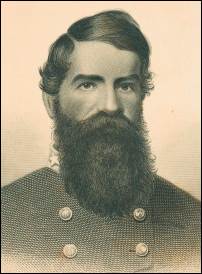
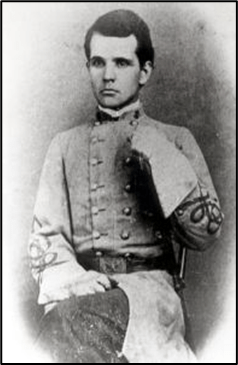
General Turner Ashby

Wyndham’s 1st New Jersey Cavalry Regiment had trotted into Harrisonburg about three p.m. on that hot June day led by Lieutenant Colonel Virgil Broderick. The command turned east along the Port Republic Road and as they did, they spotted a few of Ashby’s cavalrymen who had seemingly become detached from their unit. Ashby’s men had ensconced themselves behind a stonewall on both sides of the road. “Seeing that the force was too great for him to charge, he wheeled and retired.”

Returning to Harrisonburg, Broderick was soon joined by Colonel Wyndham and reinforced by members of his own regiment as well as companies from the 4th New York, 1st Pennsylvania, and 6th Ohio. In total his command numbered a little more than four hundred men. General Bayard, however, had specifically ordered Wyndham to do no more than “deploy pickets and vedettes.”  Reports that a squadron of Ashby’s cavalry was resting their horses just a half a mile outside of town, however, proved overly tempting to the colonel even though his orders forbid him from engaging the enemy. When informed by one of his scouts there were only “forty of fifty rebel troopers and infantry who were too tired to run or fight,” Wyndham ignored his instructions and ordered his command forward asserting, “We’ll have a little fun then.”

Colonel Percy Wyndham’s blood was up, believing his clash with General Stonewall Jackson’s cavalry commander, Brigadier General Turner Ashby, was imminent. Wyndham had sworn, publicly, that he intended to “bag him” and he believed this was the day he would do it. New York Times Reporter Charles Webb was riding with the Union Cavalry as they advanced along the Port Republic Road. As they galloped forward Webb determined “the whole thing began to look so much like a trap that I couldn’t make up my mind to enter it.” Undeterred, Wyndham’s “impulsive bravery led him on.”

Turner Ashby, on the other hand, had seized this moment to dismount his cavalry command, giving his men and their horses a well-deserved breather. Their mounts had become appreciably worn by Stonewall Jackson’s ongoing valley campaign and were in need a momentary respite. Ashby had drawn his men up along a ridge loaded with chestnut trees. With him were elements of the 1st Maryland Infantry and the 6th, and 7th Virginia Cavalry.

In column of fours Wyndham ordered “his force forward with drawn sabres, all of them wild with the excitement of the race. As providence would have it, though, it was at this very moment when Colonel Wyndham spotted his opponent. A small body of rebel cavalry was identified “drawn up across the road.” Wyndham yelled “Form platoons.”  “Catching, with moistened hand, a firmer grip on his sabre,” Wyndham was ready “to pluck the budding honors on his crest to weave them on his own.”

General Ashby’s command responded quickly to their predicament, remounting their horses, and preparing to repel the Union assault. Ashby ordered Major Oliver Funsten to make ready, and as he rode past him yelled: “Follow me.”

Ahead of Ashby and Major Funsten, however, rode Captain Edward H. McDonald. Leading a small detachment of the 7th Virginia Cavalry, he too had spotted Federal troopers as they assembled on the hill opposite them. McDonald knew he must act quickly and had done so. He hastily instructed his men to remount and charge the Federal Cavalry.

The Rebel response to the order was quick in coming. Captain McDonald, racing down Chestnut Ridge, recalled “as we approached them in our charge they began to break away from their line and ran.” Only their commander, Colonel Percy Wyndham, and a few of his men had reacted decorously to the command to charge. While his men were still forming into line Wyndham yelled “Gallop! Charge!” and down the slope Colonel Wyndham rode, all by himself.

Private Holmes Conrad

Private Holmes Conrad remembered: “After proceeding about a hundred yards I discovered that the Federal officer [Wyndham] was continuing his advance at a rapid gait but entirely alone; his command remained where I had seen it from the top of the ridge. Then too I discovered for the first time that none of those who had been with me on the summit of the ridge had attended me in my charge.” The two men were racing toward each other, unsupported.

According to Conrad: “The sun was shining full on the advancing officer whose sabre, which he handled with a master’s hand, shown like a circle of light. We each approached the narrow ravine between our respective ridges…. A sunken rail fence about 3 rails high in the bottom of the ravine was between us…. When each of us was about 8 or 10 feet from this place…. I dropped my sabre from my hand and let it hang from the sword knot on my wrist and drawing my pistol held it down by my side. The officer had reached the fence which he for the first time saw and halted.”

“The fore legs of his horse were over it. His sabre was held with the point down. He was peering over the horse’s head down at the fence which had impeded him. I gathered rein tightly in my left hand, stuck both spurs into my horse and in a moment had the muzzle of my pistol against the side of the big red nose of the fiercest looking cavalryman I ever confronted. He had an enormous tawny moustache that reached nearly to his ears; large eyes of the deepest blue and these were fastened upon me with a clear, strong gaze without the lease indication of fear.”

“Unwilling to betray my own nervousness by a faltering voice I was content to return his stare for a minute in silence and then said to him ‘Drop your saber!’ I did not tell him to ‘return.’ I was unwilling that the point of that formidable blade should be removed, even for a second from its earthward direction. He did not instantly obey. I said: ‘If you don’t drop it I’ll shoot.’ He dropped it. I told him then to unbuckle his sabre belt and hand it to me. He did so. I buckled it around me with scabbard and pistol that were on it. I ordered him to dismount which he did and to hand me his sabre which I returned to its scabbard. I then took him back up the hill, he holding to my stirrup leather….”

J.R. Crawford, who was a witness to the event, noted: “Maj. Holmes Conrad, of Gen. Ashby’s staff, rode swiftly, and demanded his surrender; but Sir Percy at first defiantly twirled his sword as though he were ready for combat. But Major Conrad rode close to him, with his pistol ready to pull the trigger, and Wyndham, seeing that Conrad had the ‘drop’ on him, said, ‘I am your prisoner,’ and handed Conrad his handsome sword which Garibaldi had given him. Major Conrad holds that sword as evidence that he alone captured Col. Wyndham….”

The Englishman who had boasted he would “bag” Ashby, failed to achieve his crowed threat. In addition, twenty-three New Jersey cavalrymen as well as their regimental colors had been captured. The turnabout would cause a considerable stir on both sides. Major Roberdeau Wheat of the Louisiana Tigers, upon spotting Wyndham, embraced the embarrassed captive, exclaiming, “Percy, old boy!” The two of them knew each other, having served together under Garibaldi in Italy.

In the years since the war several men would claim credit for the capture of Percy Wyndham. Some would say Turner Ashby had accomplished the feat himself. Jacob Crisman, a Frederick County farmer and veteran of Ashby’s cavalry, would claim credit for the feat as well. Still, the most accepted account of the event was that of private Conrad.

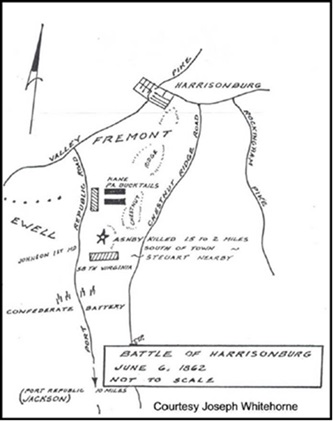
Map of the Battle of Good’s Farm or Chestnut Ridge

In the fighting that would take place later that day, a battle variously named the Battle of Harrisonburg, Chestnut Ridge, and Good’s Farm, the combat would prove costly for the Confederacy. Though the skirmish would be a victory for the Confederates, Turner Ashby would have his horse shot out from under him while resisting an attack by a detachment of Pennsylvania Bucktails. Back on his feet he was immediately struck by a bullet and killed. Jedediah Hotchkiss believed he may even have been the victim of friendly fire.

Ashby’s body was quickly removed from the battlefield and his corpse was draped across a horse in front of one of his cavalrymen. The men accompanying the body were observed “crying… like children.”  The soldiers placed his body in the front parlor of the Frank Kemper House, which is the Museum currently operated by the Shenandoah Valley Battlefields Foundation. Ladies from the town prepared his body for burial. One of the women placed a rose over the spot where the bullet had entered his body.

A brief funeral service was held at the Kemper house. General Jackson would, afterwards, enter the room to pay his final respects. According to the Reverend Major Robert Dabney, Jackson “remained for a time in silent communication with the dead, and then left him, with a solemn and elevated countenance.” Ashby’s body would be transferred by ambulance for burial in Charlottesville. After the war it would be moved and interred at the Confederate Cemetery in Winchester.

Following the battle Colonel Percy Wyndham was mounted on a horse and escorted to Port Republic. His ride must have been mortifying for instead of “bagging Ashby” he himself had been bagged. After crossing the bridge over the North River, he and his escort were redirected to Jackson’s headquarters at Madison Hall. Jackson would intercept the Englishman enroute at the Lee Hotel on Main Street. Stonewall would inquire of him why “he had come to fight Confederates when most Englishmen were pro-Southern.” Wyndham replied that General Ashby “had become so famous he had joined the Union Army with the intention of capturing or killing him.”

 Colonel Wyndham, described as “handsome, dashing, with luxuriant mustache, and a natty uniform,” “voiced his loud disgust” as he was transferred to Jackson’s headquarters at Madison Hall. Bleeding from a minor head wound, he gave his parole and was given the honor of sleeping on a hardwood floor during his brief stay at Port Republic. Shortly thereafter he was transferred to Libby Prison in Richmond.  His time in Confederate hands would be brief as he was exchanged shortly after his capture on August 17. It is said that his temperament and discourse was so irritating to Confederate guards and authorities that they were anxious to have rid him.

Following the swap, Wyndham returned to the 1st New Jersey Cavalry where he would lead his regiment at the Battle of Thoroughfare Gap in August 1862. At 9:30 a.m. Wyndham’s troopers encountered Longstreet’s vanguard while attempting to fell trees across the road on the east side of the gap. Though Wyndham dispatched a courier for reinforcements he was forced to meet the Confederate advance alone. Outnumbered and outflanked Wyndham was soon driven from the ravine. As a result, Longstreet’s Corps was allowed to join Jackson at the 2nd Battle of Manassas.

Later that year Wyndham was promoted to brigade command, which included his own 1st New Jersey, the 12th Illinois, 1st Pennsylvania, and the 1st Maryland Cavalry. In early 1863, while his brigade was headquartered at Fairfax Court House, Wyndham was given the task of running down John S. Mosby’s guerrillas. Wyndham had publicly insulted Mosby by referring to the Confederate partisan’s men as “a pack of horse thieves.”

The accusation incensed the Confederate cavalryman. In retribution, Mosby decided a personal response was in order. When a deserter from the 5th New York Cavalry disclosed the location of Wyndham’s headquarters, Mosby decided he would launch a raid on the town and capture Wyndham.

In the early morning hours of March 9, 1863, Lieutenant John Singleton Mosby led 29 Confederate rangers east along the Little River Turnpike in northern Virginia, quietly passing through a gap in the Union lines and soon arriving at Fairfax Courthouse.  Mosby entered the heavily guarded town a little after 2 a.m. in order capture Wyndham. Unfortunately, Wyndham had gone into Washington for the evening and was spared the humiliation of being apprehended for a second time. Still, Mosby was able to capture the slumbering Brigadier General Edwin Stoughton, several infantrymen, and a large quantity of horses.

On June 9, 1863, while serving as the 2nd Brigade commander under General David Gregg, Wyndham led a charge on the Confederate right flank on Fleetwood Hill at the Battle of Brandy Station. During the heavy fighting that ensued he suffered a serious leg wound. During his recovery, he was reassigned to duty in Washington, D.C., and he never again returned his brigade.

Subsequently, Wyndham’s application for promotion to Brigadier General was denied even though Major-General Joseph Hooker praised him greatly. Hooker had said of him “I found him capable, prompt, and efficient… and with an enemy in his front, enterprising and brave”. The rejection occurred following a fellow officer’s accusation “of disloyalty and of considering transferring to the Confederate Army.” Though Wyndham would continue to draw his army pay for some time, he officially retired from Federal service on July 5, 1864.

Wyndham would take part in several ventures following the Civil War. He relocated to Calcutta, India, and later to Rangoon, Burma. On February 3, 1879, his obituary appeared in the London Times. In part it read: “News of a sad accident comes from Rangoon. Colonel Percy Wyndham, a gentleman well known in Calcutta and Rangoon, announced an ascent in a balloon of his own construction. After attaining a height of about 500 feet the balloon burst, and the unfortunate aeronaut fell into the Royal Lake, whence he was extricated quite dead.” He was buried in Cockermouth Cemetery, in Allerdale Borough, Cumbria, England.

Holmes Conrad would also survive the war. In 1865 he began the study of law in his father’s office in Winchester, and on his admission to the Virginia bar in January 1866, joined his father’s practice. In 1878, he was elected to the Virginia legislature, serving until 1882. Over the next few years, he became a prominent member of the Virginia bar and acquired an influential position in the Democratic Party. In 1893 President Grover Cleveland appointed him Assistant Attorney General of the United States, and in 1895 he became Solicitor General. Following his death in 1915, he was buried in Mt. Hebron Cemetery in Winchester, Virginia.

Sources:

Cozzens, Peter. Shenandoah 1862: Stonewall Jackson’s Valley Campaign. University of North Carolina, Chapel Hill. 2008.

Hotchkiss, Jedediah. Make me a Map of the Valley: The Civil War Journal of Stonewall Jackson’s Topographer. Southern Methodist University Press. 1973.

Krick, Robert. Conquering the Valley; Stonewall Jackson at Port Republic. William Morrow and Company, Inc. New York. 1996.

Pyne, Henry. The history of the First New Jersey Cavalry, (Sixteenth Regiment, New Jersey Volunteers). Public Domain. 2018.

Robertson, James I. Stonewall Jackson: The Man, the Soldier, the Legend. MacMillan Publishing. New York. 1997.

Sherwood, W Cullen and Ritter, Ben. Americas Civil War. November 2006.

Wert, Jeffry. Mosby’s Rangers: The True Adventures of the Most Famous Command of the Civil War. Simon and Schuster Paperbacks. New York. 1990.

Winchester Evening Star. Edward H. McDonald. May 1904

Col. Sir Percy Wyndham

https://en.wikipedia.org/wiki/Percy_Wyndham_(soldier)

Ô Canada

At the time of the American Civil War Canada was comprised of several British colonies. There was Canada West and Canada East or what is now Ontario and Quebec. There was also the Maritime Colonies which included Nova Scotia, New Brunswick, Prince Edward Island, and Newfoundland. The Country of Canada as we know it today would not be created until 1867, two years after the American Civil War.

Britain, and her colonies, quicky declared themselves neutral when the Civil War broke out, announcing it would support neither the Union nor the Confederacy. As a result, Canada and the Maritimes were officially nonaligned. Still, most Canadians were largely opposed to slavery, and as we know they had long been the terminus of the Underground Railroad. Close economic and cultural ties across the border, though, encouraged Canadian sympathy towards the Union cause. Record keeping was rather slapdash back then, so exact numbers are impossible to determine, but it is estimated that between 35,000 and 50,000 Canadians fought in the war. Most fought for the North but several hundred, especially many of those that lived in the Maritimes, fought for the Confederacy. About twenty-five hundreds of these Canadians were black. Countless of these were escaped slaves.

Lots of those that volunteered were already working in the United States when the war began and countless numbers of them joined with local regiments. Others left Canada to enlist. “Some were tricked, bribed and even kidnapped by ruthless American recruiters, called crimpers.” Canadian and Maritime soldiers and sailors fought in nearly every battle of the American Civil War. By the end of the war, many had become officers and twenty-nine of them would earn the Congressional Medal of Honor.

Edward Edwin Dodds, for example, was born in Chesire, England in 1845. His family emigrated to Port Hope, Canada West, (Ontario) in 1859. At the age of 18, Dodds took a steamer across Lake Ontario to Rochester, New York and enlisted for a three-year term of military service. He enrolled on July 31, 1863, and was officially mustered in on August 28 as a private in Company C of the 21st New York Volunteer Cavalry (also known as the Griswold Light Cavalry).

The regiment served in the Department of Washington until January 1864, when it was assigned to Brigadier General George Crook’s Army of West Virginia. His regiment was designated as part of Colonel Andrew McReynolds’ 1st Brigade in Major General Julius Stahel’s First Cavalry Division. Colonel William B. Tibbitts was their regimental commander.

Post War Photo of Sergeant Edward Edwin Dodds

Dodds was promoted to the rank of sergeant on May 1, 1864, and in less than a week he found himself attached to General Franz Sigel’s command advancing up the Shenandoah Valley. On May 15 the leading elements of this Union Army, including the 21st New York, would begin to arrive at New Market. Sigel’s Army of West Virginia, though, was strung out along the Valley Pike all the way from Woodstock to New Market.

The Battle of New Market began midmorning with General John Breckinridge’s Confederate forces and Colonel Augustus Moor’s Union Brigade engaging each other on the west side of town. As the day progressed General Sigel arrived and began to push slowly reinforcements into the battle as they arrived. As the fight escalated the Union Army was driven steadily back. General Breckinridge reluctantly realized that if he was to win the battle, he would need to call up all his reserves, including the Cadets from the Virginia Military Institute. With these young boys thrown into the fight it began to look like the Confederates would carry the day.

Out of desperation, General Stahel ordered his entire Union cavalry division to form up on the east side of the Valley Pike. Colonel William Tibbitts, who had recently been promoted to command of the 1st Brigade, was to lead the charge. The 14th Pennsylvania and the 21st New York were to be at the head of the column. Sergeant Dodds was about to see the elephant for the first time.

As the cavalry attack pushed forward a hole opened in the rebel line and the cavalrymen plunged in. Musket fire was directed at them on the right by the 22nd Virginia and on the left by the 23rd Virginia Battalion. Artillery fire from three batteries raked them from the front. One of the federal cavalrymen remembered that they “mowed us down like grass.”

The Union cavalry attack was quickly repulsed with significant casualties. Sigel’s army was completely routed from the field. The cavalrymen of the 21st New York joined in the general retreat from the battlefield. The regiment, itself, was fortunate as they had just three troopers killed, twelve wounded, and three captured in the desperate assault. Sergeant Dodds had escaped completely unscathed.

The 21st New York led the retreat down the valley. About 3:00 A.M on May 16 the regiment arrived at Strasburg and setup camp. Colonel Tibbitts’ Brigade was in poor condition. They were short on arms, ammunition, and food. Though the men in the regiment considered the recent battle hard fought commanding General Ulysses S. Grant did not see it that way. Disappointed and angry with the outcome of the fight he quickly ordered General Sigel to be replaced.

Sigel would retreat his army to Cedar Creek and establish his headquarters at Belle Grove Plantation. Late on May 21, Major General David Hunter arrived at Middletown and relieved Sigel of his command. Hunter informed him that he had been ordered to take charge of the Union Army’s Reserve Division at Martinsburg.

General Hunter had been ordered by General Grant to move immediately to Staunton and join up with Generals George Crook and William Averell. If possible, he was to advance on Charlottesville or Lynchburg destroying everything of military value on his way especially the railroad. Hunter began his movement on May 25. He ordered his men to pack eight days rations and one hundred rounds of ammunition. Any additional food was to be foraged from the residents of the Shenandoah Valley.

Captain James Graham of Company H was detached with the 21st New York’s small rear echelon unit prior to General David Hunters departure from Cedar Creek. Edward Dodds would be assigned to this unit. The main body of the regiment would remain with General Hunter’s command. The small detail was to be dispatched to Camp Stoneman, which was a military post named after General George Stoneman, a prominent Union cavalry commander. The base was located near Washington D.C. and served as a staging area for cavalry troops. Graham’s job was to receive the new recruits that had arrived from Troy, and other New York state recruiters, and shape them into cavalrymen. On June 17, Captain Graham along with the small detachment of New York troopers brought fifteen hundred cavalry reinforcements from Camp Stoneman to the Shenandoah Valley.

While all this was transpiring General Hunter would fight a costly but successful battle at Piedmont. He would continue on to Staunton and Lexington burning key infrastructure as he went. In his assault on Lynchburg, he ran up against a determined foe in the form of General Jubal Early’s Second Corps. Following several clashes with Confederate troops Hunter rashly decided to withdraw. While the rest of Hunter’s men were making their way back to Martinsburg by way of Parkersburg and Charleston, West Virginia, Jubal Early’s Army was making its way down the valley on their way to Washington D.C.

The main body of the 21st New York would not arrive back in Martinsburg by train until July 15. In the waning days of June, however, the so-called Reserve Division, which included the detachment from the 21st New York Cavalry saw action several times from their base camp at Bunker Hill. The troops stationed there were commanded by Union General Franz Sigel.

In the early morning of July 3rd, for example, a detachment of Colonel Harry Gilmore’s cavalry numbering about one hundred men initiated a foray toward Bunker Hill along the Martinsburg Pike. A small party of the 21st New York had been designated to guard the ford at Mill Creek. Gilmore launched a surprise attack out of the early morning fog on the New York boys. The detail was quickly routed and forced to retreat to Buckletown about five miles south of Martinsburg. Following along on their heels Gilmore attempted a second charge. The regiment was ready for him this time. The New Yorkers fired several volleys into the Confederate cavalry as they advanced and then launched their own counterattack sending Gilmore’s men reeling up the Martinsburg Pike.

Under mounting pressure from Jubal Early’s Army Sigel withdrew his troops from Martinsburg to Maryland Heights attempting to defend the town from an assault by Confederate forces. During their retreat the 21st New York ran up against the Confederate rear guard outside of Martinsburg. The unit made two desperate charges against rebel pickets and were finally able to break through and cross the Potomac River. The cavalry regiment continued on to Harpers Ferry and Sandy Point where they were shielded by the guns on Maryland Heights.

Early sent troops to seize Bolivar Heights and Harpers Ferry. Once again, as in previous attempts, Federal forces offered little resistance, instead retreating to the protection of the siege cannons on Maryland Heights. This defense, however, delayed Early for two days and undoubtedly helped save Washington. Sergeant Edward Dodds, however, was wounded in the fighting here.

The 21st New York was not directly involved in combat at the Battle of Monocacy. The regiment did engage with Early’s rear guard on the Monocacy Battlefield after the fighting had ended, however, chasing it for four or five miles. When the unit ran up against concentrated artillery fire, they prudently retreated to the Monocacy River. Losses amounted to one killed, one wounded, and one captured.

Dodds recovered from his wound, and his rear echelon detachment rejoined the main body of the 21st New York shortly after their arrival at Martinsburg on July 15. Within hours they were dispatched to Harpers Ferry to join in the effort to intercept Jubal Early’s Army on its retreat from Washington. When news reached General Duffié, who now commanded the cavalry division, that Early’s wagon train was unprotected and heading toward Ashby’s Gap he dispatched his first brigade commander, Colonel William Tibbets, to intercept it. At this moment the brigade consisted of the 21st New York Cavalry, a small number of cavalrymen from the 2nd Maryland, as well as a section of artillery from Battery B of the 1st West Virginia Artillery. Total strength was about 270 men.

Colonel Tibbitts spotted the wagon train at about four in the afternoon and set up an ambush to try to capture or destroy the wagons. The 21st New York came swooping down on the procession while the 2nd Maryland, outfitted with repeating carbines, attacked from the rear. Confederate forces were soon able to mount a counterattack forcing the 21st New York to retreat. Still, nearly 40 wagons were captured, while many others were destroyed. Fifty or more prisoners were taken. The regiment had one killed, five wounded, and twelve captured.

About 9:00 A.M on the morning of July 17, General Duffié was ordered to escort James Mulligan’s Infantry Brigade from Harpers Ferry to Snicker’s Gap in the Blue Ridge. The detail reached Snickersville at about 1:30 in the afternoon. After a short rest they descended the mountain to the west bank of the Shenandoah River where they immediately came under fire from Confederate infantry dug in on the opposite shore.

Battle at Castleman’s Ferry July 17-18, 1864 (Map Modified by the Author from Hotchkiss Map located in the Library of Congress)

Mulligan decided he would try to force his way across the river at the ford. The river was waist deep and fast moving “with a bottom that was rocky, slippery, and uneven.”  A charge on the Confederate forces on the opposite shore was contemplated but was quickly reconsidered due to heavy the heavy musket and artillery fire. About 6:00 P.M. Tibbitts became discouraged with the standoff but did not order his men to retreat back up through the gap until dark. He left a small picket line behind to secure the position on the west bank.

Later that evening when things had quieted down Tibbetts began to think Gordon might have withdrawn his forces on the other side of the river. At about midnight the order was given to the 22nd Pennsylvania to attempt a crossing. As horses began to wade into the river the suddenly came alive with bright flashes of fire. Gordon’s men had not gone anywhere. The attack was quickly called off.

On the morning of July 18, General George Crook arrived at the gap and ordered another crossing to be attempted. Colonel Duffié directed the 22nd Pennsylvania to make a coordinated attack with seventy-five cavalrymen. They were to attack in three columns, one hundred yards apart, each containing twenty-five men. The assault immediately came under heavy fire from sharpshooters on the far bank. Convinced that the opposing shore was securely manned, the attackers were called back.

Casualties at Castleman’s Ferry were light. Seven members of the 21st New York were killed and two were captured. The failed crossings convinced General Crook, however, that it would be better to force a crossing downstream and launch an attack on the Confederate left flank. This decision would culminate in Union Army’s defeat at the Battle of Cool Spring.

Following the two failed attempts to force a crossing at the ford General George Crook ordered Duffié to ride with his fellow cavalrymen to Ashby’s Gap, cross the river, and threaten Early’s supply train. Shortly after noon Duffié’s Cavalry Division was dispatched from Castleman’s Ferry. By 7:00 P.M. that evening, the 21st New York had reached the town of Paris, Virginia, adjacent to the gap. They bivouacked here for the night.

At 7:00 A.M. the following morning Duffié’s Division crossed through the gap to Berry’s Ferry on the Shenandoah River. Lieutenant Colonel Gabriel Middleton’s Brigade led the push across the river. John Imboden’s Brigade, however, was concealed on the opposite bank and when the Federals were part way across the river, they opened up on them. Elements of the 1st New York and 20th Pennsylvania Cavalry continued their advance under heavy musketry fire. Though they experienced some initial success they were eventually forced to retire back across the river.

Colonel Tibbets deployed some of his dismounted cavalrymen along the eastern riverbank and instructed them to maintain their fire on the opposite shore. About four in the afternoon Tibbitts was called to Duffié’s command post. Duffié ordered Tibbitts to force a crossing of the river. Tibbitts voiced the opinion “the stream could not be crossed owing to the enemy and their location.” Duffié refused to listen and Tibbitts was left with no choice but to comply with the order.

Colonel Tibbitts chose the 21st New York to make the crossing. He ordered Colonel Charles Fitzsimmons, who commanded the New Yorkers, to commence a mounted charge across the Shenandoah River and secure the opposite bank. The 1st New York was ordered to provide support. There was to be a short artillery bombardment by Keeper’s Battery and then the New Yorkers were to sound the charge.

Map Adapted from Jedediah Hotchkiss Map. (Library of Congress)

When the artillery barrage was completed the 21st New York, with fewer than 300 men, dashed across the river to the opposite bank.  Several of the men broke through the Confederate line and drove on to within a few yards of the howitzer on the hill. The volume of fire from the Confederates was considerable. The 18th Virginia fired at the attackers on their right and the 62nd Virginia charged them on their left. Unsupported the 21st New York was forced to retreat. Colonel Fitzsimmons was shot in the wrist and at least eighty of the regiment’s officers and men were lost before the unit could make it back to safety on the eastern shore.

Late 1800’s Photo of Berry’s Ferry at Ashby’s Gap. The 21st New York Cavalry Attack Would Have Come from the Opposite Shore (Clark County Historical Society)

Following is an account published in the Rochester, New York, Democrat and Chronicle on June 13, 1896. “The 21st N. Y. Cavalry crossed the river at Ashbey’s [sic] Gap, in their advance, and very soon afterwards came upon the enemy in force, in the woods, who opened a sharp fire upon them. They were not nearly sufficient in number to withstand the attack and a retreat was ordered. At this time the captain of C Company (Lewis Truesdell) was severely wounded and his horse killed, and the captain found himself unable to extricate himself from his fallen horse. With the bullets flying around him, Sergeant Dodds dismounted, disengaged his captain and assisted him onto his own horse, which he also remounted. The enemy had meanwhile got around to the rear, and when our hero arrived at the ford he found it already occupied. Undismayed by this circumstance he turned his horse along the bank until he came to a favorable spot, when he leaped his horse into the river and swam across under fire, reaching the union lines in safety with his captain, who afterwards recovered and is among those who testified to the war department as to the incident.”

Casualties in the action were substantial. Among the wounded was Captain Lewis Truesdell whom Sergeant Dodds had saved from capture. Also on the wounded list was Edward Dodds himself. The wounds must have been superficial as both men were back with their regiment on July 24 in the events leading up to and including the Second Battle of Kernstown. As a matter of fact, Captain Truesdell was wounded there once again when a bullet glanced off another cavalryman’s saber and struck him in the shoulder.

In the month-long period following the 2nd Battle of Kernstown the 21st New York spent its time refitting and reacting to rumors of Confederate incursions into West Virginia and Pennsylvania following the burning of Chambersburg. Dodds and his regiment were dispatched to guard various fords along the Potomac River. General Philip Sheridan assumed overall command of the Middle Military District on August 7 at which time the New Yorkers were ordered to march to Harpers Ferry to join with the rest of the army.

Action at Charlestown August 21, 1864 (Author Adapted the Hotchkiss Map Located at the LOC)

On the morning of August 24, Duffié’s Division was positioned west of Charles Town on the Leetown-Charles Town Road. During the fighting here Tibbet’s Brigade rode into an ambush. Gilmore’s troopers were concealed in a wood and fired upon them as they attempted to pass. Most of the brigade’s casualties were suffered by the 12th Pennsylvania Cavalry. One of the members of the 21st New York who was wounded, though, was Sergeant Edward Dodds. He was injured, apparently, while firing from a prone position. A bullet struck Dodds in the face, glanced off his cheekbone, and ricocheted into his right arm.

The wound was serious and required the amputation of Dodds’ right limb. If you view the post war photo of him above only his left arm is exposed. The injury necessitated some extended recovery time in the hospital. Instead of receiving a discharge, though, six weeks after losing his arm Sergeant Dodds asked he be allowed to rejoin his command. Dodds reported back to the regiment for duty at Pleasant Mountain Remount Camp, which was situated between Elk Mountain and South Mountain in Maryland. He remained on duty there as a clerk with this detail until the close of the war, when he mustered out with his comrades. Dodds was, in fact, discharged on a surgeon’s certificate of disability on July 29, 1865, at Alexandria, Virginia “by reason loss of right arm and other wounds received.”

For his outstanding bravery and courage at the Battle of Ashby’s Gap Sergeant Dodds was awarded the Medal of Honor on June 11, 1896. Though he is certainly not the only man to earn the distinction while serving in the Union Army he is the only Canadian to do so while fighting in the Shenandoah Valley. His citation reads: “While engaged with Confederate forces at Ashbys Gap, Virginia, on July 19, 1864, a captain of the 21st New York Cavalry fell wounded on the battlefield and lay at the mercy of the enemy. Without regard for his own safety, Sergeant Edward Dodds braved the fusillade to go to his captain’s side and carry him to a place of safety.”

Marker Outside the Canton Cemetery in Ontario Commemorating Edward Edwin Dodds receipt of the Congressional Medal of Honor.

Following his discharge from the U.S. Army and 21st New York Volunteers, Edward Dodds opted to remain in the United States. Settling in Rochester, New York, he secured employment as a reporter with Rochester’s newspaper, the Democrat and Chronicle. During the 1870s he chose to return home to Canada where in 1877 he became the Town Clerk of Hope Township in Northumberland County, Ontario. From October 13, 1892, until at least early 1896, he served as the U.S. Consular Agent for Port Hope’s Peterborough office. Dodds died on January 12, 1901, and was laid to rest where his parents had been interred at the Canton Cemetery in Canton, Ontario.

Twenty-nine Canadians received the Medal of Honor for their actions during the American Civil War. At least nine of these recipients are buried in Arlington National Cemetery. Again, it should be noted only one of these Medal of Honor recipients, Edward Dodds, is buried in Canada.

Only four Canadians were awarded the Medal of Honor after 1900. One of those was Douglas Munro who was born in Vancouver, Canada. He is the only person from either country to have received the medal for actions performed during their service in the United States Coast Guard.

Medal of Honor Citations for individuals born in other countries other than the U. S. during the Civil War:

Australia 1, Austria 1, Chile 1, Czeck Republic 1, Denmark 2, England 46, France 12, Germany 45, Hungary 1, India 1, Ireland 102, Italy 2, Malta 1, Netherlands 2, Norway 6, Poland 1, Russia 1, Scotland 18, Spain 2, Sweden 5, Switzerland 1, and Wales 6.

Of the 1,522 Medals of Honor issued for service in the Civil War, including Canada, 287 (19%) were awarded to foreign born soldiers.

More to come.

Sources

Bonnell, John C.  Sabres in the Shenandoah: The 21st New York Cavalry, 1863-1866. Burd Street Press. Shippensburg, Pa. 1996.

Knight, Charlie. Valley Thunder: The Battle of New Market and the opening of the Shenandoah Valley Campaign May 1864. Savas Beatie. New York, N. Y. 2010.

Noyalas, Jonathan. The Blood-Tinted Waters of the Shenandoah: The 1864 Valley Campaign’s Battle of Cool Spring, July 17-18, 1864. Savis Beatie LLC. El Dorado, Ca. 2024.

Patchan, Scott. Shenandoah Summer: The 1864 Valley Campaign. University of Nebraska Press. Lincoln, Nebraska. 2007.

Generations of “Old Blood and Guts”

I remember, when as a young adult back in Maine, spending some quality time one evening watching a World War II movie with my dad. The film was called Patton. The motion picture had come out in 1970 so I would have been a senior in high school at the time. After the film was over, I thought this might be an appropriate time for me to quiz him once again regarding his wartime experiences. He had always been very evasive on the subject, stating he had few fond memories from that time. As a young boy I had often interrogated him on the subject. This time I thought he might feel more comfortable addressing the subject. He was not.

My Dad had fought as a private first class with the 28th Infantry Division during the war. The patch they wore on their shoulder was a red keystone symbolizing the State of Pennsylvania. The unit had been given the nickname “Bloody Bucket” division by German forces due to the shape and color of its keystone insignia. In little more than a month after landing at the Normandy beachhead, as part of the Allied invasion of Normandy, the men of the 28th had entered Paris and were given the honor of marching down the Champs-Elysées on August 29, 1944. My dad had mentioned this honor several times.

28th Infantry Division Patch

The 28th suffered extremely heavy casualties that autumn during the costly Battle of the Hürtgen Forest which took place between September 19 and December 16. The campaign was the longest continuous battle the U.S. Army fought during World War II. My dad once told me he had frozen his feet on a cold December night in that woodland. He said most of the men in his company had never been fitted with the proper winter footwear.

Sometimes he would talk about how cold it had been during “the Bulge.” He once confided to me that on one of those freezing nights, during an artillery bombardment, he had been compelled to leave his foxhole to relieve himself. In his absence his bunker received a direct hit from German artillery fire killing every one of his comrades hunkered there. It always brought tears to his eyes when he talked about it. I asked him once if he would like to attend one of the 28th Infantry Division’s reunions. He told me all the people he would like to see again had been killed in that foxhole and buried in Liege, Belgium.

Coincidentally, one of the most memorable events about which he often spoke was a close encounter he had with a high-ranking army officer. He said he was ambling down a street one cold winter morning and was attempting to pass by a man who was approaching him dressed in what appeared to be a private’s uniform. The soldier suddenly grabbed my dad by the arm, spun him around, and demanded that he salute him. He interrogated my father as to why he had not done so. He warned him he could be court martialed for not saluting a superior officer. The officer addressing him was “Old Blood and Guts” himself, George S. Patton the III. Fortunately, my dad was never punished or court martialed for his transgression. He did say the incident “scared the bejesus out of him” though. My dad passed away in 2004 and the story of the George Patton encounter would be the one war story he related most often.

General George S. Patton III of WWII Fame.

My narrative, though, is not about George S. Patton III, or my father, but it is about George S. Patton Senior, George’s grandfather. George Sr. was born in Fredericksburg, Virginia in 1833. He graduated from Virginia Military Institute in 1852 second in his class. Patton would go on to teach school in Richmond while at the same time studying law. He would resign his position in the fall of 1855 after being admitted to the Richmond Bar Association. In November of that same year, he and Susan Thornton Glassell of Alabama would be married. “On their wedding night the couple headed for Charleston, Kanawha County, in what is now West Virginia. Patton had been offered a partnership in a small law firm.”

Colonel George Smith Patton, Sr.

In 1856 George organized a militia company called the Kanawha Minutemen, later the Kanawha Riflemen. The company had a strength of from 75 to 100 men, of whom 20 were lawyers. “The company was comprised of the Kanawha Valley’s social elite. They performed at public functions throughout the state, earning a reputation that they could perhaps dance better than they could fight.” Such thoughts were put to rest in 1861 when the Riflemen became the foundation of the 1st Kanawha Regiment, which would later evolve into the 22nd Virginia Infantry.

When the Civil War broke out Patton enlisted on May 8, 1861, becoming the captain of Company H of the 22nd Virginia Volunteer Infantry.  Patton’s first experience with combat came on July 17, 1861, at Scary Creek, just a few miles outside of his hometown of Charleston. Recently commissioned as a lieutenant colonel, Patton commanded some eight hundred and fifty men who were part of a force under the direction of Brigadier General Henry Wise. This small Confederate army had been tasked with resisting a Union push up the Kanawha Valley. The Federals were part of Brigadier General George McClellan’s drive into western Virginia from Ohio. Late in the battle, while trying to rally routing troops, Patton was struck by a minie ball in the right shoulder. The impact of the bullet shattered the bone and threw him from his horse.

Patton was transported to the rear and was informed that his arm needed to be amputated. Patton refused to have the limb removed. To emphasize his determination to keep the extremity he is reputed to have pulled a pistol and threatened his caretakers. Patton kept his arm, but never regained full use of it. The Confederates did not win the battle and were forced to retreat from the Kanawha Valley. Unable to be moved because of his wound, Patton was left behind and captured. A few weeks later he was paroled and went home to recuperate. He would spend the next eight months recovering from his wound.

Returning to his regiment Patton saw action again on May 10, 1862, when he led the 22nd Virginia in an attack against a Union regiment at Giles Court House in Virginia. Brigadier General Henry Heth led a small brigade, including the 22nd and 45th Virginia, against the 23rd Ohio, now under the command of Lieutenant Colonel Rutherford B. Hayes. According to the May 20, 1862, edition of the Richmond Dispatch “the command of General Henry Heth was informed that they would meet the enemy on the following morning, and preparations were at once made for an advance. At daylight the next morning the column reached the vicinity of Pearisburg, the enemy’s pickets were driven in, and a general firing commenced, the 45th on the right, and the 22d on the left. The fight lasted one hour and thirty minutes, when the enemy were driven from their position, through the town of Pearisburg and down New river below the Narrows. Our forces behaved with great gallantry, and kept up the pursuit as far as the Narrows. The loss on our side was one killed and seven or eight wounded.” Among the injured was George Patton.

Colonel Patton had been wounded once again. This time he had been shot in the abdomen. “Patton was laid against a nearby tree and, fearing that he was dying, he began writing a farewell note to his wife. General Wharton, his brigade commander, rode up and asked him how he was doing. George answered that he believed the wound was fatal. According to Patton’s son, George William, Gen. Wharton dismounted and asked if he could examine the wound. He stuck his unwashed finger into it and exclaimed, ‘What is this?’ as his finger hit something hard. He then fished around and pulled out a ten dollar gold piece. The bullet struck this and had driven it into his flesh and glanced off.” Patton would survive his injury.

Patton’s finest hour, however, probably came at the Battle of New Market. The 22nd Virginia Infantry Regiment was part of a small army under the command of Major General John C. Breckinridge. The army had been quickly created to resist a Union thrust under Major General Franz Sigel who was pushing up the Shenandoah Valley. The Confederates were so greatly outnumbered they had to call upon 247 cadets from the Virginia Military Institute to serve as reinforcements. One of the cadets who would fight with the Corps of Cadets was Patton’s youngest brother, William Mercer Patton.

The fight took place on May 15, 1864. In the ensuing battle the Confederates made a stand against superior numbers of Union troops. During the latter stage of the battle, Patton was commanding the First Brigade in place of the sickly Echols. Patton’s two regiments numbered about a thousand men. He was defending the right of the line against a Union cavalry charge which was attempting to break through and outflank the Confederate line. When the cavalry charge broke through, Patton maneuvered the 22nd Virginia and the 23rd Virginia to either side of the gap in the line creating a deadly crossfire. The cavalry charge led by Major General Julius Stahel ran straight into ten pieces of artillery including six guns from Chapman’s Battery, a section of artillery manned by VMI cadets, and two guns from McClanahan’ battery under Lieutenant Carter Berkeley. The combined Confederate firepower devastated the Union cavalrymen, forcing them to route to the rear. Many troopers were killed, wounded, or captured.

On September 19, 1864, at the Third Battle of Winchester, Colonel Patton again found himself in command of Echols’ brigade. When the engagement opened, Patton’s brigade was first tasked with supporting Confederate cavalry along the Martinsburg Pike North of Winchester near Stephenson’s Depot. As the battle expanded in his rear Patton was gradually forced to move his brigade south toward Winchester and to the east side of the Pike. By late afternoon Patton’s brigade anchored the Confederate left flank near the Hackwood Plantation. 

Patton’s Retreat from Hackwood at the 3rd Battle of Winchester. (Map provided by SVBF, and made by H. Jesperson)

Around 3 pm, as Major General John Gordon’s Division was being pushed back, Patton’s three regiments were making a stand on the left of the line against a determined attack by Colonel Isaac Duval’s Division. On his right, Gordon’s division began to fall back under pressure from Colonel George Well’s and Colonel Thomas Harris’ Infantry Brigades and from the 1st New York Dragoons and the 9th New York Cavalry on their left. Cut off and nearly surrounded Patton was forced to retreat. It was during this retreat and attempted rally that Patton was struck in the right leg by a jagged piece of iron from a bursting artillery shell.

Robert H. Patton, in his book on the Patton family, described George Paton’s wounding: “He was standing in his stirrups on a Winchester Street when an artillery shell exploded nearby and sent an iron fragment into his right hip. He’d been trying to rally his men, who were in full retreat before onrushing Yankee cavalry….” He was taken to a nearby house and later captured.

Philip Williams House where George Patton Died from His Wounds.

George S. Patton II and George S. Patton III at the grave of George S. Patton Sr. who was killed during the Third Battle of Winchester.

Patton twisted in agony until Union soldiers captured him and took him to the home of Philip Williams on Piccadilly Street. The amputation of his right leg was recommended by Union physicians, but Patton refused as he had once before when wounded in the arm. Within a few days gangrene set in and on September 25, 1864, he died of his wound. His body was interred in the Stonewall Cemetery, in Winchester, not far from where his wound had been inflicted. He was buried next to his brother Colonel Waller Tazewell Patton of the 7th Virginia Infantry who had been mortally wounded at the Battle of Gettysburg during Pickett’s Charge.

Neither George Patton senior or George Patton junior would gain the same notoriety as the third descendant in the Patton line for commanding a tank brigade in World War I or for commanding the Third Army in World War II. For the war in which George Senior fought he was the man the younger Patton regarded passionately as the quintessential soldier, one who had demonstrated extraordinary courage in battle and had met his demise while leading his troops in a desperate fight. His grandson would attempt to do the same during a German counteroffensive in the Ardennes Forest in December of 1944. Now you know the genesis of my father’s respect for a man who once threatened to court martial him for passing him by.

Besides George, six other Patton boys would go off to fight for the Confederacy.

  1. John Mercer (1826-1898) would become the commander of the 21st Virginia, but had to resign in August 1862 owing to poor health.
  2. Isaac William (1826-1890), would lead a Louisiana regiment and be captured at Vicksburg.
  3. William Tazewell (1835-1863), would command the 7th Virginia and be killed at Gettysburg during Pickett’s Charge.
  4. Hugh Mercer (1841-1905) became an officer in his brother’s 7th Virginia Infantry.
  5. James French (1843-1882) became an officer with George in the 22nd Virginia.
  6. William Macfarland (1845-1905) who was a cadet at VMI, would take part in the battle of New Market. 

Sources:

Patchan, Scott C. Shenandoah Summer: The 1864 Valley Campaign. University of Nebraska Press. Lincoln, Nebraska. 2007.

Patchan, Scott C. The Last Battle of Winchester: Phil Sheridan, Jubal Early, and the Shenandoah Valley Campaign, August 7 to September 19, 1864. Savas Beatie. El Dorado, California. 2013.

Richmond Dispatch. May 20, 1862

SVBF, Shenandoah Valley Battlefield’s Foundation.

https://warfarehistorynetwork.com/article/general-george-s-patton-sr-civil-war-veteran/

https://en.wikipedia.org/wiki/George_S._Patton

The Continentals

Within a matter of hours news of John Brown’s attack on Harper’s Ferry had gotten out to neighboring towns via telegraph and word of mouth. While attending a ball in Winchester, George Kurtz of the Continental Morgan Guard was made aware of Brown’s raid. Kurtz and Captain Hugh Low gathered their militiamen, departed the celebration, and headed for the train station.

Members of the Continental Morgan Guard militia unit hurried to the corner of Market and Water Street and boarded the passenger cars belonging to the Winchester and Potomac Railroad. Nobody recorded which locomotive was tasked for the journey. Each of the engines had names though including Ancient, Pocohontas, Farmer, President, Virginia, and Potomac. One of these was quickly pressed into service. The chief engineer, Thomas Robinson Sharp, would pilot the train on its thirty-two-mile journey to Harpers Ferry.

Norris 4-4-0 locomotive like the Ancient, Virginia and Potomac locomotive.

Once at Harper’s Ferry the company disembarked from the train and headed for the armory. They quickly surrounded the firehouse where John Brown was holed up. One member of the unit wrote, “we were in a skirmish line with our guns at port, our thumb on the hammer, and finger on the trigger”. They would remain in the town serving as backup to Robert E. Lee and his team of marines who were tasked with the job of securing the firehouse. The marines would punch a hole in the door of the structure, enter the building, and capture Brown and his band of insurrectionists. The squad of militiamen would remain in the area to until after the trial and execution of Brown and his accomplices to ensure nobody would conduct an operation to free the conspirators.

The Continental Morgan Guard, or Company A 31st Virginia Militia, had begun organizing on June 22, 1855, in Winchester, Virginia. The unit adopted uniforms resembling the pattern of the Continental Army. “The coats were made of blue wool with buff casimire trim. They wore white doe skin breeches, black top boots, buff casimire waist coats, and black tri-corner hats. The hats were trimmed with the brass numbers 1776 on them, a powder horn device made of brass on a leather cockade, and a flowing white swan plume. They also wore white ruffled shirts and white gloves to complete the outfit.”

Continental Guard and Soldier in Regular Dress.

Each member was required to secure for himself a uniform within sixty days of his election to the company. “It was an expensive outfit, costing more than some could afford. Much effort was expended in helping the volunteers with expenses, however. On April 3rd, 1857, for example, “the ladies of Winchester held a fair for the benefit of the ‘CMG’. The proceeds were enough to uniform fifteen new members who couldn’t pay for the cost of the uniforms otherwise.”

 On April 18, 1861, just six days after the firing on Fort Sumter, the “Continental Morgan Guards” enlisted in the Confederate Army. “On June 4th, they would become the oldest company assigned to the 5th Virginia Infantry CSA as Company K with 133 officers and men.

The 5th Infantry Regiment would be commanded by 59-year-old Colonel Kenton Harper. Harper had worn many hats including “newspaper editor, soldier, Indian agent, plantation owner, banker and politician.” He was also an officer of the Virginia militia which was then the U.S. Army during the Mexican War.  Eight days after having been given command of the 5th Virginia he helped General William H Harman lead a force of 2,400 men to seize the U.S. Army arsenal located at Harper’s Ferry. Four thousand muskets and thousands of tools were taken and sent to Tredegar Iron Works in Richmond to aid the war effort.

As far as the makeup of the regiment eight companies of the 5th Virginia Infantry would come from Augusta County and two from Frederick. On April 27, 1861, the 2nd, 4th, 5th, 27th, and 33rd Virginia infantry regiments, along with the Rockbridge Artillery Battery, were combined into what was to be called “Virginia’s First Brigade” and placed under the command of Brigadier General Thomas J. Jackson. During the war, the members would serve under Generals Thomas Jackson, Richard Garnett, John Winder, Elisha Paxton, John Walker, and William Terry.

Four companies from the regiment, including Company K, saw their first action at the Battle of Hoke’s Run, also known as the Battle of Falling Waters or Hainesville, which took place on July 2, 1861, in Berkeley County. The fighting was more a skirmish than a battle. Losses were light with the regiment suffering a total of eight casualties. Company K had just one of its members wounded.

In mid-July the 1st Brigade was ordered to join the main confederate army at Manassas. Outsmarting and outmaneuvering their Union adversary, General Robert Patterson, the unit departed from Winchester on July 18, marching thirty miles to Piedmont. Following breakfast, the soldiers were loaded onto railway cars belonging to the Manassas Gap Railroad for the thirty-four-mile train ride to Manassas. Disembarking at the junction the brigade marched to the battlefield and went into camp near Blackburn’s and Mitchell’s Ford, occupying the Confederate right flank along Bull Run.

Map of Bull Run Battlefield showing the 5th Virginia on the right of Jackson’s Line.

As the fighting began to heat up on the Confederate left flank on July 21, the 5th Virginia was sent to the right to reinforce Longstreet while the rest of the brigade marched two miles to the left of the line. When it became clear that the action at the fords was a feint, the 5th trooped to Henry House Hill and fell in on the brigade’s right flank. Jackson’s “instructions were to wait, fire, and charge the enemy as they appeared over the crest, about fifty yards in front.”  

Soldiers from Generals Bee and Evans’ Brigades were eventually forced to retreat from their advanced position. As they did so General Barnard Bee’s big moment came as he attempted to halt the retreat of his own soldiers. One story says Bee questioned Colonel Kenton Harper of the 5th Virginia asking: “What troops are these?” Harper replied, “Fifth Virginia Regiment, Jackson’s Brigade.” Bee turned and shouted to his men: “Rally men, rally! Look! These Virginians stand like a stone wall.” In doing so he gave the Brigade and Jackson their famous moniker.

About 2 p.m. Griffin’s and Ricketts’ Batteries were sent to an exposed position on the right of the Union line. A duel ensued between these guns and those belonging to General Jackson. The 33rd regiment advanced toward the guns and released a volley that devastated the union gunners. Jackson presently ordered a charge with the bayonet. “Yelling like furies” the 5th Regiment joined the rest of the brigade charging toward the enemy.

When the charge was ordered on the Union artillery in their front every company in the 5th Virginia claimed to be the first to reach the guns. Undoubtedly the members of Company K were mixed in with the crowd. The assault marked the climax of the Battle of Bull Run. The regiment suffered moderate casualties in the fighting. Of the 570 members of the regiment on the field that day there were 39 casualties. Eleven were killed and twenty-eight were injured. Company K suffered just four wounded.

Accounts from the battle tell us there were grey and blue uniforms worn by both adversaries during the battle. Both sides had contingents that sported colorful Zouave uniforms. “Many of their units donned all-gray outfits; many other poorer companies wore civilian clothes. Brigadier Generals Thomas Jackson and Barnard Bee, for example, dressed in their U.S. Regular Army dark blue uniforms.” “The thick black smoke made it extremely difficult for the commanders to identify the enemy. Rather than identify the gray clad regiments, officers ordered their men to fire.” “Friendly fire thus killed or wounded many Soldiers,” maybe even Brigadier General Bee.

What we do know from records left behind, the members of Company K were dressed in their unique Revolutionary War garb during this their first major battle. We cannot be certain, however, if the tradition carried on throughout the war. What we do know is the company would fight with Jackson in his famous Valley Campaign at Kernstown, 1st Winchester, and Port Republic. They would participate in all the campaigns of the Army of Northern Virginia throughout the war. The company would surrender fewer than a dozen of the 92 men left in the regiment at Appomattox Court House. Regardless of how they were clothed, members of Company K gave their all for the cause in which they believed.

5th Virginia Infantry. H. E. Howard, Inc. Lynchburg, Va. 1988.

https://en.wikipedia.org/wiki/Winchester_and_Potomac_Railroad#:~:text=The%20greatest%20use%20and%20value,and%20the%20Manassas%20Gap%20Railroad.

Page Valley War, Part 1: Lost and Alone in the Valley

Valley Civil War history is almost always about the Shenandoah Valley and its vital Valley Turnpike.  Whenever the parallel, smaller Page Valley is mentioned, it is seen as a sideshow to what was happening in the more well-known, larger Shenandoah.  Jackson’s Valley campaign in spring of 1862, when he marched from Luray to Front Royal in 1862, is one of the few Page Valley only operations that garners much attention.  The Page Valley however, on the south side of the Massanutten Mountain, has its own rich Civil War history. 

William Watlington

William Watlington found his own unique history within the Page Valley.  His story highlights the unique terrain and dangers that inhabited the region.  But first, some context.

September, 1864 was an eventful time in the lower valley.  The battle of Third Winchester had seen the Union army of Philip Sheridan throw Jubal Early’s Confederates out of Winchester in panic and confusion.  Early’s men scampered south to the impressive heights of Fisher’s Hill just south of Strasburg.  Sheridan had been frustrated by his Third Division of cavalry’s inability to get around the Confederate right flank and block the Valley Turnpike at Third Winchester.  Brigadier General James Wilson’s division was the smallest of Sheridan’s three cavalry divisions and a lackluster attempt to turn the Confederate flank had foiled Sheridan’s plan to bag Early’s entire army.

Sheridan, however, saw another opportunity to “put the cork in the bottle” once again as he approached Fisher’s Hill.  He ordered his Chief of Cavalry, Major General Alfred Torbert, to send horsemen down the Page Valley to Luray.  From there, Torbert was to ride through the New Market Gap and block Early from proceeding further south at New Market. 

Wilson’s division led the way and by September 20 they were skirmishing with Williams Carter Wickham’s small Confederate cavalry brigade just north of Front Royal.  The next day, Wickham’s force stymied the Union advance at Gooney Creek, about six miles south of Front Royal.  Torbert and the 1st Division caught up with Wilson and the plan was to resume the advance and breakthrough Wickham’s roadblock at Gooney Creek and race towards Luray.

Except Wickham wasn’t there on the morning of September 22.  The Confederate cavalry had retreated a few miles further south to the small village of Milford (present day Overall).  Here the valley narrowed considerably, and the Confederate position was formidable. After a few attempts to flank the Confederate position, Torbert called an end to fighting and retreated about four miles north of Milford.  The next morning, the Union horsemen continued their retrograde movement, crossing the North Fork of the Shenandoah River, seven miles from Strasburg around noon.  Torbert decided to report to Sheridan about this turn of events.  

The 3rd Indiana Cavalry was a veteran unit that had been re-organized into two companies upon the completion of its three years of service.  The two companies consisted of men who had reenlisted as well as recruits who had not yet served their three years of service.  Too small for combat assignment, the companies had been assigned as the escort for Third Division commander James Wilson.  Oftentimes, the escort was ordered to carry orders and messages between commands.  Three men from the escort were assigned the duty of carrying the report, William Watlington, Robert Gray, and a man named Ward. 

A recruit who joined the regiment in October, 1863, Watlington had also been under enlistment back in July when John Morgan made his raid through Indiana.  Armed with a sixteen shot Henry carbine while members of the regiment in Virginia were armed with single shot Gallagers and Sharps, he had been part of a home guard unit that protected Madison, Indiana during Morgan’s Raid.  Now a veteran of a year of service, Watlington would undergo a harrowing adventure in the Page Valley.

Initially, all went well.  Leaving the column, the three men moved quickly to Strasburg where they were told of the battle of Fisher’s Hill and that Sheridan had moved up the Valley to Woodstock.  Watlington recalled, “With a smooth pike now before us we pushed forward at a more lively gait.  At no time since leaving the command had we come down to a walk.”  This rapid pace had taken its toll on their mounts and Watlington and Robert Gray finally stopped at Fisher’s Hill to rest their horses while Ward rode ahead with the message.  After resting their mounts, Watlington and his companion rode back to Strasburg where they bivouacked with a group of infantry and four members of their cavalry division.

Having been given no orders beyond the delivery of the message, the six cavalrymen decided to return to their division.  Assuming that the command would be conveniently located where they had left it the day before, the squad moved out on the morning of September 24.  Reaching the banks of the North Fork around noon, they were startled to find that the command was not there. 

In between their leaving on the mission and their return, Torbert had learned of the victory at Fisher’s Hill and realized that it was vitally important for him to get to New Market as quickly as possible.  On the morning of the 24, he reversed the command and headed south again, this time encountering no opposition at the ford as his horsemen raced south towards Luray and the New Market Gap.

This change of events put the little band of Union cavalrymen in a fix.  They were alone in an area notorious for Mosby’s men and guerilla bands.  Both groups were known to trail advancing Union columns to scoop up stragglers.  For Mosby, the captures provided military information and sowed fear in the Union ranks. His captives were typically sent up the chain of command and to Confederate prisoner camps. For the guerillas, they provided booty and oftentimes death as they held no firm allegiance to any course other than their own.  Prisoners only slowed them down.

The men decided that, if the Union troops had moved out that morning, they should be able to overtake the command in ten to fifteen miles.  They were not sanguine about their chances, however; “With this hope in view we pushed forward at a rapid gait, but not without some misgivings as to our success,” admitted Watlington.

As they neared the crossing of the south fork of the Shenandoah River, they rode to a nearby cabin and asked the “Virginia Widow” living there as to when the cavalry had crossed.  Being told by the woman that the command had crossed the night before, the men now realized that their comrades had to be at least 20 miles up the Luray Valley to Luray itself.

Realizing their danger, they once again held a short council of war.  No one wanted to be captured by Mosby’s men and sent to a prisoner camp.  Nor did anyone relish an encounter with any of the guerilla gangs that resided on the mountainsides of the Blue Ridge.  Examining and priming their revolvers, they unslung their carbines and moved them to a more ready position across their saddles.  Resolutely, they moved out.

They had traveled but a few hundred yards before turning at a sharp bend in the road and saw two men in Confederate uniforms.  They duo made a short run for some bushes along the road.  In the meantime, seeing that the men appeared unarmed and outnumbering them, the cavalrymen shouted for them to halt, which they did.  Riding up to the pair, the Union men questioned their captives.  The men claimed to be deserters from Early’s army and were returning to their homes down the valley.  Not wanting to be burdened with prisoners, the cavalrymen wished them well and sent them on their way.

About a ½ mile further on, the small band came upon a camp site, recently used by their command.  As was often the case, horses unable to continue had been released and replaced by captured horses.  Watlington’s own mount was struggling to keep up and he observed one of the abandoned mounts that looked in better shape than his own.  After examining the horse, he quickly transferred his saddle and equipment. The men moved out once again.

Two miles later they struck the Front Royal and Luray Pike.  Almost simultaneously, Watlington’s mount revealed why he had been abandoned.  “The horse I had taken up was one that had been abandoned because of a weakness in his back and loins, and his sudden breakdown in the road was the same effect as if his back had been broken.”  Watlington, not wanting to be a burden to his companions, told them to move on and he would make do.

Now afoot in dangerous territory, Watlington hid his saddle and other horse equipment in a sink hole near the road, keeping only his revolver and carbine.  As he completed his task, he was startled by the sound of several carbine and revolver shots.  Running up the mountainside, he crept back towards the Pike to the origin of the shots and found nothing.  He guessed that his friends had encountered a band of Confederates and either ran them off or been captured. Coming back out on the Pike, an eerie quiet prevailed. Now even more alarmed, Watlington moved slowly up the Pike.

Rounding another of the innumerable curves on the road, he spotted someone on horseback approaching him.  Realizing there was only one, he fought the urge to dart into the bushes and moved toward the individual.  The person was in fact a 10- or 12-year-old boy who was returning home from the mill with a peck of corn meal.  The boy reluctantly dismounted when ordered and Watlington, once more mounted on “an old Yaller horse”, rode up the Pike much relieved to be mounted once again.  He reasoned it shouldn’t take a great deal of time for him to overtake his comrades.

Having ridden about ¼ of a mile, Watlington was shocked to see a small group of men standing in the road about a half mile off.  Some wore Union blue and all seemed to be in an intense discussion. 
The conversation was so intense that the group did not see Watlington on his steed.  Reasoning it was better to leave the Pike, he dismounted and headed up the mountain, away from the river.  In front of him was an open field that ran along the Pike for 150 yards and leading up to a road that trailed up into the Blue Ridge Mountains.  Beyond the field, only trees could be seen.  If he could reach the tree line, his plan was to cross the mountain road, continue south and strike the Pike later near Milford.

His plan worked well as he crossed the open field furtively, darting from one small bush to another until he was into the woods.  Once he entered the forest, his adrenalin pushed him deeper into the trees until he became so disoriented he didn’t know which direction he was traveling.  After some time wandering around, he espied a clearing ahead with a small house located several hundred yards downslope.  Beyond the clearing he could see a mountain range.   Scattered across the mountain side were several wisps of blue smoke indicating a cabin or guerilla camp.  He also saw a road to his left that passed along the edge of the woods and within a few yards of the cabin. 

Watlington was so confused that he decided to risk approaching the cabin in hopes of determining the way to Milford.  He decided the best approach was the direct approach and boldly climbed a fence and approached the cabin across the open clearing.  As he approached the cabin, he observed a “very old man” sitting on the porch.  In the adjoining room he could also see an old woman.  Reaching the cabin, he asked for water.  A younger woman stepped out of the entry way and showed him a bucket of water.  After slaking his thirst, he asked the woman the way to Milford and the most direct way there.  In reply, the woman said it was about 4 miles in the opposite way from Watlington’s most recent path.  He had been traveling north instead of south.

Thanking the woman, he headed back across the clearing.  He had gone but 100 yards when he heard several voices behind him.  Turning, he saw several heads over the top of the fence headed his way.  In a moment or two, he would be in plain view of the men.

Realizing it was too late to run, he frantically looked for any kind of cover.  A few feet away was a small cedar tree.  With only seconds to spare, he dropped behind the bush and tried to make himself as small as possible.

The group continued down the road and were absorbed in conversation.  Passing only a few yards from his scant hiding place, Watlington slowly moved around the bush to keep it between himself and the group.  As they passed, he realized that they were the same men who had forced him to give up his horse to escape their notice earlier.  As the men disappeared from view, Watlington jumped up and ran the 100 yards to the woods, bounded across the fence, and crashed into the trees running for some distance before he dared to stop and rest.  As he regained his strength, he assessed his situation and location.

He reckoned that he was 2-3 miles from the Pike on the Blue Ridge Mountain side.  Walking south, he struck a road that seemed to lead in the right direction and was able to reach the Pike.  Surmising he was only about a mile from Milford, he marched south.  Arriving in the village about an hour before sundown, he headed to the first house he saw hoping for a drink of water.

As he approached the back of the house and before he could request a drink, a middle-aged woman met him and asked fearfully if he was a Union soldier.  When Watlington responded in the affirmative, she responded, “For God’s sake, hide yourself as quickly as possible.”  She hurriedly informed him that a guerilla gang was camped nearby.  Of the worst kind, they attacked the rear of the Union columns to rob and murder “having no use for prisoners and consequently never took any.”  More alarmingly, a party of them had been in Milford only a short time before and threatened all kinds of vengeance on Union soldiers.

Watlington was struck by her manner and was surprised to find someone so concerned for a lost Union soldier in such a dangerous area.  The woman was so distraught and urgent in her warnings that he believed in her desire to keep him from harm.  He felt he had no choice but to place his life in her hands.

After a quick drink of water, he asked the woman the best place to hide until dark.  Pointing towards the river, the woman showed him a path down to the shore.  Finding an old tree on the riverbank so undermined by the river that its roots were exposed, he crawled under and remained there until dark.

In his hideaway, Watlington had time to truly assess his situation.  Because of all of his detours and misdirected marching, he figured he had only made 5 miles that day.  Being mounted, the column would have made at least 10 miles.  The only way to catch up was to travel that night.  He resolved to continue his walk south as soon as it was fully dark.  Deciding to march as lightly as possible, he left his carbine in his hiding place and ventured out to the Pike.

Hiking quickly, he moved rapidly for about 2 miles before the events of the day, lack of food, and adrenaline subsidence forced him to slow his pace.  As he passed cabins along the road side, any that showed light from within were passed as quietly as possible so as to not arouse the occupants.

Around midnight, he reached a fork in the road.  In the dimly lit road, he got down on his hands and knees and felt the ground for horse tracks.  Both paths had had horse traffic but he determined that the right fork seemed to have been traveled by a larger body of cavalry.  Trusting his instincts, he took the right fork.

In less than a ¼ mile he reached a small cluster of buildings.  Warily approaching the little hamlet, he entered.  With a few different roads and paths leading out of the town, he briefly became disoriented and felt he was going in circles.  Backtracking to the fork, he chose the left fork and continued on his way.  As he traveled throughout the night, an occasional campfire could be seen up on the mountainside indicating a guerilla camp.  He was tiring quickly and had to make frequent stops to rest but would not lie down for fear of falling asleep.  The continued flare of campfires along the mountainside served to spur him on even as he staggered south.

By dawn, his drowsiness had abetted somewhat and he began to pick up the pace.  Suddenly, he was electrified to hear the familiar “saddle up” bugle call of the Union cavalry.  “I assure you I made good use of my time and ‘let no grass grow under my feet’ while I was making for the command a mile beyond.”  Running hard, he reached the Union camp.  Watlington was safe.

This wild adventure had many twists and turns.  The five other Union cavalrymen Watlington had left with from Strasburg had indeed been captured shortly after his horse broke down.  Fortunately for them, it had been Mosby’s men who captured them and were sent to prison camps.  Thomas Gray, the other 3rd Indiana Cavalry member, was sent to Richmond to sit out the rest of the war as a prisoner of war.

As William Watlington aged, this experience in the Page Valley was never far from his mind.  Having kept a journal throughout his service, Watlington wrote and re-wrote his war memoirs over the next 60 years.  Several versions of his memoirs were developed during this time, but these September 1864 events never wavered in their details.  Those 24 hours alone in the Page Valley left an indelible mark on his memory.  What particularly stuck out for him was the woman in Milford who had risked her life to help him.

Though not a veteran of Gettysburg, Watlington accompanied other 3rd Indiana Cavalry comrades to the 50th anniversary of the great battle.  Upon the conclusion of those events, he – like many veterans – visited other sites from their military service.  One he most wanted to visit was Milford.  His hope was to find the woman who had shown him such kindness as to warn him away and directing him to a place to hide.

When he reached Milford, he found the woman’s house consisted of nothing more than the foundation.  Fortunately, a neighbor directed him to Mary E. Larrick, a granddaughter of the woman.  From her, he was able to finally learn the woman’s name:  Harriett Haines.  He also found out that she had left the area after the war and moved to Woodstock in the Shenandoah Valley. She died there in 1881.

At the age of 83, the 24 hours lost in the Page Valley had grown to almost mythical proportions.  Mrs. Haines had become his savior in his time of need.  He regretted never having been able to thank her for her help.  Watlington, in April, 1925, 61 years after the event, penned this tribute to Harriett Haines. 

“In this reminiscence of the occurrence herein recorded I – no doubt – was saved from being captured, and I ever afterward felt thankful to Mrs. Haines for her kindness in my behalf, on that 24th day of Sep 1864.  Many times I have regretted that I never had the privilege of meeting her afterward, and expressing to her my gratitude and thankfulness for what she did for me that day…In Mrs. Haines we find a woman with the most noble traits of character – strong in her convictions of right, and as she saw the right, she had the courage and conviction of upholding it – under whatever conditions she might be surrounded.”

In my research for my history of the 3rd Indiana Cavalry, I found Watlington’s story compelling.  In a 1923 typewritten version of his memoirs, he devotes 12 pages to those 24 hours in Page Valley.  Later, I began to research Harriett Haines.  What I found was a much bigger and more complex picture of life as a Page Valley Unionist.  In future installments, I will tell the story of an execution, a Lincoln pardon, scouts and spies, and Galvanized Yankees – all connected to Harriett Haines and her family.

Copies of William Watlington’s various versions of his journal can be found at the Indiana State Archives and the Indiana Historical Society.

Jim Goecker is the author of “Hoosier Spies and Horse Marines:  A History of the 3rd Indiana Cavalry, East Wing,” available from McFarland Publishing or your online book source.